MacGuffin Graphic Novel Bookshop

macguffin.jpg

If you’re ever in the Tidewater/Hampton Roads area of Virginia, do yourself a favor and visit MacGuffin, The Graphic Novel Bookshop. I’d been in nearby Norfolk, visiting my Mom for Christmas, but ventured out to Newport News on Christmas Eve to seek out this shop that’d I’d seen mentioned on ComicsReporter (or Journalista, I can’t remember). The place wound up being about a thirty minute drive from Norfolk, but it was well worth it. Although they say it’s better to “give than receive,” I covered both bases by giving the store owner my debit card and receiving in return Linda Medley’s beautiful hardbound Castle Waiting collection, Jason’s The Iron Wagon and volume two of Isaac the Pirate.

As I wandered through the store, I couldn’t help but wish that this store were actually in Winston-Salem instead of five hours away. On the other hand, though, it’s probably for the best that it’s not nearby for financial reasons–I could easily have spent a thousand dollars during this one visit.

I wish this place the utmost success, not just because this particular store is so nice, but because I’d really like to see places like this be sussessful and thereby demonstrate that this sort of shop is a viable business model–and not just in big cities like New York.

Perhaps the best way to describe MacGuffin is to point out what you won’t find there:

  • Anything made out of chain mail
  • The “Highlander” Part 12 DVD playing at excruciating volume
  • Surly, stinky employees
  • Magic: The Gathering cards
  • Boxes of old superhero comics in those little plastic bags
  • Statues of semi-naked women with swords

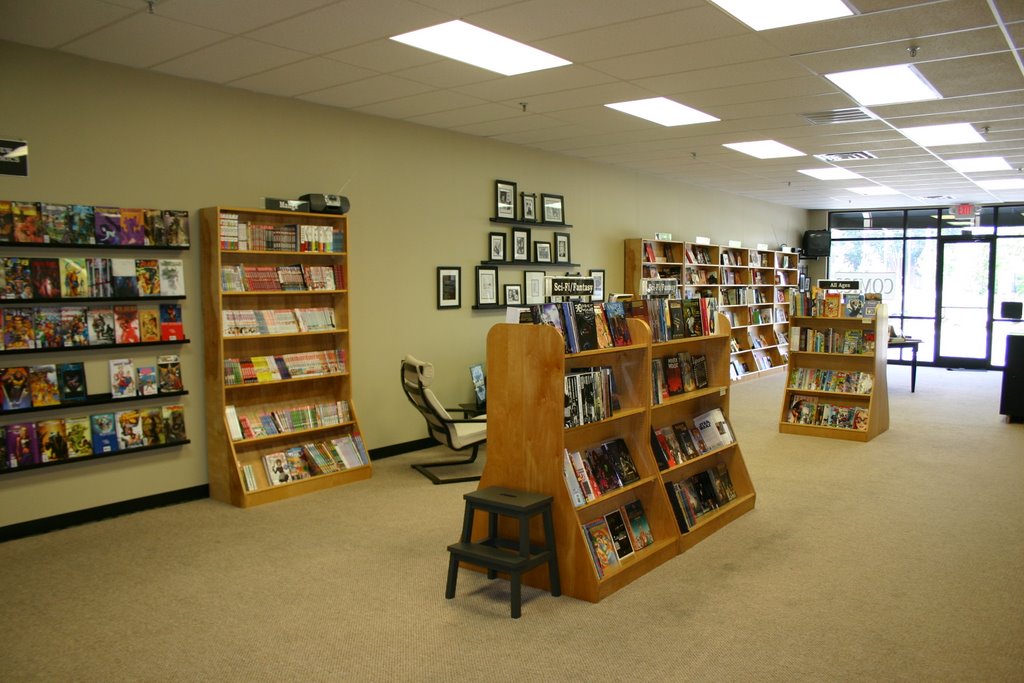
What you will find there, though, is a huge selection of graphic novels from pretty much every major publisher you can think of. Especially nice is the way the books are all shelved by genre: fiction, crime & mystery, action/adventure, non-fiction/biography, etc., allowing you to browse by area of interest. I’m always amazed to see graphic novel sections in comic book stores arranged alphabetically by title, an arrangement that presupposes that you already know what your looking for by name. Not only is this a terrible idea from a sales perspective, since the customer thereby browses through other books that are unrelated content-wise to the book he/she is seeking, but also because someone not already interested in comics has no real “jumping on” point.

Also nice is that when you first walk in the door, there’s a display table of new, attractive items right up front. When I was there, the new Popeye volume was front and center. Also near the door is a rack of top sellers and notable items which included things like Pride of Baghdad and Fun Home. Fun Home sported a card noting it was “Time Magazine‘s 2006 Book of the Year.” Something like this is pretty much par for the course in any normal book store, but for some reason you never see comics retailers doing this kind of stuff.

The rear of the store had some racks of regular “pamphlet” comics (including both issues of Midnight Sun!) and their stock seemed to be a good mix of mainstream and indy stuff, but definitely heavier on the indy stuff than a regular “Andriod’s Dungeon”-style shop. The monthly books were a bit dissheveled and occasionally dog-eared; despite the unusually heavy showing of indy stuff, you can tell that pamphlet books are not this store’s focus–it’s called the “Graphic Novel Bookshop” after all…

If there was a weak spot to the store it was its somewhat sparse manga selection. I was hoping to find volumes four and five of Monster, since my local Borders inexplicably stocks volumes one through three and then skips to six. Likewise, I’ve been looking to purchase any and all volumes of Sexy Voice and Robo, but have yet to see them for sale anywhere. I did notice, though, on the MacGuffin blog that they’re apparently making an effort to beef up their Manga section.  Props to that.  They’ll likely not woo a huge chunk of teenagers off the floors of the local Borders (and I mean “floors” literally) without a substantial investment in money and space, but I’d think a good selection of the “artier” manga stuff might sell well, and compliment the existing selection.

On the way out I spoke breifly with someone who I assume to be Sam Hobart, the shop’s owner.  He was very nice and seemed to have a genuine knowledge about, and passion for, what he was selling–particularly welcome qualities, since even some indy-friendly mainstream stores often aren’t particularly well versed in some of the books they stock, beyond knowing enough to safely guess whether the books will sell or sit on the shelves.

In short, I’m anxiously awaiting the Starbucks-like expansion of MacGuffins throughout the country.

Upcoming Superhero Movie from The Phillippines

Philippine Entertainment Portal | News | “ZsaZsa Zaturnnah” rated A by CEB

Based on this still, I predict that this will be the greatest film ever made.

Sleeping Dog

sleeping_dog.png

Merry Christmas!

Yeah, that’s right: “Merry Christmas!” Not “Happy Holidays” or any of that other crap. Apparently there’s a “war on Christmas” happening at the moment—and since that makes us white male heterosexual Protestant-types an oppressed minority, I’m gonna start acting like it. STICKIN’ IT TO THE MAN!

christmas_06.png

Jennifer de Guzman on “Cherry Picking”

Comic World News | Heaven Knows I’m Miserable Now

If you’re up on comics news, you likely know that DC Comics is set to launch a new line of comics aimed at girls, called “Minx.” Despite the myriad message board debates about various aspects of this launch—from the name of the line to the dearth of actual females involved in the effort—I really don’t care too much about the whole “Minx” thing one way or another. (Although I’m always glad to see new work coming out from the likes of Jim Rugg, Andi Watson, and fellow SCAD grad Ross Campbell.) SLG editor-in-chief, Jennifer de Guzman, though, addresses an aspect of the launch that I am very interested in, namely the “cherry picking” of indy talent by bigger comics companies (which has come up before). You can read her column on the subject via the link above.

My first thought is that, as someone with a background in music who then moved into the world of comics, (thus demonstrating my lack of practical thinking on a viable life’s pursuit not once, but twice) it has always struck me as odd that the concept of the “option,” a standard music practice, is not present in the comics business—or if it is, it’s at least certainly not prevalent.

The way this usually works in music, as I understand it based on my experience being signed to San Diego’s ill-fated PC Music label (original home of musical pest Jack Johnson), is that when an artist is signed to a label, indy or otherwise, the label buys the right to publish a set number of records by that artist—usually one–but also as part of the contract buys the exclusive right to if they so choose, purchase the rights to publish a set number of records after that initial one.

What this does is sets up a situation where a record label can invest in developing an artist, even if that means losing money on an initial record (or records), without fear that another company can just come along after the fact, cherry pick the artist, and capitalize on their (the initial record label’s) hard work and investment. That investment can be capitalized on instead by the initial record company in one of two ways: either take the option and record a second record by the band which presumably leverages the investment in the first to sell more units, or in the event that a bigger record company shows interest in the band and wants to sign them themselves, that company then has to buy the option(s) from the first company in order to have the right to do so.

It’s always seemed to me that this is a system that would work well with creator-owned indy comics, both for creators and companies. As with recording contracts, the number and terms of such options would be part of the contract negotiations of course, and a publisher might have to sweeten the pot a bit royalty-wise to get an option or options from an artist as part of the deal.. but I can’t imagine that this would be a system that would really be a huge barrier to signing new talent. In fact, I think it’d probably make things slightly easier for an artist trying to break into the comics business since the publisher would be more likely under such an arrangement to eventually recoup a profit by publishing an artist who’s an unknown quantity.

To pick an example cited in the article, it was Jim Rugg’s book Street Angel, published by Slave Labor Graphics, that lead directly to his current work with this Minx line. He was able to leverage that work to get better paying comics work—and why shouldn’t he? I know based on the number of copies sold that he likely didn’t make much from Street Angel in royalties. But it seems fair and logical that Slave Labor, the book’s publisher, should likewise be able to leverage this investment for their overall gain, since, like Rugg, they didn’t really make a whole lot of money from the book either. The artist made a heavy investment in time, and the publisher in both that and in money; it seems like they both should be able to reap some reward from that investment now and maybe a recording contract-style options system might move things that direction if implemented.