I Listened to The Cure’s Entire Discography and Lived to Tell About It

So… a few weeks ago I decided to listen to The Cure’s entire discography start-to-finish, in chronological order. Here are a few random thoughts:

  • I have no idea why I did this. Like a lot of folks my age, I had an “angsty teen” phase in the late 80s where I wore a lot of black and listened to The Cure, The Mission, Sisiters of Mercy, etc., but The Cure’s not really a band that I’ve had much interest in past my early college days. I’ve for sure been in a “listen to a band’s whole discography” phase of late and I’ve done so recently with Roxy Music, The Jesus Lizard and a few others. Those, though, are some of my absolute favorite bands and listening to their catalogs really just reconfirmed what I already know: I like them a lot. Doing a catalog listen-through to a band I’m not really that into any more actually proved to be a more interesting experience since it actually engaged my critical faculties a lot more.
  • The Cure’s first record isn’t very good. Whether you’re talking about the original UK release Three Imaginary Boys or the somewhat altered US version, Boys Don’t Cry, The Cure’s first release isn’t great. Yeah, I know it contains fan faves like “Killing an Arab,” “Boys Don’t Cry,” and “Fire in Cairo,” but compared to some of the other post-punk stuff that was coming out in 1979/80 the Cure’s first record is pretty slight stuff. It’s not even in the same league as records like Metal Box by Public Image Ltd or Chairs Missing by Wire.
  • The second record is a whole lot better. Seventeen Seconds–released a year later in 1980–almost sounds like it was made by an entirely different band. Spooky, sparse and moody, this is where the band establishes the template for what most of their early phase will sound like. Listening to this again after many years I’m struck by how even the shorter songs seem long; the songs are often quite spare with just two or three basic parts, but the band is comfortable repeating things with only slight variations in arrangement in order to build up mood.
  • The holy trinity. There seems to be a lot of debate among Cure aficionados about which of the  three records Seventeen Seconds, Faith, or Pornography constitutes the high point of the band’s early career. Which of these you favor is going to depend largely on where you fall on the mopey-depressed/angry-depressed scale. Certainly, as a disgruntled teenager I gravitated toward Pornography and that’s what still sounds the best to me… but that’s maybe just nostalgia.
  • “Then they get poppy.” The band released a bunch of singles right after Pornography which were eventually collected and released as the record Japanese Whispers. People seem to isolate this as the point at which the band began to exhibit some pop sensibilities. Re-listening to all the early stuff, though, I was struck by what a good pop songwriter Robert Smith is throughout their career. If you strip away the production and leave the basic chord progressions and melodies from even the moodiest of early Cure songs, you’ve got some pretty solid pop tunes.
  • Why’s everyone hatin’ on The Top? I don’t think I had this record when I was younger, but I was surprised how much I liked it this go-round. It’s definitely the product of a band in flux, but I like that kind of thing. The only really “catchy” single here is the song, “The Caterpillar,” but this record seems like the beginning of the band’s best era–the Kiss Me/Disintegration psychedelic pop phase–and, while nowhere near as cohesive as either of those two records, it warrants better than the 2/5 stars it gets from AllMusic.
  • Kiss Me, Kiss Me, Kiss Me is the best Cure record. Other than a few die-hard fans of the early ’80s Cure, it seems like most folks consider Disintegration to be the band’s best record. Maybe it’s just that I was well beyond my Cure-listening phase by the time that Disintegration came out, but as an adult, Kiss Me is the one record in their catalog that I find myself going back to and really digging. It’s all over the place tone-wise, with bleak tunes like “This Kiss” and “Shiver and Shake” tempered with upbeat numbers like “Why Can’t I Be You” as well as the poppy “Just Like Heaven” and “The Perfect Girl.” The band seems to be still experimenting a bit here–which I like–whereas Disintegration seems like the record by which the signature Cure sound (sitar guitar, lots of chimes, etc.) has pretty well codified. I’m used to hearing Kiss Me on vinyl and I missed “Hey You” on the CD/digital version, though.
  • Disintegration-era Cure: biggest “alternative” band in the land. There’s obviously a vast disparity between the 10 million-selling record Nevermind that Nirvana would release a few years later and The Cure’s three million-selling Disintegration, but I think music history has retroactively diminished the commercial importance of Disintegration. I may be overlooking some obvious record, but is there another example pre-1989 of an “alternative” band with a single that reached #2 on the U.S. Billboard Hot 100? (The album itself reached #12 on the U.S. and #3 on the U.K. charts.)
  • And the filler begins…. Man alive, there’s a lot of filler post-Disintegration. By 1989, when Disintegration was released, the band already had one Best Of (1986’s Staring at the Sea) and one live record (1984’s Concert). In the years following, they release an album of remixes (Mixed Up), a two CD live record in ’93 (Show), a single CD live record in ’94 (Paris), another greatest hits record in 2001, a two CD set of B-sides and demos in 2004, a 2010 three CD reissue of Disintegration that includes demos and a live show, and there’s apparently yet another remix album in the works.
  • They’re a pretty damn good arena band. I’d never heard those ’93 and ’94 live records before and it initially seemed weird to hear this band playing in enormous arenas. But why would that be weird? Even in the post-Nevermind music climate The Cure was still a huge phenomenon. And they’re actually pretty damn good arena shows. I shouldn’t really have needed to be reminded of this. I road-tripped to Chapel Hill to see this Cure show back in ’92 and I remember it being a pretty good show, as coliseum shows go.
  • “Everything after Disintegration sucks, man…” During the course of my listening, more than a few folks on Twitter expressed this basic sentiment. I have to admit that none of the post-Disintegration stuff really stuck with me, but honestly these aren’t bad records; they’re just competent records from a band that seems to have run its course ideas-wise. And that’s 100% OK for a band that’s been around and kicking out records for thirty-something years.
  • “Wild Mood Swings is totally their worst record, man…” I got more than a few of these as well. (Although to be fair, big Cure fan/my former SLG editor/current Image Comics PR & marketing person Jenifer de Guzman mentioned this as one of her favorites.) I don’t know that I’ll be jamming out to Wild Mood Swings myself any time soon, but it’s the one post-Disintegration record that stood out to me as a genuine (and occasionally successful) attempt to move in a new creative direction. It also features some interesting instrumentation in a few places, including a lot of Fender VI bass, which you don’t hear a lot of. I can understand why this record isn’t a fave among the gothy crowd, but I found it a bright spot amidst the often-homogenous run of post-Disintegration records.
  • And in conclusion: I think my mopey Cure-listening days are well behind me, even after an immersive listening of this variety. I probably gave short shrift to a lot of the band’s later material–a once-through is hardly fair–but, it’s a lot to ask of a band to continue to be vital and creative for three decades. Of The Cure’s contemporaries, only Mission of Burma and Wire come to mind as bands that are still making really great records thirty years into it–and they’ve both been substantially more spare in their output than The Cure (maybe a wise choice?). I’m sure I’ll still put Kiss Me, Kiss Me, Kiss Me on the ol’ turntable every once in a while, but I think this experiment was more than enough Cure-listening to last me a while.

S is for Serafina Pekkala

Selecting an “S” subject for this week was tough. My other two candidates were Sydney Hen from Charles Portis’s Masters of Atlantis and Sukie Rougemont from The Witches of Eastwick by John Updike. Ultimately, though…

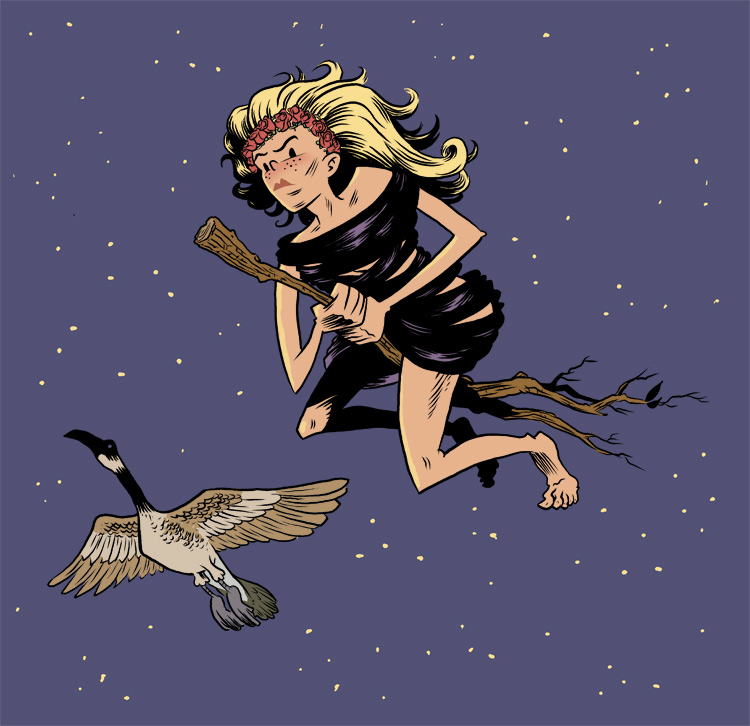
S is for Serafina Pekkala — from His Dark Materials by Philip Pullman

As you can see, I mixed things up a bit with this one visually… but she just didn’t look right hovering on that newsprint background I’ve been using for these illustrations so far. If I ever do a post card set or something along those lines though, I’ll whip up a version of her–without her dæmon Kaisa–on the newsprint background so she’ll match.

I haven’t seen any of the movies (are there any besides the initial Golden Compass adaptation?) so it was pretty easy for me to stick with the book’s description of Serafina, the Finnish witch queen:

She was young–younger than Miss Coulter; and fair, with bright green eyes; and clad like all the witches in strips of black silk, but wearing no furs, no hood or mittens… Around her brow was a simple chain of red flowers. She sat on her could-pine branch as if it were a steed, and seemed to rein it in a yard from Lyra’s wondering gaze.

I couldn’t seem to turn it up in the text, but I’m pretty certain she’s described as having blond hair. Inexplicably, they cast a brunette to play her n the movie:

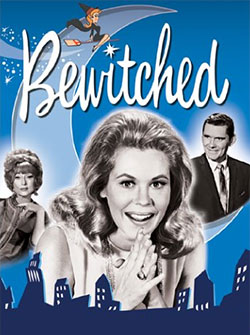
Is there some reason a witch can’t have blond hair? Clearly the casting director here didn’t grow up watching Bewitched:
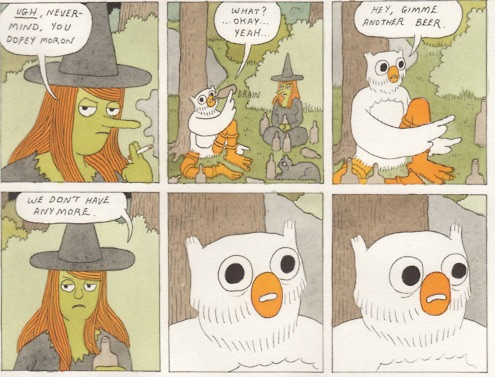
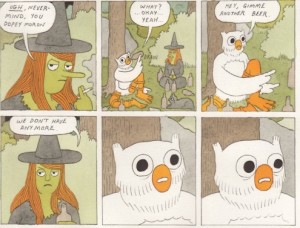
Of course, when I first started thinking about a witch and her bird familiar, what immediately came to mind was one of my favorite webcomics, Megg, Mogg and Owl:
Next week: “T”…

You can find all the AlphaBooks entries to-date at the AlphaBooks tumblr: http://alphabooks.tumblr.com. You can also follow many of the entries as they’re posted in real-time by following the #AlphaBooks hashtag on Twitter on Mondays.


R is for Robert “Bobby” Shaftoe

Well, here’s my very late “R” AlphaBooks entry. This isn’t one of my faves, but after an initial delay from being at SPX, followed by a failed attempt to draw Rick Deckard from Do Androids Dream of Electric Sheep, I figured I needed to go ahead and get something posted. So…

R is for Robert “Bobby” Shaftoe — From Cryptonomicon by Neal Stephenson

I loaned my copy of Cryptonomicon out to a friend years ago and never got it back, so I just kinda winged it for the physical attributes of this character. He’s pictured here, though, from a scene I remember distinctly from the novel: Marine Ranger Robert “Bobby” Shaftoe is stationed in pre-WWII Shanghai and encounters a sushi restaurant for the first time. It’s a hilariously-written scene–you can read it here (about half-way down)–and for some reason it’s one of the scenes I most vividly remember from the book.

Bobby Shaftoe had looked in the windows of the place before, and watched the man with the knife, trying to figure out what the hell he was doing. It looked a hell of a lot like he was cutting up uncooked fish and putting the raw meat on bullets of rice and handing it over to the Nips on the other side of the counter, who were wolfing it down.

It had to be some kind of optical illusion. The fish must have been precooked in the back room.

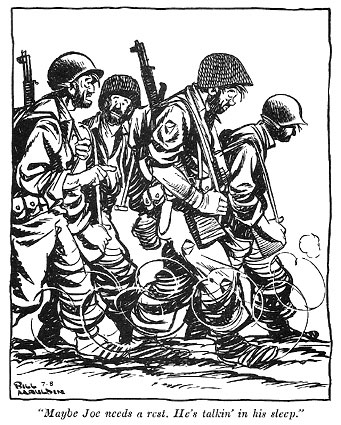
I attempted a sort of “Willie and Joe” thing with the clothing here, but I found Manga Studio not really well suited for this kind of loose linework. I should probably investigate further and see if I can find some MS brushes that more closely mimic the “dry brush” effects that naturally occur with this sort of inking. And, of course, there’s just my natural ineptitude with this style of drapery rendering. Observe the master, Bill Mauldin, in action:

Next week: “S”…

You can find all the AlphaBooks entries to-date at the AlphaBooks tumblr: http://alphabooks.tumblr.com. You can also follow many of the entries as they’re posted in real-time by following the #AlphaBooks hashtag on Twitter on Mondays.

Drawing of Bob Dylan

I’ve really been digging the new Bob Dylan record, Tempest (despite its dopey Bob Seger-esque album artwork) and it inspired me to do this drawing of the man himself:

The original art for this is for sale here.

My Review of Mastering Comics

I wrote a review of Jessica Abel and Matt Madden’s new comics how-to/textbook Mastering Comics in the current Publishers Weekly Comics Week. Check it out here.