Midnight Sun GN Cover

Things are winding down as far as Midnight Sun goes.  The folks at SLG are looking over some low res comps of the book, and a friend has graciously volunteered to proof read the thing (thus saving me from my own terrible spelling), but beyond that, the book is pretty much done–so much so, in fact, that I cleaned my studio top to bottom.  Feather duster, Swiffer, the whole bit.  This is just a weird compulsive thing that I always do whenever I finish a comics project.  Fortunately today, things wrapped up in the early afternoon; I’m strangely compelled to do this ritual, though, regardless of time and have in the past cleaned my studio at two or three in the morning.

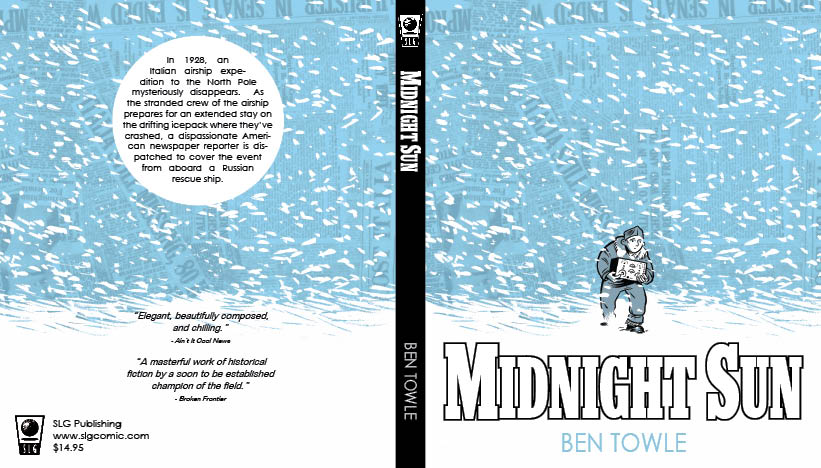
The last item to pull together was the cover.  Here’s what I’ve got:

cover_ext_final.jpg

The final design is a mishmash of Scott Saavedra’s design and the original design I did for issue one of the original comic book series.  I’m still not really 100% happy with the circle bit on the back and the way it works with the two quotes below, but I’m not really sure what else to do at this point.  If I’m struck by inspiration between now and when I have to upload the real press-ready files to SLG, I may tweak that back cover a bit.

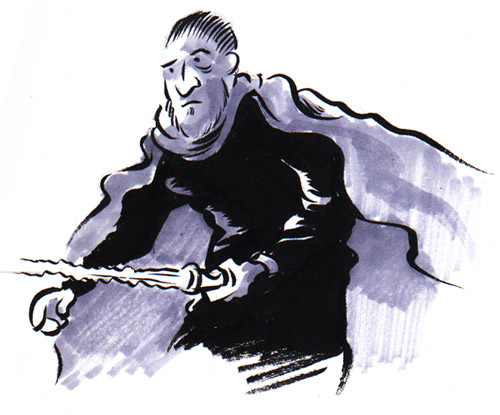
Shetchbook 10/24

sketch_102407.jpg

Chris Ware and Perspective Drawing

The most recent Mad Magazine (the one with the insurance caveman on the cover) includes a Chris Ware parody among the gags in the “Fundalini Pages” at the beginning of the issue. Mad‘s comics/graphic novel parodies are usually presented in the form of a review, with text above and a (supposed) excerpted page from the work in question below. Here’s the drawing that accompanied the review:

mad_ware.jpg

Whoever drummed this up did a pretty good job I think capturing and riffing on some of Ware’s hallmark stylistic and formal devices. One thing, though, struck me as being not as “Chris Ware-esque” as it could be: the architectural scene in the upper left corner (highlighted in the scan above).

The drawing itself looked familiar, and a quick flip through the Jimmy Corrigan book revealed the source image the Mad artist had based his panel on, albeit horizontally flipped and with figures on the street eliminated:

ware_orig.jpg

This image has been beautifully executed in technically correct linear perspective, as you can see worked out below:

ware_linear

Filippo Brunelleschi or Albrecht Dürer couldn’t have done it any better. What’s interesting to me, though, is that this sort of mathematically accurate perspective drawing is really not typical of Ware. Unlike most draftsmen as accomplished as Ware, he most often employs “wrong” (perhaps “non-linear” would be a better word?) perspective in his work, drawing objects entirely flat on the picture plane, using overlapping or other visual cues to create visual depth; in isometric perspective, a type of drawing usually reserved for diagrams and technical drawings; or–even odder–with one surface of a structure drawing with one perspective scheme and another surface drawn via an entirely different scheme.

Here are some examples:

Flat “non-perspective”

ware_none.jpg

Note how here the two surfaces of the house, which–were this an actual house, seen through the human eye–would be receding to vanishing points on the left and right, remain entirely parallel to the horizon and not at an angle to one another. Absent also is any perceived change it the spacing of regularly spaced features (think of how fence posts appear to get closer together the farther away they are) like the windows on the house. The only major device used to create depth of field here is overlapping of elements like the ice truck in front of the house and the bicyclist behind the tree. The whole thing’s flattened out, almost as if were a paper toy that hasn’t been cut out and assembled yet (hmmm….)

Isometric Projection

ware_iso.jpg

Ware very often also employs isometric projection-like drawing when depicting both interior and exteriors. In a true isometric projection the angle between the coordinate axes is 120°–in this example it’s more like 145° or so (72° x 2 is the arc between the blue orthogonal in the drawing and the corresponding red orthogonal to the right). Unlike in the first example, the two surfaces of the structures here are at angles to one another, but–and this is the salient feature of an isometric projection–the orthogonals remain parallel to one another, and would never meet at vanishing points on a horizon line. As with the example above as well, there is no perceived diminishment of scale along the axes. This sort of axonometric spacial representation is seen in early video games as well–and aped by webcomics like Diesel Sweeties.

The Mix-n-Match

ware_mix.jpg

In this example, Ware has treated each of the two visible surfaces of the structure with a different perspective method. The front surface of the building is drawn almost as if it were in one-point point perspective–as if we were standing directly in front of the building dead-center looking straight at it (or perhaps, in “non-perspective” as above). If this were the case, though, we’d not see any of the side surfaces of the structure. The left side of the building is visible here and gets treated entirely differently; it’s drawn as if it were in standard two point perspective and the viewer were eye level with the curb. It’s interesting to me that Ware has filled that side of the structure entirely with black, since it’d be interesting to see how he would have dealt with rendering windows and the like on that side of the structure. If they were drawn to “obey” the two point setup, they’d fall along those dotted orthogonals shown above. The left-facing surface of the front stairs, which might logically be treated the same as the left surface of the building itself, is done in “non-perspective” as in the first example above.

At some point it might prove interesting to go through Jimmy Corrigan and make note of at what points in the story Ware decides to employ traditional linear perspective, as in the panel aped by the Mad parody. A cursory look indicates to me that these instances are pretty rare (no doubt why I found that panel in the parody image un-Warelike). I’d be willing to bet that an in depth analysis of Ware’s use–and non use–of perspective would reveal that these instances of true linear perspective are utilized by the artist deliberately at certain points in the narrative and for very specific reasons.

Gimme a grant, and I’ll figure it out…

17 1/2 Hours at Bojangles’

onionhead.jpg

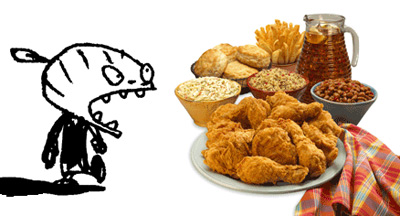
Be sure to check out Paul Friedrich’s blog tomorrow, the 16th, as he’ll be participating in an Suburban Xtreme Endurance Event in Raleigh, spending an entire day in a Bojangle’s restaurant.  Here’s the skinny from the press release:

October 16, 2007
Paul Friedrich and Bryan Pack will attempt to spend an entire 17 1/2 hour day at
Bojangles’ 3808 Western Blvd Raleigh, NC 27606.

From the moment Boj’s open their doors to serve their spicy chicken biscuits until they sell their
last order of cajun fries and lock the doors, Paul Friedrich and Bryan Pack will be there. Can it be done?

JUST ANNOUNCED: Eleanor Spicer, Bojangles’ historian/expert will be joining Paul and Bryan!

SPX 2007 – Final Thoughts

Saturday night after posting my previous entry on SPX, I headed downstairs to try to catch the tail end of the Ignatz awards and then to rendezvous with some folks afterwards, but managed–as seems to be becoming my unintentional tradition–to miss the entire ceremony.  Not in a million years will I ever suggest that a comics award ceremony be longer, but next year I’m gonna get off my duff and get to the damn thing.  Apparently (like last year as well) there was insufficient room in the “model U.N.” area for everyone that wanted to see the awards anyway, so I likely wouldn’t have gotten in even if I had gotten motivated a few minutes earlier.

Results-wise, I heard immediately that Ted Stearn, who I was really rooting for to finally get some props, didn’t win anything.  My friend Chris Reilly remarked appropriately that Ted was rapidly becoming the “American Roger Langridge,” getting nominated over and over again for awards and never winning any of the damn things.

Unlike Friday’s post-show shindig, the joint was jammed after the awards.  Some individuals, who I’ll not mention by name, managed to “acquire” a shopping cart somewhere between dinner and the party, and were using it to wheel around a case of store-bought beer and a bottle of Jack Daniels, both ow which were being consumed liberally by all concerned.  There were too many notables in attendance to do a roll call of, but suffice it to say, everyone seemed to be having a good time and really yucking it up big time, no doubt in part because of the prospect of sleeping in on Sunday rather than having to hit the convention floor bright and early, as on the previous day.

Overall, this year’s SPX seemed by all anecdotal accounts I heard to have been a really standout show, and I’m hoping its success will put to rest the “SPX vs. MoCCA: Last Show Standing” prediction that had been floating around for a bit early on when MoCCA first started catching on.  I heard via “friend of a friend” chatter a figure of 500 exhibitors, 2000 attendees through the door, but that’s just hearsay, so make of that what you will.

Whatever the numbers may have been, it definitely seemed to me–and the folks near my table–that there were a ton of new faces at the show, which in a lot of ways is more important than a total number through the door.  I noticed a fair number of “Press” badges on folks, so hopefully that speaks to a strong comics press presence as well.  I don’t know a lot of these folks by sight, but I met and spoke to Heidi MacDonald of Publishers Weekly “The Beat,” and Whitney Matheson was on the floor as well.  There was some journalist from Vermont hanging out in our hotel room after the party, but I didn’t catch his name, and folks from ComeXology.com and The Dollar Bin podcasts were in attendance as well.

Curiously, the one element that’s been present at the last couple of SPX shows that I didn’t note this year were editors from the bigger comics publishers and/or “regular” book publishers.  It seems like these days every-damn-body’s already got a book deal, so maybe they just ran out of deals to give out… or cartoonists to give them to?

Adam and I hit the road around ten on Sunday morning and thus didn’t attend any of Sunday’s events.  If there’s one thing I wish SPX would do over the long run, it’s decide on a strategy for what to do with Sunday and then stick with it.  Over the years Sunday’s involved at times another day of the show, a softball game/picnic, panel discussions, lunch at Dave & Buster’s, etc.  This year it looked like there were some good panels in place and if that continues to be the focus for next year, maybe Sunday will begin to become an integral enough part of the show that more folks will stick around.

I, as usual, took my camera but never took any actual pictures of anything.   Heidi’s got some pictures up over at The Beat, as will some other folks here shortly I’d guess.