Make That: Should Have Waited Two Days…

…Because yet another review of Midnight Sun has appeared on those crazy internets. This time it’s actually an early (December 24th) review of the book from—presumably—the print edition of Publishers Weekly (!), which is just now making it to the online archive. Scroll way down-the comics section is the very last. It’s a quite positive review and really the only complaint is that the book is “too short,” which as Jennifer de Guzman points out on the SLG news blog, is really about the best criticism one can ask for.

I’m glad to see the reviewer here has taken the lead character, H.R.’s, drinking in stride, referencing him thus: “….a gin-soaked New York reporter (was there any other kind?)” The different level of emphasis various reviewers have given to the character’s drinking brings up an important consideration to anyone setting a story in the past: how to balance technical accuracy of the time period with the how the social morays and practices of a particular time are going to be seen through modern eyes.

In the specific case of Midnight Sun, I did a fair amount of reading on general world history in the 1920s and particularly, for the first chapter of the book, on America in the 20s. As a lover of spirits, I took particular interest in prohibition, which was in full effect in the United States during the time period in which Midnight Sun takes place.

The first thing I was struck by in reading about prohibition was just how prevalent drinking was before prohibition was enacted. The second thing I was stuck by was how much more prevalent it became after prohibition was enacted.

Pre-prohibition, folks apparently drank with Deadwood-like frequency, but rarely in the home. People went out to drink. During the prohibition years, though, with alcohol illegal, it—really for the first time in the U.S.—entered the home. There, much to the delight of frat-boys for generations afterwards, it gained an avid fan base it had never had before: women. Men might have gone out for a night of boozing on the town when it was legal, but now it had become much safer to consume in the privacy of one’s home… and with it there for the taking, the ladies inevitably had to see what it was all about.

With similar irony, the prohibition years saw the rise of hard liquor as a common drink, and the parallel development of the cocktail. With all forms of alcohol now illegal, liquor had a huge advantage over beer and wine in its compact size and high alcohol content per volume. And with liquor now being produced “unofficially” in stead of legitimate distilleries, the quality and flavor of booze was sometimes less than optimal. The solution: mix the liquor with other, legal liquids to change the taste. Hence, the cocktail.

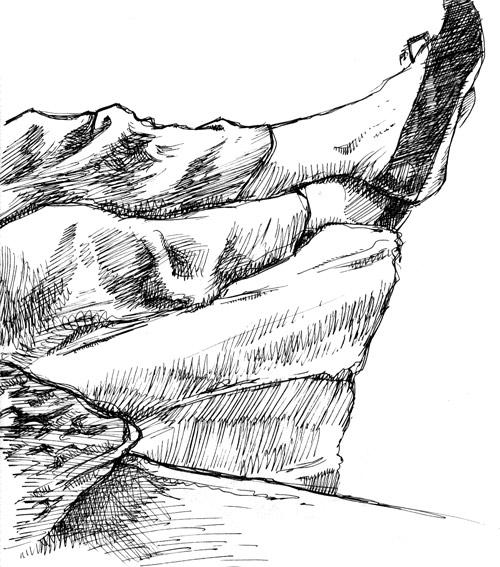
Sketchbook 2/6/08

sketch_0206081.jpg

I Shoulda Waited One More Day…

…To do yesterday’s Midnight Sun roundup, that is, because today another review appeared–and a pretty high-profile one at that. The current installment of The Onion AV Club Comics Panel reviews the book largely favorably and gives it a rating of “B.” Relative to the other items reviewed this week, that puts me behind the new volume of E.C. Segar’s Popeye, but ahead of The Evil Dead and Shark-Man. Nothing to complain about there!

One of the aspects of the book that the reviewer doesn’t find appealing its out of sequence storytelling. As with a lot of things that get mentioned by individual reviewers, I think this is largely a matter of taste, and perhaps what one is used to reading-wise. I’d not really thought of it too much until the reviewer brought it up, but aside from straight flashbacks (“Peter Parker, bitten by a radioactive spider during a science demonstration…”) most mainstream comics are presented in standard chronologically linear sequence.

Curiously, though, out of sequence narrative has been a part of the prose writer’s toolkit pretty much throughout the modern era. To take one of the most popular pieces of fiction as an example, the narrative in The Lord of the Rings is presented as an alternating sequence of two stories that interlock and overlap time-wise. Astute readers can even take advantage of Tolkien’s methodical (or perhaps, obsessive?) attention to detail to correlate certain scenes from the two parallel stories by means of verbal clues, or even more obscure mentions, like the phases of the moon at various points. Taking a look at a timeline of the story reveals the remarkable complexity of the narrative’s chronological arrangement, particularly if you know the novel and know in what sequence this same information is presented. And structurally speaking, The Lord of the Rings is pretty tame stuff.

I remember reading an interview with director Quentin Tarantino, in which he seemed a little dismayed by the amount of attention that the out of sequence narrative in Pulp Fiction was receiving, pointing out basically the same thing: “people do this in books all the time.” In a comics class I taught a while back, I broke down the events of Pulp Fiction and placed them in chronological sequence. Doing this revealed not only how presenting the narrative in a different sequence that than the one in which the events occur chronologically can move portions of the story to more suitable locations in the narrative structure, but also how a non-linear sequence can allow you to get away with “bending” things a bit. Were Pulp Fiction presented in chronological sequence, you’d likely be asking yourself, “Why the heck is Harvey Keitel’s character at a cocktail party in the middle of the morning?” I’ll attach a PDF of this lesson to the end of this post for the truly curious.

My reasoning behind telling the story in Midnight Sun out of sequence was precisely the same as above: to move the revelatory events of the story to the place where they need to occur for the story to work. Imagine, for example (anyone who’s actually read the book) how your reaction to the character of Zowie would be changed if it was revealed from the get-go that reuniting with her finance had was essentially a lost cause. Chronology be damned–just move the crash scene to the end. Likewise, with the hallucination scene where one of the stranded crewmen imagines he’s at restaurant in Rome, the subjective hallucination is shown first, then the story tracks backward to show how he came to be in his current state, thus also working to “sync up” the end of that scene with the scene from the parallel shipboard portion of the story that ends chapter three.

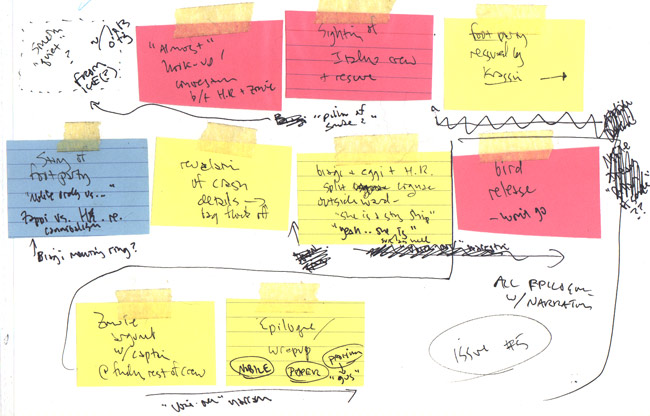
In fact, when working on the structure of Midnight Sun, rather than laying events out in a conventional outline, I used a system of color-coded index cards that I could move around at will to change the sequences in which events in the story would occur until I settled on an arrangement I liked. Here’s my “outline” for the final chapter of the book:
ch5_time.jpg

The blue cards are all scenes of the stranded men on the ice. The red cards are all scenes that involve H.R., either in America initially, or on the Russian rescue ship later. The yellow cards, which only appear in this chapter’s outline, are scenes once the two parallel stories have converged and the rescued men are on the Krassin. Each of the sets of cards began as, and could be arranged again into, the standard linear sequence of events.

Anyway, here’s that lesson from several years back on linear and non-linear sequencing in narrative. (You can probably tell from reading it that I really would have rather used some other example besides Pulp Fiction, but I was thinking that folks might be more interested in hearing my ramblings about that than, say, La jetée.)

Midnight Sun Roundup

I’ve had a few things Midnight Sun-related trickle in over the last week or so, so here’s a rundown:

Brian Heater over at the Daily Cross Hatch ran a nice write-up of the book back on the 23rd. The blog itself, including the review post in question, seems to be having some technical issues and is stuck in a state of perpetual reloading, so here’s Google’s cache of the review.

———–

Since I’ve been blogging about Midnight Sun and its subject matter I’ve been exchanging the occasional email with Ingunn Løyning of the Spitsbergen Airship Museum. The museum up until this point has been mainly in the organizational stage–planning, accumulating a collection, etc.–but is set to open in Svalbard, Norway this year. At any rate, Ingunn recently sent me a link to this documentary (alas, in Italian) about the Italia‘s captain, Umberto Nobile. The navigation is a bit peculiar: you click on one of those thumbnails in the upper left to launch various segments of the film, which then plays to the right. The material specific to the Italia expedition begins about halfway through. There’s some really amazing footage included of the airship itself as well as the various crewmen.

The folks from the museum have also apparently forwarded a copy of Midnight Sun to a number of Nobile’s relatives, including his daughter, Maria. It’s pretty scary to think that relatives of the real-life individuals portrayed in the book are now reading it. It’s made me revisit my early thoughts when putting together the book regarding whether to use people’s actual names in the story.

Given the extent of derivation the story wound up making from the real-life events of the crash, I had given some real consideration to not using any real names for the people or the airship. Ultimately, I decided to stick with the real names, even if I wound up changing things around a bit in the story. I think if the story had developed in a way that any of the characters were portrayed unfavorably, I might have gone that route, but as things stood, I thought it might seem somewhat disingenuous and even disrespectful to not use the real names–almost as if I would be “stealing” the story and claiming it as mine. Anyway, it’s not like there’ve been dozens and dozens of airship crashes at the North Pole; it would have been pretty obvious what real event the story was based upon.

———

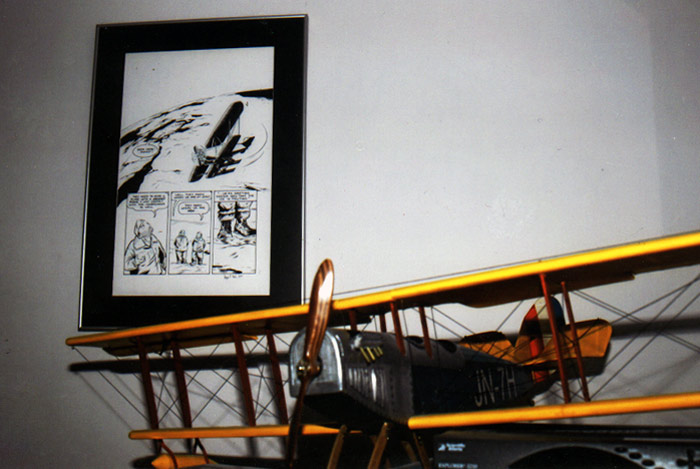
When my father came to visit recently to see Marion, he asked me if he could have an original page from Midnight Sun. Of course, I let him have his pick of what I had on-hand. He managed, typically, to pick one of my absolute favorite pages from the book: the “circling plane” page from Chapter 5. He sent me a picture of it framed, which is interesting since I don’t think I’ve ever seen any page I’ve done framed (although I’ve sold and given away a few, some of which may be framed somewhere for all that I know).

ms_framed.jpg

A curious coincidence here is that my dad apparently just happened to have a model biplane in his house that appears to be the exact model as the one depicted on the page: a Fokker CV-D.

Stephan Pastis Podcast (With Guests!)

In the comments section of my Pearls Before Swine post from last week, Bob Andelman (A.K.A. “Mr. Media”) posted a link to a podcast interview he recently conducted with the strip’s creator, Stephan Pastis.  Ironically, given that my initial post was mainly about Pearls winning a readers’ pole and thus being added to the Winston-Salem Journal, the most interesting (and animated) part of the interview is Pastis’ discussing his, and many other cartoonists’, well-justified vitriol for those same readers’ poles, when used to determine what strips should be dropped from papers.  Also of note are call-ins from two well-known fellow cartoonstists: Mark Tatulli of Lio, and Rick Kirkman of Baby Blues.