

…To do yesterday’s Midnight Sun roundup, that is, because today another review appeared–and a pretty high-profile one at that. The current installment of The Onion AV Club Comics Panel reviews the book largely favorably and gives it a rating of “B.” Relative to the other items reviewed this week, that puts me behind the new volume of E.C. Segar’s Popeye, but ahead of The Evil Dead and Shark-Man. Nothing to complain about there!
One of the aspects of the book that the reviewer doesn’t find appealing its out of sequence storytelling. As with a lot of things that get mentioned by individual reviewers, I think this is largely a matter of taste, and perhaps what one is used to reading-wise. I’d not really thought of it too much until the reviewer brought it up, but aside from straight flashbacks (“Peter Parker, bitten by a radioactive spider during a science demonstration…”) most mainstream comics are presented in standard chronologically linear sequence.
Curiously, though, out of sequence narrative has been a part of the prose writer’s toolkit pretty much throughout the modern era. To take one of the most popular pieces of fiction as an example, the narrative in The Lord of the Rings is presented as an alternating sequence of two stories that interlock and overlap time-wise. Astute readers can even take advantage of Tolkien’s methodical (or perhaps, obsessive?) attention to detail to correlate certain scenes from the two parallel stories by means of verbal clues, or even more obscure mentions, like the phases of the moon at various points. Taking a look at a timeline of the story reveals the remarkable complexity of the narrative’s chronological arrangement, particularly if you know the novel and know in what sequence this same information is presented. And structurally speaking, The Lord of the Rings is pretty tame stuff.
I remember reading an interview with director Quentin Tarantino, in which he seemed a little dismayed by the amount of attention that the out of sequence narrative in Pulp Fiction was receiving, pointing out basically the same thing: “people do this in books all the time.” In a comics class I taught a while back, I broke down the events of Pulp Fiction and placed them in chronological sequence. Doing this revealed not only how presenting the narrative in a different sequence that than the one in which the events occur chronologically can move portions of the story to more suitable locations in the narrative structure, but also how a non-linear sequence can allow you to get away with “bending” things a bit. Were Pulp Fiction presented in chronological sequence, you’d likely be asking yourself, “Why the heck is Harvey Keitel’s character at a cocktail party in the middle of the morning?” I’ll attach a PDF of this lesson to the end of this post for the truly curious.
My reasoning behind telling the story in Midnight Sun out of sequence was precisely the same as above: to move the revelatory events of the story to the place where they need to occur for the story to work. Imagine, for example (anyone who’s actually read the book) how your reaction to the character of Zowie would be changed if it was revealed from the get-go that reuniting with her finance had was essentially a lost cause. Chronology be damned–just move the crash scene to the end. Likewise, with the hallucination scene where one of the stranded crewmen imagines he’s at restaurant in Rome, the subjective hallucination is shown first, then the story tracks backward to show how he came to be in his current state, thus also working to “sync up” the end of that scene with the scene from the parallel shipboard portion of the story that ends chapter three.
In fact, when working on the structure of Midnight Sun, rather than laying events out in a conventional outline, I used a system of color-coded index cards that I could move around at will to change the sequences in which events in the story would occur until I settled on an arrangement I liked. Here’s my “outline” for the final chapter of the book:
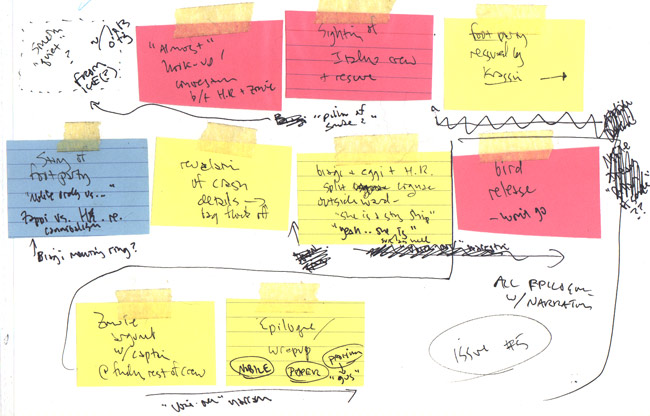
The blue cards are all scenes of the stranded men on the ice. The red cards are all scenes that involve H.R., either in America initially, or on the Russian rescue ship later. The yellow cards, which only appear in this chapter’s outline, are scenes once the two parallel stories have converged and the rescued men are on the Krassin. Each of the sets of cards began as, and could be arranged again into, the standard linear sequence of events.
Anyway, here’s that lesson from several years back on linear and non-linear sequencing in narrative. (You can probably tell from reading it that I really would have rather used some other example besides Pulp Fiction, but I was thinking that folks might be more interested in hearing my ramblings about that than, say, La jetée.)
Recent Comments