
May 27 2008
How Different Cartoonists Draw Water
Both of the projects I’m currently working on involve drawing oceans, bays, harbors and just lots and lots of water in general. Oyster War, which takes place on the Chesapeake Bay, obviously has plenty of action taking place on the Bay, and Amelia features a good number of scenes of her plane, The Friendship, attempting takeoffs from Trepassey Harbor. I had to draw water a bit for Midnight Sun and wasn’t entirely happy with the end results. So, before starting Oyster War and Amelia I’ve begun by gathering as much photo reference as I can find of bodies of water. I’ll likely also make a trip to Salem Lake and perhaps the Yadkin River, the only two bodies of water nearby, for some life drawing.
I thought it’d be helpful, though, to also have a look at the ways other cartoonists “translate” water into drawings in their work, so I wandered over to the bookshelf and had a look:
Roy Crane
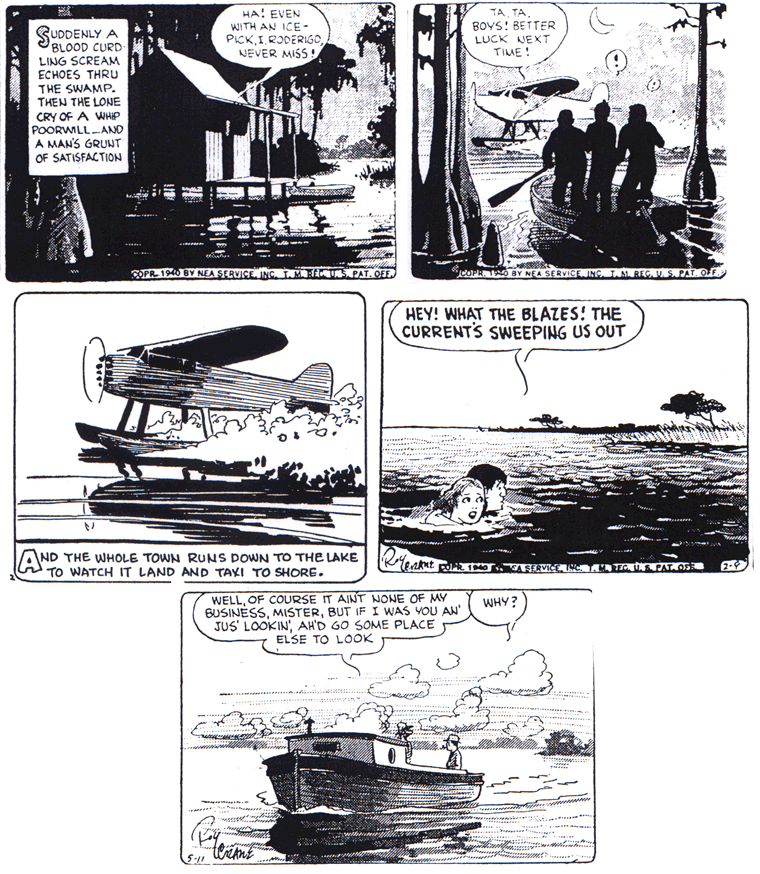
Above are a few sample panels by one of my favorite cartoonists, Roy Crane. Of late, Crane’s drafting chops seem to often get compared unfavorably to later adventure strip artists–specifically Milt Caniff–but what often gets lost in this is the the two cartoonists worked in different media. Crane worked on duotone board, a type of drawing board that, when brushed with particular fluids, would produce two different types of “hatched” gray tones. Crane used this technique masterfully in Wash Tubbs to produce stunning natural scenes of lakes, reflections, vegetation, shadows and other subtle effects that are achieved quite differently than traditionally done with black ink only. The scans above are unfortunately from the old NBM reprint series, which didn’t really capture the duotone effect very well. Here’s a scan, though, of a Wash Tubbs as printed, clipped from the newspaper section:
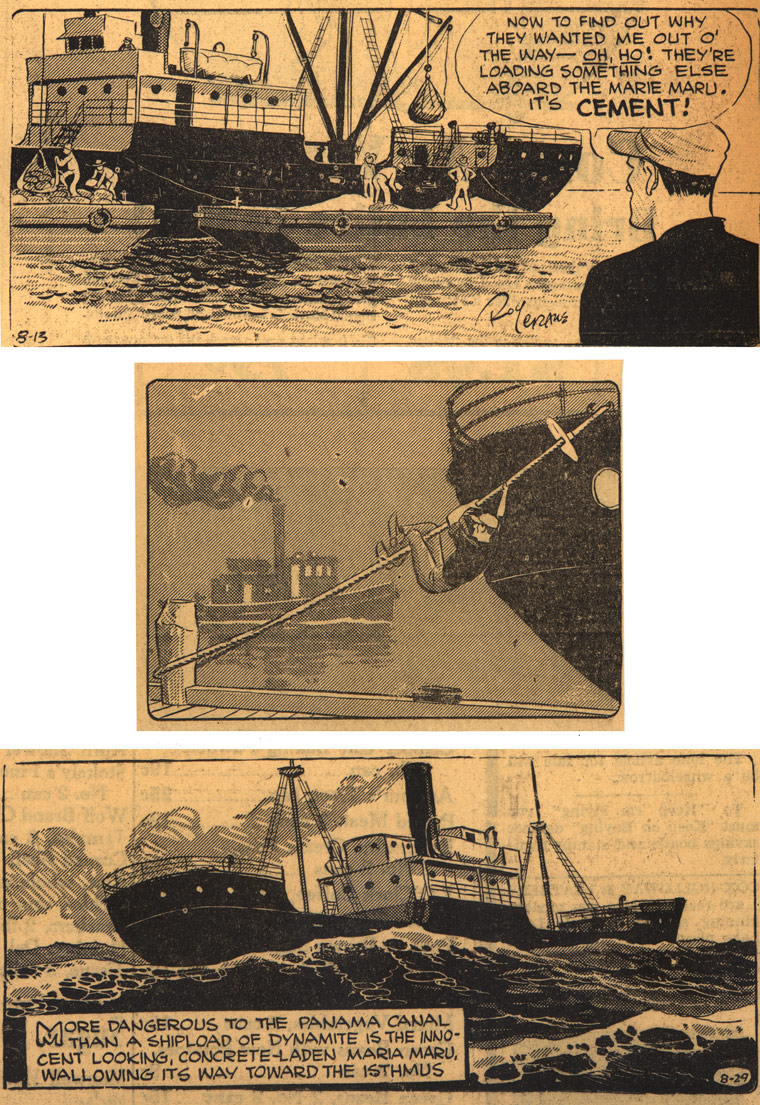
The way Crane uses the three available tones (black being the third) to create atmosphere and depth really blows me away. I tried, with mixed results, to emulate this look in my first book, Farewell, Georgia, by applying zip-a-tone to both my ink and gray layers. With the recent vogue for two and three color books in the indie set (not to mention stuff like Casanova) I’m genuinely surprised that Crane is rarely given his due as a true master and innovator of this look.
Drew Weing
Ok, for Drew’s work I didn’t go to my bookshelf, but rather to my browser’s bookmarks. These beautiful examples of water are all taken from Drew’s great nautical-themed webcomic Set to Sea. What strikes me most about these panels is not just Drew’s obvious drafting badasssery, but also the fact that he’s got such a rich “vocabulary” of mark-making to indicate water.
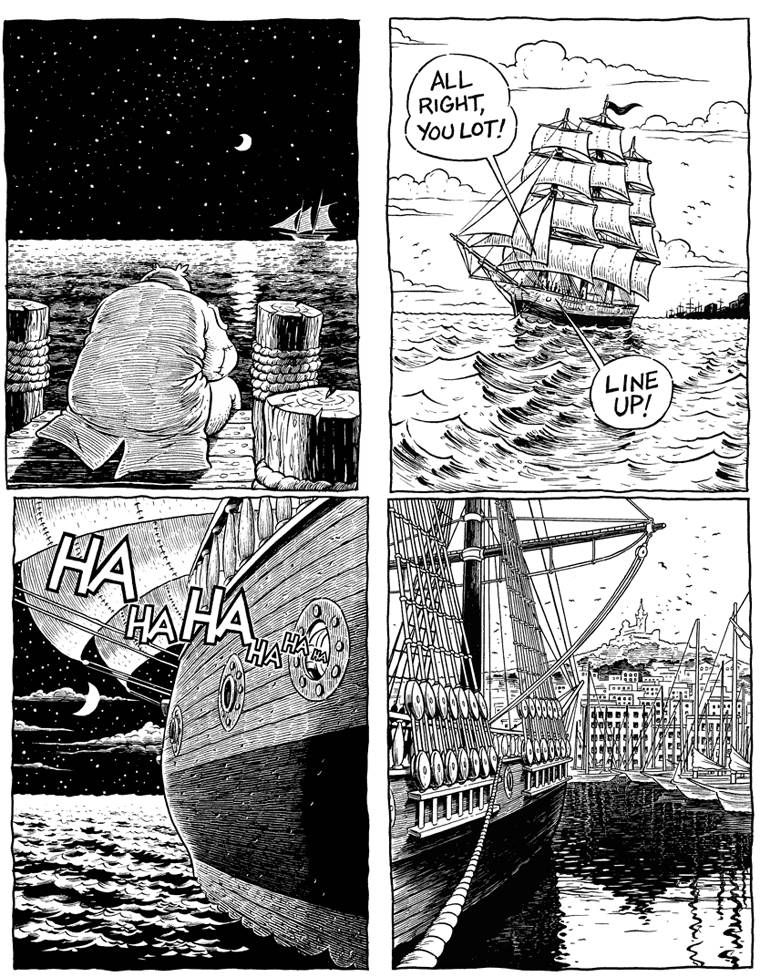
Tony Millionaire
Tony Millionaire draws great ships and pretty damn good water, too. He, like Drew Weing, has a few different styles of water-rendering that he employs depending on the demands of the panel and how things on or in the water need to be drawn. The top two examples here are, I’m guessing, done from photo reference; the water and the reflections don’t seem to be done in his natural style. (Or maybe that’s how he draws when he isn’t drunk?) They’re quite nice, though, I think.

Craig Thompson
These are a couple of panels from Goodbye, Chunky Rice by Craig Thompson. I really like the big, chunky stylization of the wave shapes here. Unlike some of the folks above, Thompson has a fairly consistent water-drawing style throughout the book:

R. Kikuo Johnson
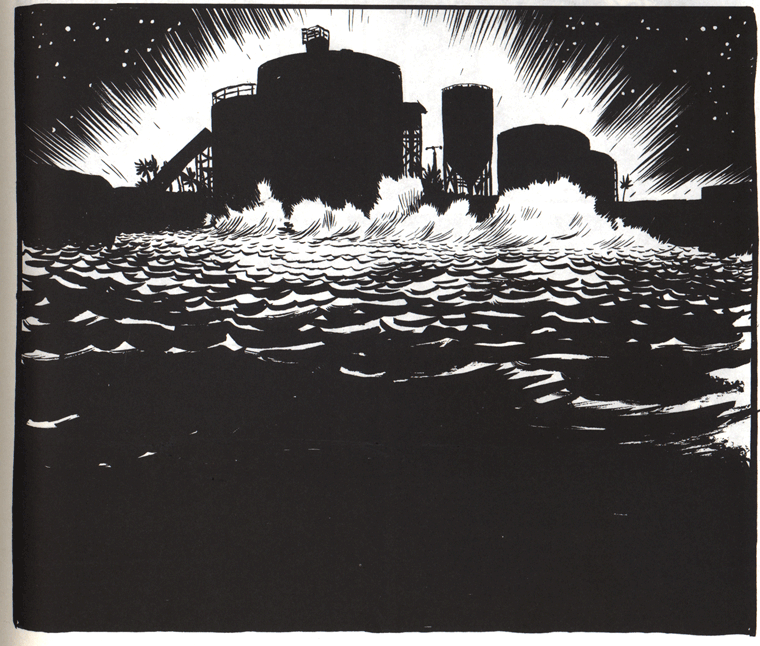
R. Kikuo Johnson seems to be switching up his drawing style a lot lately, but here in his book The Night Fisher he’s squarely in “Toth mode” and drawing some great-looking water with lots of heavy blacks:
Some notable exclusions:
Masashi Tanaka‘s manga Gon has some absolutely stunning drawings of water, but I wasn’t able to include them here since I’ve ditched my old Paradox Press books and apparently loaned out my newer CMX volumes. Oh well…
When looking for examples of nicely-drawn anything one of the first places it occurred to me to look was in Jeff Smith‘s Bone. My next thought, though, was that there really aren’t any scenes in the whole 1000-plus page book with much water. The only one I could really find was the Moby Dick sequence and I was really surprised to find that the water and waves there were drawn with pretty standard “squiggles.”
I’m sure there’re tons of great water-drawing cartoonists out there, though. If you’ve any suggestions please post them to the comments section. Maybe I’ll set up a public Flickr group…
May 20 2008
Interviewed at Chasing Ray

As part of this year’s multi-blog Summer Blog Blast Tour, there’s an extensive interview with me posted over at Colleen Mondoor’s literature blog chasingray.com. This is the most extensive interview I’ve done about Midnight Sun, and probably the only really in-depth interview I’ll do specifically about the book since the it’s been out for a while at this point.Colleen is a scholar of northern exploration and, because of her background in both this and in general literature, she hit me with a number of pretty interesting questions that aren’t typical the usual line of inquiry one usually gets from interviewers from the comics press.
I’ve read some of the interviews you have done online and I think I have a decent understanding of how you found out about the Italia (via a personal curiosity/interest in dirigibles) and why you decided the book really only worked as historical fiction, not nonfiction. (And I completely understand what you were saying there.) I do wonder though why you didn’t completely fictionalize it – why not just make up a dirigible and give it a different reason for being up there and not even consider the facts of this particular disaster? (The Andree flight was in 1897 so balloons and dirigibles were not unknown in the polar regions for several decades.) Why did you decide to keep your downed craft the Italia? [ to the rest of the article… ]
I think last year’s lineup included Eddie Campbell and Gene Yang, but it looks like this year I may be the only cartoonist on the roster. There’s a pretty solid group of prose folks on the roster, though, so keep an eye out this week.
Recent Comments