HeroesCon 2017 Mega-Panel!

heroes 2017 flyer_HR

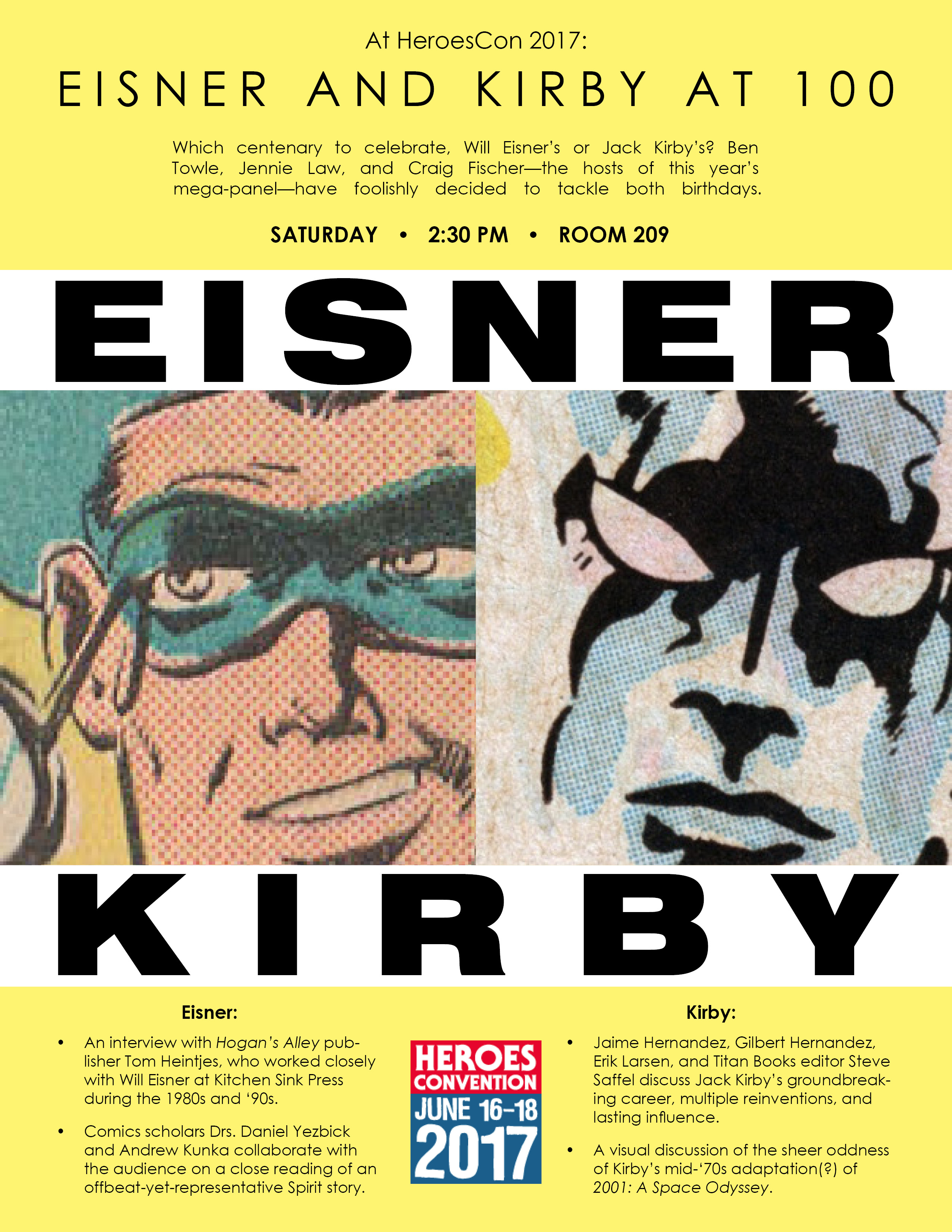
Here’s the skinny on the 2017 HeroesCon Mega-Panel. It’s Saturday at 2:30 in room 209. Full HeroesCon programming is available on their website.

EISNER AND KIRBY AT 100

Which centenary to celebrate, Will Eisner’s or Jack Kirby’s? Ben Towle, Jennie Law, and Craig Fischer—the hosts of this year’s mega-panel—have foolishly decided to tackle both birthdays.

First is Eisner: Ben will interview Hogan’s Alley publisher Tom Heintjes, who worked closely with Will at Kitchen Sink Press during the 1980s and ‘90s, particularly on a monthly column that appeared in Kitchen Sink’s comic-book-sized Spirit reprints. Expect insights into both Eisner the artist and Eisner the man. Craig will follow by inviting two razor-sharp comics scholars, Drs. Daniel Yezbick and Andrew Kunka (himself one-half of the Comics Alternative podcast team), to collaborate with the audience on a close reading of an offbeat-yet-representative Spirit story.

Then Kirby: Jennie will guide a panel of super-fans—cartoonists Jaime Hernandez, Gilbert Hernandez, and Erik Larsen, and Titan Books editor Steve Saffel—through a free-wheeling discussion about King Kirby’s groundbreaking career, multiple reinventions, and lasting influence. Finally, Ben will discuss the sheer oddness of Kirby’s mid-‘70s riff on 2001: A Space Odyssey—a fitting place to end, since Eisner and Kirby were monoliths that pushed comics to higher evolutionary achievements.

London: 40 Years of 2000 AD Exhibit/Paris: Les Super Héros

Over the past spring break, my family and I took a trip to London and then to Paris. Since it was our family vacation I mostly managed to kept my comics-centric interests in check during the trip, but I couldn’t help but make a couple of detours to check out comics-related things. So, here are a few thoughts:

London:

Our visit to London overlapped with the tail end of the Future Shock: 40 Years of 2000 AD exhibit at the Cartoon Museum. I would never have known about London’s Cartoon Museum if I’d not been specifically searching for comics exhibitions pre-London visit. And that’s too bad, because the museum itself is great and this particular exhibit was truly amazing.

The museum is, though, definitely off the beaten path. You really have to be aware of the place’s existence and be actively seeking it out in order to find it. It’s at 35 Little Russell St, Bloomsbury, London, which is a narrow street that tees into a pedestrians-only throughway, so it’s not somewhere you’d likely just happen upon.

Capture

The exhibit itself was great, though. As an American growing up in the ’80s, my exposure to 2000 AD was mostly through the Eagle Comics reprints of Judge Dredd and other 2000 AD stories. The USA-specific Brian Bolland covers of those Eagle reprints made me a fan for life of his work and it was a real treat to see some Bolland originals at the exhibit. I’ve also always been a huge fan of Carlos Ezquerra, who remains to this day my favorite Dredd artist, and there was plenty of Ezquerra on display as well.

Backing up, though… here’s what the general layout of the exhibit looked like:

IMG_20170411_103628 IMG_20170411_105903

In addition to the copious amounts of original art on the walls, there were a few odds and ends like this case full of 2000 AD issues:

IMG_20170411_104742

BUT, back to that copious original art! I took a handful of pictures of the artwork before I saw a sign admonishing people not to take pictures of anything other than the general layout of exhibits. But, at that point I’d already snapped a bunch of pictures–and, hey, I figure I’m safe from Comics Museum Interpol now that I’m back in the People’s Republic of Trumpistan. So, here’re a few pics I took. First, a bunch of amazing art by Massimo Belardinelli, Gary Leach, and Dave Gibbons:

IMG_20170411_103802 IMG_20170411_103810 IMG_20170411_103829

Check out this fantastic McMahon Scorched Earth spread… and to the right of it some original Carlos Ezquerra Stainless Steel Rat pages:

IMG_20170411_104241

Second only to Ezquerra in my book is Brian Bolland, He would eventually pretty much retire from doing interior pages at all, so it was especially great to see a bunch of his Dredd pages on display here–alas, though, not the one featuring the most iconic Dredd image of all, Bolland’s “Gaze into the fist of Dredd” panel.

Seeing Bolland inking up close is pretty stunning. It’s not surprising that he’d eventually focus solely on covers, given the amount of time it must take to crank out pages like this.

IMG_20170411_105340
IMG_20170411_105038

It was interesting that pretty much all the artwork had balloons/lettering added on vellum, as you can see in that top close-up. The artwork beneath shows through, but I guess that’s something that wouldn’t pick up in a photostat? There were tons and tons more 2000 AD art on display–all sectioned by character–but I stopped taking pictures when I realized it wasn’t allowed.

The Cartoon Museum also has an upstairs gallery that houses what I’m assuming are pieces from its permanent collection. I visited literally just an hour or so before I had to catch the train to Paris, so I only did a quick walk-around, but here’s the general layout:

IMG_20170411_110936Among the pieces up there was the original cover painting for the V for Vendetta collection. You can also spot here a Miracleman cover and a Kevin O’Neill LOEG page. Bonus points for the Rupert in the stairwell!

IMG_20170411_111239

The exhibit overall was really, really amazing and I feel really lucky to have been (completely coincidentally) in London when it was going on. Bonus: I bought some Moomin greeting cards at the museum gift shop:

IMG_20170412_093342

One final London note. While touring the city via bus, I noted this storefront with some sort of Beano display. I have no idea what this is, but wish I’d had time to investigate.

IMG_20170410_120009

Paris:

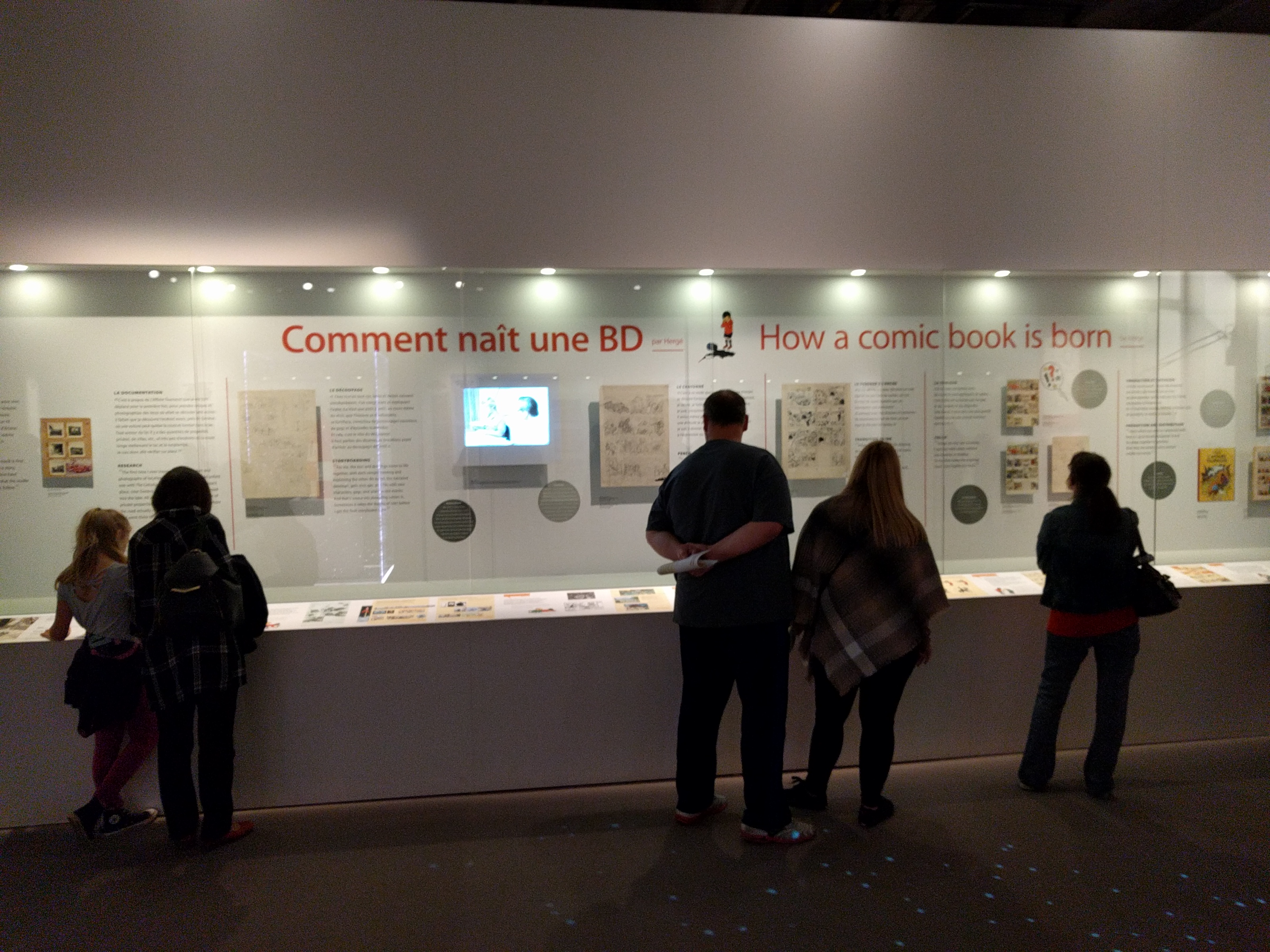
I was a little surprised that there wasn’t much going on in Paris as far a comics exhibitions go while we were there. Before leaving, I did though turn up this Joann Sfar show at the Dalí museum. Here’s a big ad for the same show I spotted at several Paris Metro stations:

IMG_20170411_195027If we’d had an extra day, I’d probably have gone to it, but from what I read in advance it didn’t seem like there would be much actual original comics art there, so I didn’t prioritize it. Before I move on to the one comics thing I did get to, I’ve got to throw out this one generally art-related anecdote:

While in Marais we decided to wander into a department store, Le BHV, just for fun. We mostly looked at clothes and toys, but out of the corner of my eye I spotted an arts and crafts section. My jaw literally dropped when I saw the art supplies they had on-hand. BHV seemed like a higher-end department store–maybe equivalent to something like Bloomingdale’s here–but the arts and crafts section (do U.S. department stores even carry art supplies?) was better than 90% of the dedicated art supply stores I’ve been into in the U.S. This is maybe a third of the section:

IMG_20170412_122719 IMG_20170412_122726 IMG_20170412_122741 IMG_20170412_122818On to comics, though! I’d gotten some great recommendations from a Parisian friend for comics shops to visit. The one he recommended near Notre Dame, Un Regard Moderne, had odd hours and didn’t open until the afternoon, so sadly we missed it. He also, though, highly recommended Les Super Héros, which was near the Pompidou Center, which we were visiting anyway. And it is an amazing store. Here’re a few pictures that say more about the place than I could:

I wish I’d had had room for more books in my luggage (Delta lost our luggage at Heathrow, we bought more clothes, luggage found/returned, had to haul new & old clothes back, etc.) but sadly I bought just three books: a recent Winshluss book, a limited edition black and white edition of the new Christophe Blain Gus book, and a Toppi reissue.

Winshluss’s Pinocchio from a few years was one of my favorite books of that year (2011?). The art in Smart Monkey is quite different from that in Pinocchio, however. Most noticeably, it’s all black and white (which is unusual for French comics in general). The first three quarters or so of the story is wordless, with dialog only in the epilogue. It comes with a small minicomic which reprints a short story featuring the same monkey character which appeared in a Top Shelf collection a while back.

The Blain book is a limited black and white edition of the newest Gus book, Happy Clem, the fourth in the series. The Toppi book is Momotaro, an adventure set in medieval Japan. Boom has been publishing some English translations of Sergio Toppi books here in the U.S., but I don’t think this is one of them. I can’t read Italian at all (Toppi’s native tongue) but I can kinda muddle through French, so this is better than nothing!

A week is hardly enough time to take in amazing cities like London and Paris, so I hope to return soon to one or both of them–and when I do, I’ll surely be able to spend more time exploring each city’s comics culture. Maybe I’ll even make it to Angoulême eventually…


Chuck Berry RIP – Some Chuck Berry Songs You May Not Know

Years ago I decided to focus my blog writing exclusively on comics-centric subjects. With the recent death of Chuck Berry, though, I’m making an exception.

If you knew me in my pre-comics days, you know that I spent some time as a musician–and more to the point: I’ve always been passionate about music. Like everyone interested in music I’ve had fluctuating musical interests. My tastes have grown and matured over the years. When I look (or, more accurately, listen) back on things I liked when I was younger, I often cringe. There are, though, a few musicians I have loved unequivocally my whole life. One of them is Chuck Berry.

I was first introduced to Chuck Berry’s music by my mother–albeit in a sideways fashion. My mom’s a huge Beatles fan and so we had Beatles records around the house when I was growing up.  My favorite songs on these records were tracks like “Rock and Roll Music,” Honey Don’t,” “Everybody’s Trying to be my Baby,” “Matchbox,” and “Roll Over Beethoven.” Only years later did I realize these weren’t Beatles tunes at all, but covers.

Digging into the sources of these recordings, I wound up purchasing The Great Twenty-Eight, a best of Chuck Berry record. It’s (as best as I can recall) the first record I bought with my own money and (for sure) one I still own and listen to today some thirty years later.

My appreciation of Chuck Berry only deepened as I delved more intensely into music in my 20s while playing in bands in the 1990s. I’m fairly certain my old band, Come on Thunderchild, played more than one Chuck Berry cover, but the only one I can specifically remember now is “Round and Round.” I got this tattoo around this time:

chuckChuck Berry died a few weeks ago on March 18th, and Sound Opinions–the great public radio music review/criticism show out of Chicago–did a fantastic appreciation of Chuck Berry’s life and legacy, along with a top ten list of his best songs. Their list is hard to argue with, but it’s definitely skewed toward his best-known and most recognizable tunes: Maybelline, Johnny B. Goode, You Never Can Tell, etc. I’d like to, though, post my own quick list here–as kind of an addendum to that list–of a few great Chuck Berry songs that aren’t necessarily the ones you may be most familiar with:


The Things I Used to Do

Chuck Berry didn’t do a ton of straight blues songs, but when he did–as here with his version of Guitar Slim’s “The Things I Used to Do”–the results could be pretty great. The studio version of this song appeared on his 1964 LP St. Louis to Liverpool (my personal pick for best single Chuck Berry LP) and it’s a great recording. This version, filmed for Belgian TV in 1965, is maybe even better. Check out both of the jaw-dropping guitar solos here. (Check also “The Love I Lost,” another great Chuck Berry straight blues performance.)


Oh Louisana

If you gave credence to most of the appreciations of Chuck Berry that appeared after his death, you’d get the impression he stopped writing original music in 1964. His original output post 60s was for sure pretty hit-or-miss, but there are absolutely some amazing Chuck Berry songs from the 70s if you’re willing to dig for them. By far my favorite post-60s Chuck Berry tune is this one, “Oh Louisiana,” from his 1971 record, San Francisco Dues. It’s part blues, kinda funky, and has a great vocal from Berry.


Reelin’ and Rockin’ (American Hot Wax version)

So, “Reelin’ and Rockin'” is of course one of Chuck Berry’s biggest hits and you’ve probably heard it a million times. This version, though, is from the 1978 Alan Freed biopic, American Hot Wax. In addition to featuring more explicitly lurid lyrics than the recorded version, it’s a pretty great live performance by Berry who at this point is in his early 50s.


I Love Her, I Love Her

This great track is from the hard-to-find 1968 LP From St. Louie to Frisco. It’s got a fantastic, grinding groove and big Stax-style horns. Check out those piano riffs at the end, courtesy of August “Augie” Meyers of the Sir Douglas Quintet.


Brown Eyed Handsome Man (Mercury version)

Here’s another Chuck Berry song you’ve heard a million times before… but not this particular version. Berry left Chess Records and recorded for Mercury between ’66 and ’69. One of the oddest moves during this period was the ’67 Mercury release Chuck Berry’s Golden Hits, which consisted mostly of newly-recorded versions of the original Chess hits. These recordings are contentious among Chuck Berry fans, but I think there’re some interesting nuggets here. My favorite is this re-recorded version of “Brown Eyed Handsome Man.” Unlike most of the other Mercury versions which are sped up, this one’s maybe even slowed down a bit? I loses a bit of its “chugga chugga” rhythm in favor of a mellower grove. I love all the great Johnnie Johnson organ and electric piano.


Drifting Heart

“Drifting Heart” is an early Chuck Berry (1956) oddity. It was the flip side of “Roll Over Beethoven” and later was the last track on the LP After School Session. Here Berry’s squarely in ballad mode with perennial secret weapon Johnnie Johnson supplying a simple pentatonic piano figure that–along with a snakey tenor sax–gives the track a vaguely mid-eastern vibe. This is Chuck Berry at his most Nat Cole.


Fish and Chips

“Fish and Chips” appeared on the 1970 LP Back Home, Chuck Berry’s first record after he left Mercury and returned to Chess. This great little tune has an almost country-ish vibe (not surprising from the guy who wrote “Maybelline”) that’s accentuated by an accompanying harmonica part from “Boogie Bob” Baldori.

Comics: Parallel Stories on Separate Horizontal Tiers

That’s the most awkward blog post title I’ve probably ever come up with, but I don’t really know what else to call it. Scott McCloud or Neil Cohn may have some term for it, but what I’m referring to is basically this–which I encountered most recently in the Valerian and Laureline volume, Heroes of the Equinox:

Capture

What’s going on here is we’re following four different characters’ story-lines and the artist, Jean-Claude Mézières, is showing us each of their stories on an isolated horizontal tier that we follow for a while until the converge back together later in the story. (And note the great Moebius Arzach reference via the winged creature on the third row.)

The thing that stood out to me here was how much this technique is “of the medium.” Comics is often presented as a “nested system” in which each panel is read in a specific, isolated, sequential order without regard to the page as a whole. This sort of arrangement, though, makes use of the readers’ apprehension of the page as a whole. We see the parallel tracks and understand the formal conceit before reading the content of the panels themselves.

I wondered, though, how often this technique was used in comics. I had a few thoughts myself, but also got some good suggestions via twitter. Here’s a French comic, L’Espace D’un Soir, which is an entire BD that has four stories of characters in a building, each on a different tier, all happening concurrently. I really like how each story arc (I’m struggling for terminology here again) seems also to be color-coded with a unique palette.

C49bE9YVcAAPHTv

Another instance that turned up via Twitter was this Multiple Man page by Jason Loo. As far as I can tell, this is a sample page rather than something actually published by Marvel–which is unfortunate, because it’s such a great concept. It’s not exactly an instance of parallel stories/tiers, but it’s similar in nature, combining that basic idea with a maze-like Chris Ware-esque layout you navigate via little “tabs” reminiscent of Jason Shiga’s “choose your own adventure” comic, Meanwhile.

multiple man

Speaking of Chris Ware… if there’s some formal comics hijinks going on, you can be pretty sure that Chris Ware is on the case. I don’t recall any instance of him using a straight parallel stories/tiers setup, but he often cordons off individual stories layout-wise, sometimes tying them into physical relationships/locations with balloon-tail-like connectors.

1681628-slide-slide-6-chris-ware-brilliantly-bundles-building-stories

The most well-known instance of the parallel stories/tiers setup is Fantastic Four #277, in which John Byrne shows us a Thing/Johnny Storm/She-Hulk story on the top row and a Reed/Sue/Dr.Strange story on the bottom. The two rows are separated not just with a traditional gutter, but also with a horizontal black line, a device that encourages you to read the top row all the way across the spread then jump back to the bottom of left-facing page to start the bottom row.

ff_277_01

Tezuka’s epic, Pheonix, apparently uses this technique. (Phoenix has been on my to-read list forever.) Here’s a page in which we see characters in individual escape pods, each shown in distinct horizontal sequences. This is from a sequence in the third volume, but the fourth volume, Universe, is supposedly done entirely using parallel stories/tiers. (I’ll update this post if/when I get around to reading Phoenix.)

tezuka

If you’re thinking that the potential side-scrolling nature of webcomics yields fertile ground for this kind of layout, you’re correct. Here’s one example of what I assume are many: Decrypting Rita by Margaret Trauth. It’s another instance where there’s a distinct color palette setting off each of the parallel stories.

Capture2

An impressive use of this side-scrolling technique in a physical book is Tymothi Godeck’s 35-foot-long leporello comic, !. While it doesn’t adhere strictly to a parallel stories/tiers layout, it for sure incorporates elements of it in places throughout. Here’s my After-School Comics Club kids holding the unfolded comic aloft:

CWdWaIqWwAAMlCi

And here’s a bit of parallel stories/tiers going on:

untitled-4


I saved the most impressive use of parallel stories/tiers, though, for last. Rebecca Dart’s Rabbit Head is a work that shows off what this type of storytelling can do if you really dig into its formal possibilities. It’s difficult to describe how Rabbit Head works without just reading the thing, but basically it starts with a single story/tier in the center of the page. Then, elements from an individual panels “fork off” into their own tiers, above or below the previous. As the story progresses, more and more of these narrative tiers branch off, until there are seven stories/tiers going concurrently. Then, at about mid-point, exactly the reverse begins happening: elements from the outer tiers get re-incorporated into the inner tiers, until finally we’re back down to the one initial tier/character. It’s stunning.

IMG_20170313_114038

IMG_20170313_114050

IMG_20170313_114057

IMG_20170313_114108

I just started really contemplating this layout technique a few days ago when I read that Valerian story, but I’ve apparently been at least unconsciously interested in it for a while. It only occurred to me while writing this post, that I’ve used this technique myself–albeit in just one instance–in my 2008 book Midnight Sun. In this sequence I have the stranded airship crew’s narrative going on in the upper 2/3 of the page, while the lower 1/3 follows the main character as he simultaneously travels to investigate the story of the crashed airship.

Capture

Do you have other examples of comics that use the parallel stories/tiers layout (or a less awkward term for this layout)? If so, feel free to comment or email them to me!


Update (3/15/17):

In addition to the comments to this post, I’ve gotten some good feedback via twitter, so I thought it’d be good to add them here. First, some terminology stuff from Neil Cohn:


And here’re a few suggestions of additional instances of the parallel stories/tiers technique:

Additionally, Pat McKeown did a great parallel stories/tiers piece in Weasel #1. The published version is NSFW, but here’s a blocked-out version:

mceownlayoutclean2Right/control click on that image, open it in a new tab, and zoom in in order to read it. You can find a great analysis of it here.

My Faves of 2016

Here’s a short list of some of my favorite comics–and comics-related–things from 2016. And, as always, keep in mind my usual caveat: these are just my personal favorites; I make no claims for the best!


Children of Captain Grant – (all ages graphic novel) by Alexis Nesme, based on work by Jules Verne

captaingrantweb1

I was gobsmacked when I saw a few sample pages of this posted on an Italian comics website and I bookmarked the page, thinking I might shell out for a French language version just to have to look at. Months later, I was delightfully surprised to see that it was getting an English translation, courtesy of Super Genius Comics (which seems to be a new imprint of Papercutz). The story here is a solid, straight-ahead adaptation of the Jules Verne short story of the same name. It’s a classic nautical Adventure to Foreign Lands-type story–and one that’s largely clear of the colonialist insensitivity that can make stories from this era tricky to deal with for younger audiences.  The real star here, though, is the jaw-dropping painted artwork. Oh, also, did I mention that all the characters are done as animals? Hands-down my favorite comic of 2016.

[Buy]


Manben – (Japanese comics documentary TV show) hosted by Naoki Urasawa 

12825827_666110360198278_1436233349_n

There are few things I love more than seeing other cartoonists’ studios and learning about their process. There’s a fair amount of information out there about this subject as far as it relates to Western artists, but the world of Manga has remained largely shrouded to outsiders. This year, though, I became aware of Manben, a Japanese TV show hosted by master manga artist, Naoki Urasawa. The premise of the show is simple: in each episode, they record a manga artist at work and then Urasawa discusses process with them. Obviously this is all conducted in Japanese, but some kind soul has fansubbed English subtitles for the episodes to-date. You can find most of the episodes streaming on DailyMotion.

[Watch]


Peter Arno: The Mad, Mad World of The New Yorker’s Greatest Cartoonist – (prose biography) by Michael Maslin

3337853

I’m a huge fan of New Yorker cartoonist Peter Arno, so this one’s been on my radar since I first got wind of it. It’s a much needed start-to-finish look at this important figure in the history of comics–one who’s not had a comprehensive biography to this point. One of the most interesting sections of the book appears almost as an addendum: pull quotes from currently-working New Yorker cartoonists discussing the influence and impact Arno’s had (or not had, in several cases) on them.

[Buy]


Webcomics Coverage at The Beat – (online comics news) by Maggie Vicknair and Heidi MacDonald

captureIn terms of “eyeballs on the page,” webcomics are surely the most widely-read form of comics–and yet, like pretty much any form of comics that’s not distributed via the direct market, webcomics are rearely covered/reviewed/discussed in most comics circles. And that’s why it’s so great to see that The Beat has been covering them regularly this past year in two features: Webcomics in Review (reviews of ongoing webcomics) and Webcomics Alert (noting newly launched webcomics).

[Read]


Space Battle Lunchtime – (comic book series) by Natalie Riess

spacebattlelunchtime1

I’m a sucker for comics about cooking and this is a great one. Here’s the setup: Peony is a baker from Earth who’s abducted by aliens so she can compete in an intergalactic cooking competition. The story is tons of fun, the cartooning is loose and expressive, and the coloring is fantastic. What’s not to love? The first story arc (the “partner challenge”) is collected in a trade paperback, or you can follow along with the individual issues as the come out.

[Buy]


Nod Away – (graphic novel) by Joshua Cotter

nod-away-cover

This came out way back in February, but it’s for sure one of the best GNs of 2016. It’s the first installment of what’s sure to be an epic SF story. Even at 250-ish pages, Nod Away just begins to set up the opening pieces of its Philip Dick-esque story. That the cartooning is beautiful will come as no surprise to anyone who knows Cotter’s previous series, Skyscrapers of the Midwest.

[Buy]


Palomino Blackwing Pencil Sharpener – (art supply)

50122

I’d been searching forever for a good handheld sharpener and I’ve finally settled on the Blackwing. My requirements were: two stage sharpening (one stage exposes the lead, the other sharpens), must fit into a standard pencil case, must have replaceable blades. The Kum model that most people recommend had all of these but also had lead pointers (that I never use), the blades seemed to wear out quickly, and it tended to break colored pencils. The Blackwing has none of these issues. I’ve been using it for about a year and have yet to need to change blades.

[Buy]


We Told You So: Comics as Art – (non-fiction book) by Michael Dean and Tom Spurgeon

toldyouso

This one’s a late entry–it came out in December and I received it for Christmas–and I’m only 200 or so pages into it, but so far it’s definitely one of my top non-fiction books of 2016. We Told You So is an oral history of the the alt/indie publisher Fantagraphics. It’s a huge slab of a book and it’s beautifully designed. There’s a lot of “inside baseball” here and things are occasionally mentioned in passing that could probably use a bit of explanation/context… but it never really impedes the overall narrative. That it’s somewhat self-congratulatory shouldn’t surprise anyone given the title of the book, but hey, it’s Fantagraphics!

[Buy]


Providence – (comic book series) by Alan Moore and Jacen Burrows

providence10-reg

As literally every single write-up of Providence will tell you, this series is a “slow burn.” Well, the burn turned into an inferno right about the time issue 10 hit the stands in 2016. It’s taken me a while to come around to the art in this series (and I still don’t think it’s well-served by the kind of coloring that’s used here) but it’s become one of my favorites, and a potential late-era Alan Moore masterpiece. If you decide to dig in, I recommend reading each issue twice: once just for the main plot, and a second time referencing the extensive panel-by-panel notations at Facts in the Case of Alan Moore’s Providence.

[Buy]


Critical Chips – (comics criticism/writing) edited by Zainab Akhtar

f398698fd5007049c94a98c6eadf62e4_original

This is another late entry that I’m not all the way through yet… but so far this Kickstarter-funded collection of comics writing has been largely great. The ten pieces herein–by an array of folks including David Brothers, Joe McCulloch, Annie Mok, and more–address a wide range of comics (Krazy Kat to Copra) in a way that’s insightful and smart, but immensely readable. My only complaint: it’s so nicely put-together that I regret getting the digital, rather than print, edition.

[Buy]