
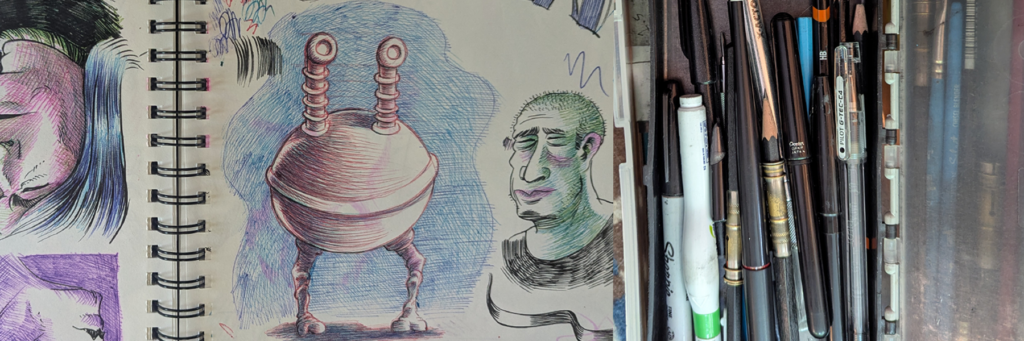
By happenstance, I recently completed two sketchbooks that I’d been working in simultaneously: my larger daily sketchbook and a smaller, more portable notebook-sized Moleskine. I’ve occasionally posted bits of my sketchbooks here in the past, and I’m doing so again now–although, I’ve done full video flip-throughs this time. Also, I thought this would be a good occasion to write down a few points about sketchbooks that I used to discuss with my students at CCAD about the importance of keeping a sketchbook and what the point of it is.
If you want to skip the latter and just have a look at the sketchbooks, you can go there directly.
Otherwise…
On Sketchbooks
I used to give a more formalized talk to my CCAD students about sketchbooks–along with a slide deck, etc. But here, I’ll just throw out a list of general thoughts about sketchbooks as someone who’s kept one pretty much since I was a child.
- Why would you not keep a sketchbook? One reason is that seeing other people’s “sketches” in social media can be intimidating. Here’s the thing, though: just like you’re a lot more likely to see Instagram posts of people’s fabulous Caribbean vacations rather than them cleaning the fryer at Arby’s at the end of the shift, you’re really not seeing people posting all of their bad drawings–which are exactly the kind of thing that actual sketchbooks consist of.
- Same deal with “sketchbooks” you buy from pros at cons: these are curated collections of the artist’s best stuff.
- So, re. both of the above: don’t be intimidated by the “sketches” you see around.
- Your sketchbook should mostly be filled with “bad” drawings. That’s why part of my sketchbook talk to my students is going through my sketchbook so they can see that it’s not full of neat, beautiful, fully-rendered drawings.
- Corollary of all of the above: your sketchbook is for you.
- The most important reason a sketchbook is good for you as an artist is that it’s a place for non-directed drawing. What’s non-directed drawing? It’s drawing whose whole purpose is simply the act of drawing. It’s not part of a school assignment, a freelance gig, etc.
- There are two types of non-directed drawing that you should be doing in your sketchbook: (1) drawing from imagination, and (2) drawing from life*.
- “Drawing from imagination” = doodling.
- *Despite what a lot of art teachers/professors tell you, drawing from pictures is great. I mean… don’t hold your breath waiting for live life models to show up in your living room.
- Use your sketchbook to improve things you’re not great at. I still struggle with hands, clothing/drapery, and gesture. That’s why you’ll see a lot of that in my sketchbook. I’m looking at MOJO Magazine mostly for hands and Vogue for clothing/drapery and gesture.
- Fool around with different media you don’t usually use. You’ll see my sketchbook is filled with me goofing around with watercolors, carbon pencils, and all kinds of other odd things I don’t use as a cartoonist–and especially ballpoint pens.
- Make drawing in your sketchbook a habit and you’ll not have a problem finding time to work in your sketchbook. Do you decide whether you have time to brush your teeth? No. Because it’s a habit.
My Sketchbooks
I usually have two different sketchbooks going at the same time: a large daily sketchbook that I leave in the living room at home, and a smaller more portable notebook-sized sketchbook that I use when I want to draw somewhere other than home. As mentioned, just by happenstance I finished both of my current sketchbooks recently and you can see flip-throughs of them below.
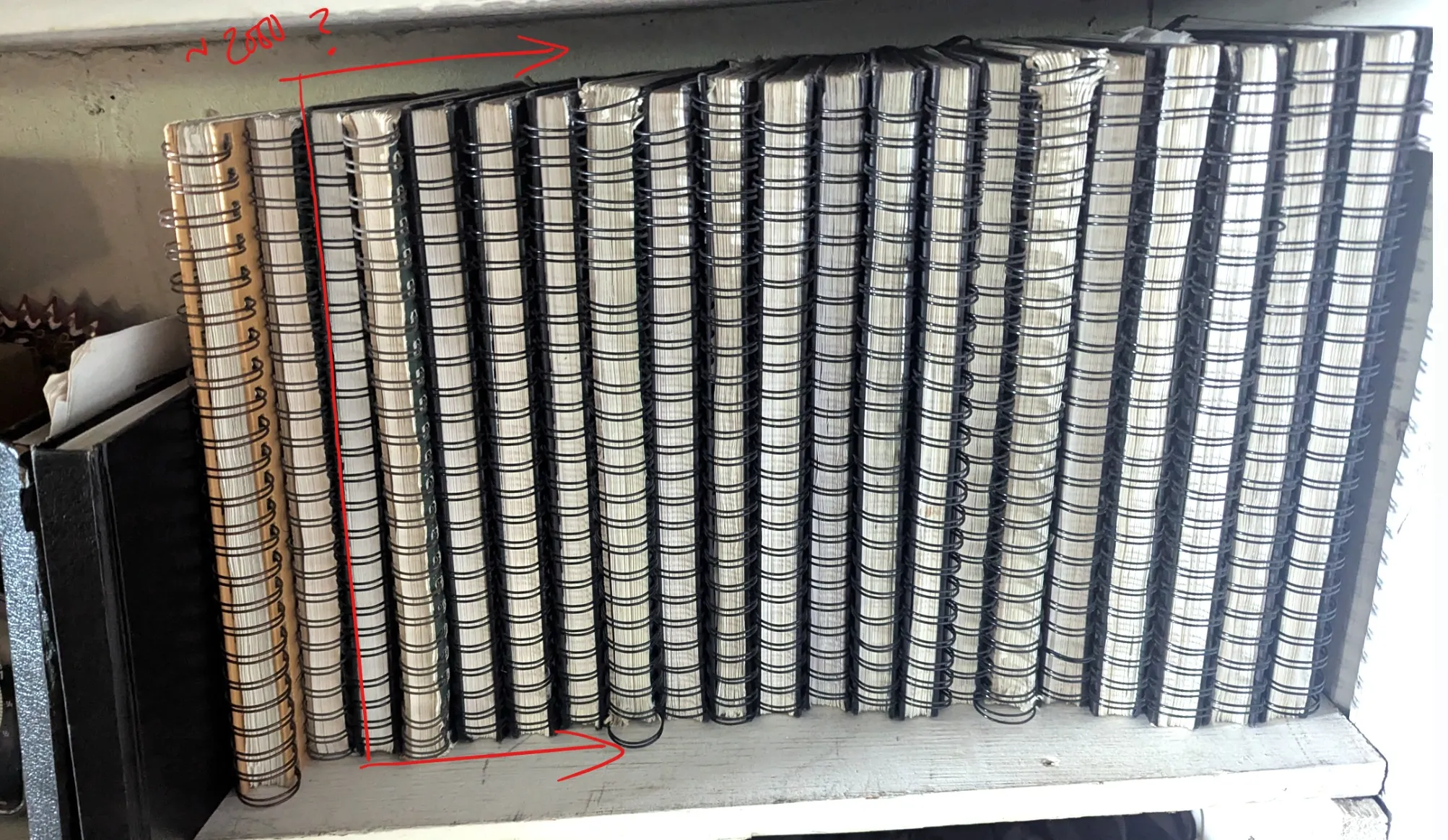
Daily sketchbook – For many, many years my daily sketchbook of choice has been the 9″ x 12″ 80 page Cachet Select Spiral Bound Sketch Book… which sadly appears to be no longer made. I’m literally inconsolable. So I guess the first video below is a look at my very last Cachet Select Spiral sketchbook.
Here’s my shelf of old sketchbooks in my studio. You can see that everything from about 2000 onward are Cachet sketchbooks. <sad emoji, etc.>
Portable sketchbook:
I like to have a smaller sketchbook for traveling, doodling during meetings or presentations, etc. In this case it was a 5″ x 8″ Moleskine. That said, despite the Moleskine brand seemingly becoming the “default” hand-held sketchbook brand of late, their paper quality is actually pretty sub-par. The cartoonist Trungles has some great suggestions in their Bluesky feed for non-Moleskine books to draw in. My replacement choice was a Hand Book Co. sketchbook that I’m really liking.
Flip-through – daily sketchbook:
First, a note: I draw on both sides of the pages in my sketchbook, and in order to keep the spine on my left as I draw, I flip the book over when drawing on the left-facing pages–which means that all of the left-facing pages are upside-down, like this:
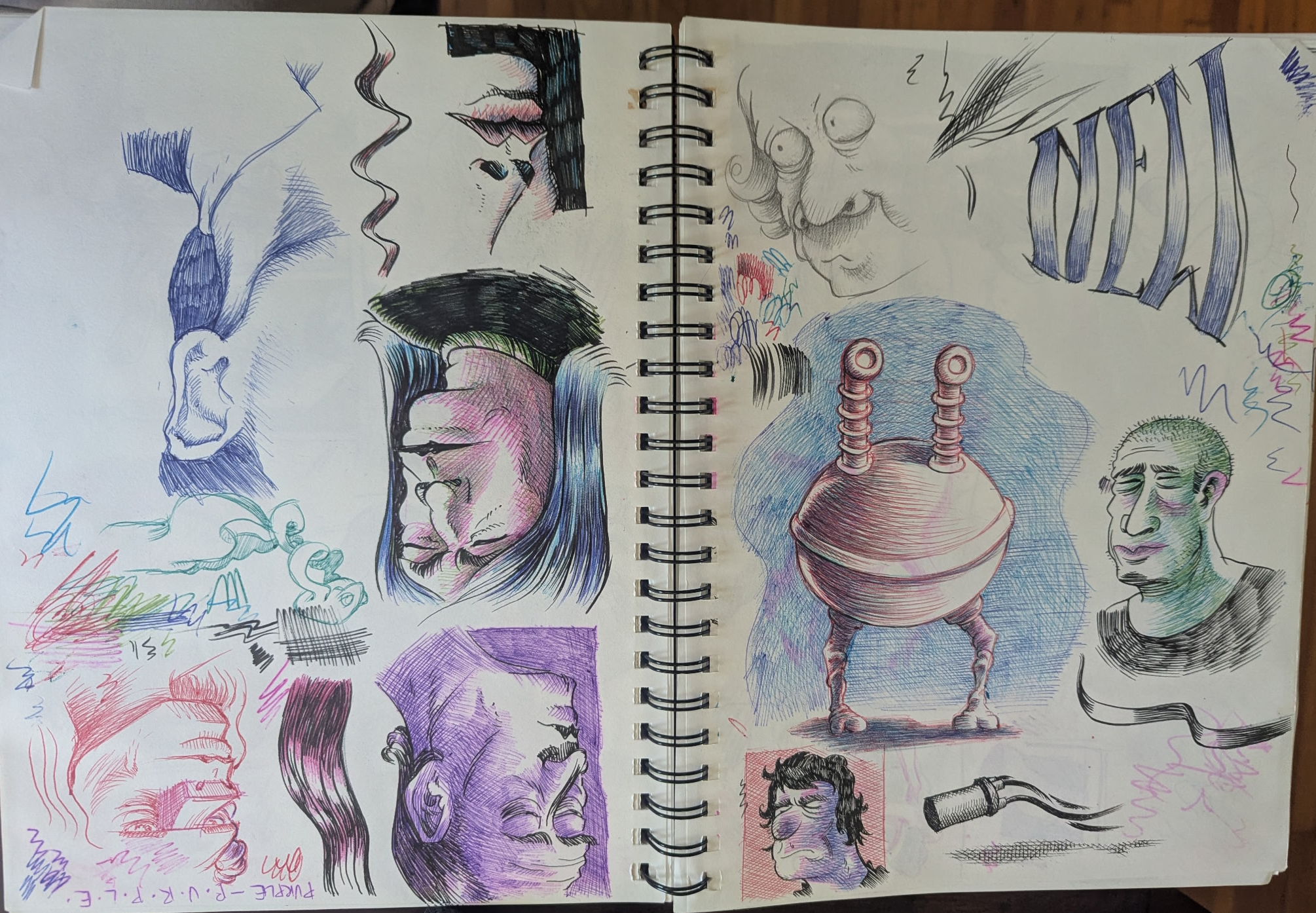
So, for this video, I’ve filmed all the right-facing pages first, then flipped the book over and filmed the left-facing ones; it’s not in chronological order.
Here’s the daily at 5x speed:
… and here it is at regular speed:
(Music: Hallogallo by Neu!)
Flip-through – portable sketchbook:
The first five or six pages here (the stuff that’s just black pen) are from ages ago. I started this sketchbook and then kinda forgot about it. Once I picked it back up again and put it into circulation (when all the color/ballpoint pen stuff starts) it remained in circulation up to finishing it.
Since this sketchbook is small and lays flat, there’s none of the flipping around stuff, as with the bigger one.
Here’s the portable at 5x speed:
… and here it is at regular speed:
(Music: Pea Plucker’s Pavane by Suni McGrath)
Recent Comments