My Next Book: Four Fisted Tales: Animals in Combat

Book Announcement 

With the cat now officially out of the bag, here’s the full scoop on my next comics project: It’s called Four Fisted Tales: Animals in Combat and it’s forthcoming (probably in two-ish years or so) from Dead Reckoning, the new graphic novel imprint of  The Naval Institute Press. Here’s a description of the book, straight out of my pitch/proposal:

From hauling munitions to finding mines, and even being captured by the enemy and traded in a PoW exchange, animals have fought—and often died—alongside their human counterparts in virtually every military conflict in recorded history. There are plenty of graphic novels telling the stories of the men and women who’ve fought in the trenches, jungles, and deserts of the world’s battlefields; Four Fisted Tales: Animals in Combat tells the stories of the animals who fought alongside them.

The comics/publishing news site ICv2 did a short write-up about two of Dead Reckoning’s recent acquisitions, including Four Fisted Tales. You can read it here.

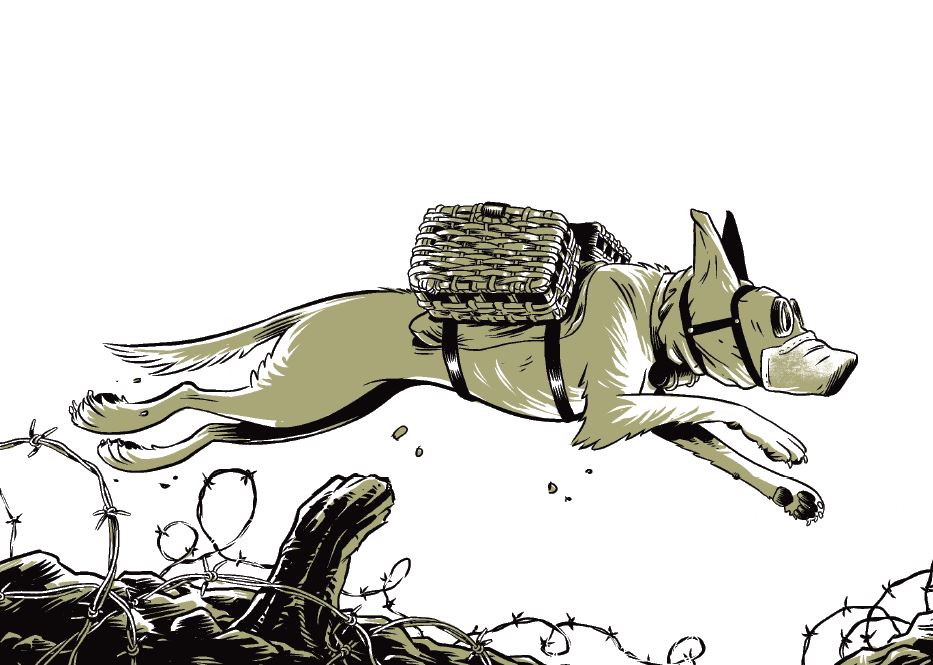
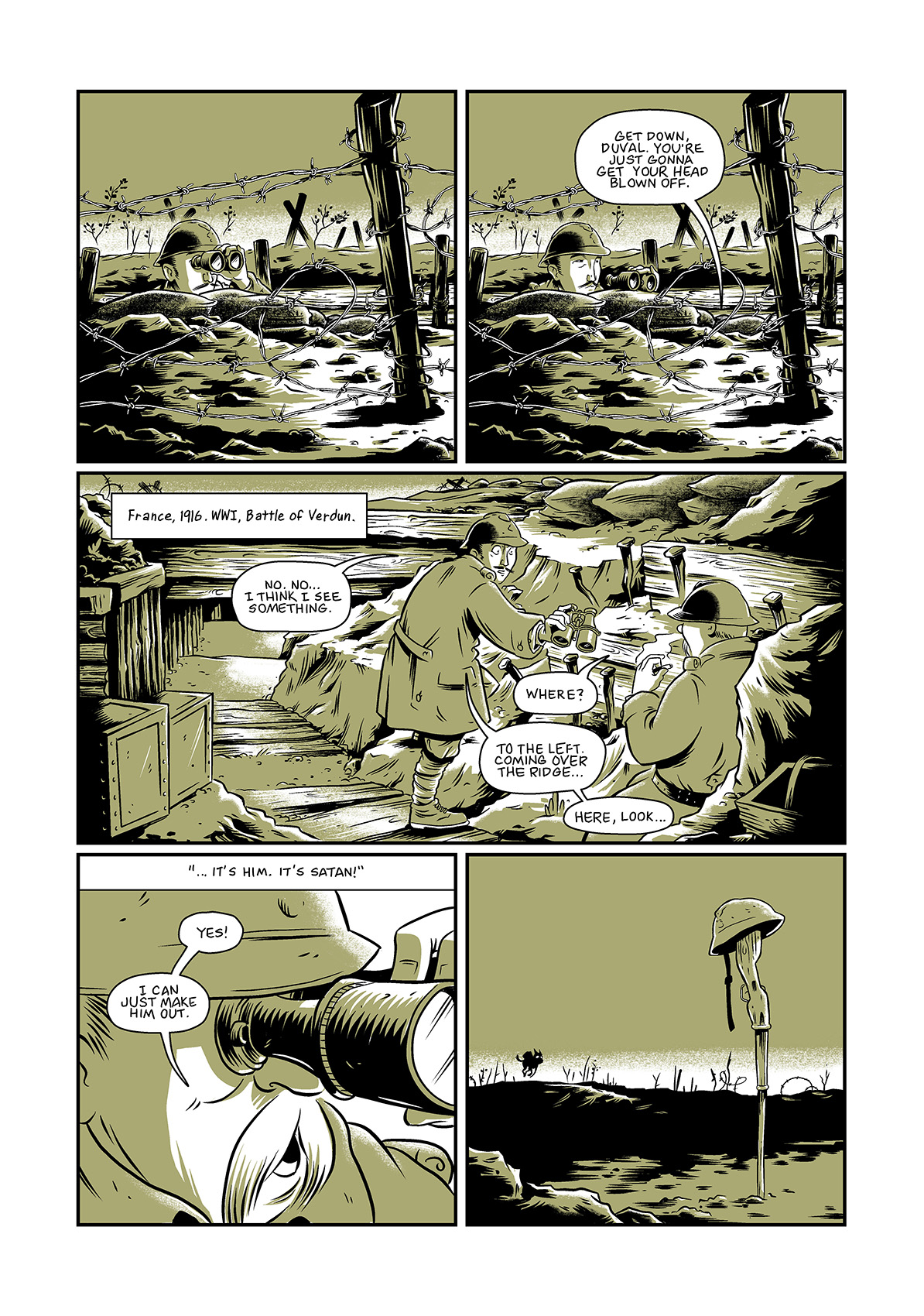
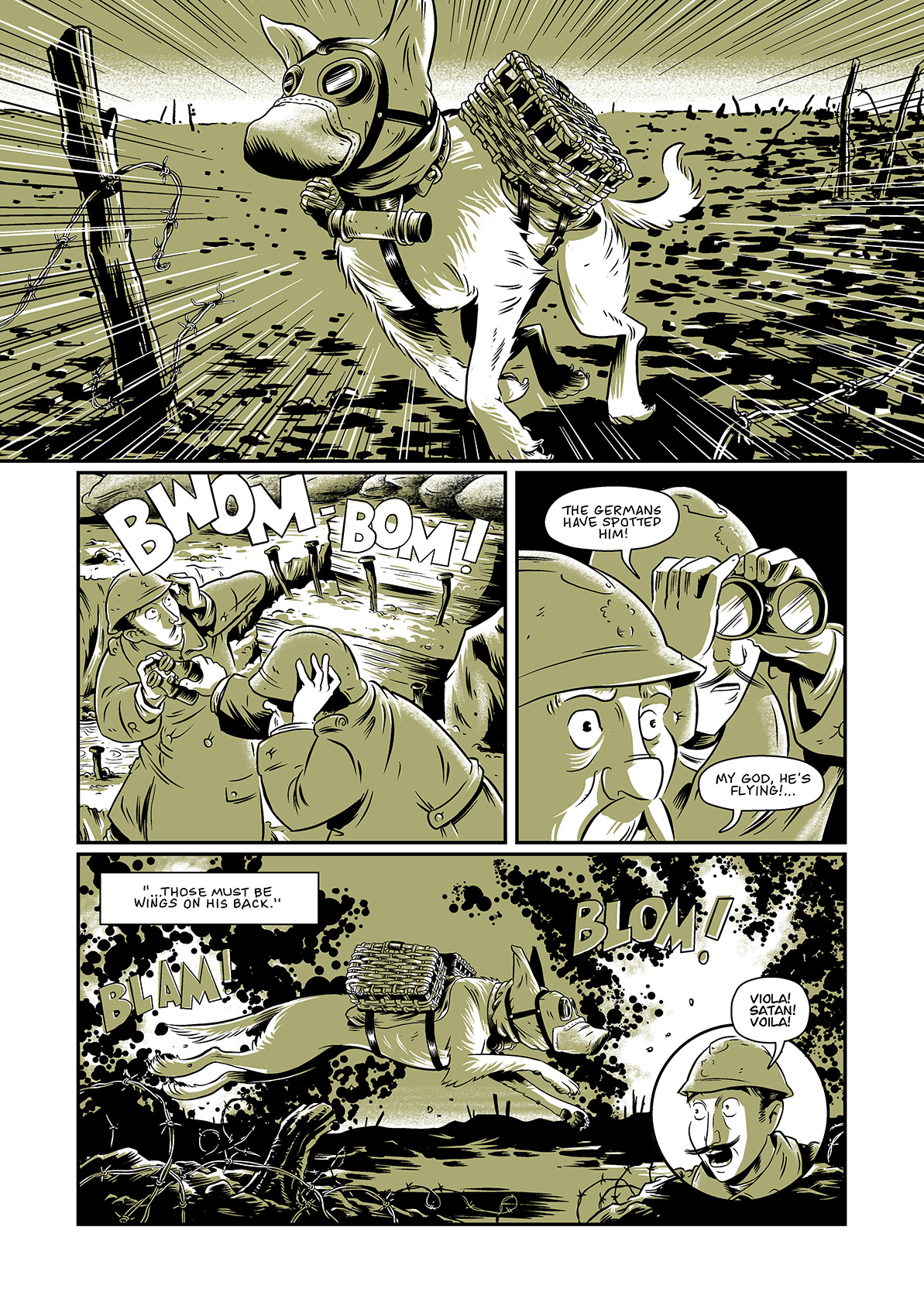
The book comprises fifteen short stories about various animals used in combat–dogs, a bear, dolphins, rats, and more. In this respect, it’s a bit of a flashback for me to my very first book, Farewell, Georgia, which was also a collection of short stories. Four Fisted Tales a return to an earlier form visually as well; it’ll be done not in full color, but in the “line art plus spot color” style that I’ve used previously in books like Amelia Earhart: This Broad Ocean and Midnight Sun. Here’re some completed sample pages:

Drawing Digitally 

I don’t like the guy’s face in the inset panel of that second page and I’ll probably redraw it… but that gives you a general idea of what the look of the book will be.

It’s also going to be the first book I’ve done fully digitally. If you follow me on Twitter, you’ve probably surmised that it’s drawn in Clip Studio Paint, as that’s my preferred drawing software. I’d love be able to use CSP for the entire process, but I’ll have to do the spot color in Photoshop since CSP doesn’t have a true CMYK mode that’s viable for professional offset printing purposes. That’s unfortunate because I much prefer working in CSP generally, and also because I like the Frenden charcoal and conté brushes in CSP (you can see them used in some of the olive tone in the sample pages) to the stock Photoshop equivalents. Oh well… 

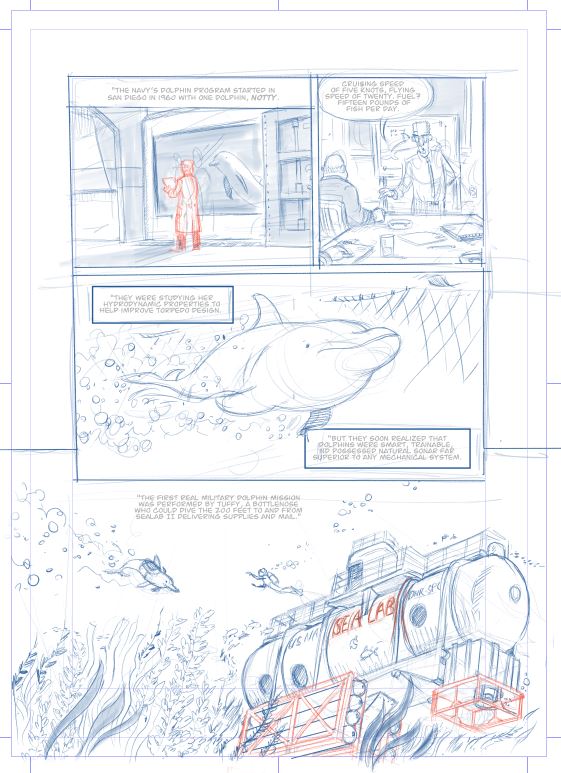
Just for fun, here’s an in-progress page from the story about military dolphins. And, yes, that is a hallway from the lab in The Shape of Water in the first panel there. 

As you can see, my in-progress pages are about halfway between being thumbnails and finished pencils. That, combined with the fact that I’m writing the stories as I go, is contributing to these taking a while to knock out, but I’ve done three of the longer stories already and moving from this state to finished inks/tones will be relatively quick.

For what it’s worth, I’m still trying to work intermittently on In the Weeds, but I’m treating Four Fisted Tales as my “day job” and In the Weeds as a weekend project.  If deadlines start getting tight though, I’ll put In the Weeds completely on hiatus until Four Fisted Tales is complete.

Perseverance

 A final note: it’s easy to get the idea–especially with the ubiquity of social media–that everyone but you is an instant success. And, yeah, there are some people who wind up with fame and fortune right out of the gate. But the more common story is that of repeated rejection, perseverance, then gradual movement toward success. I recently saw a talk by cartoonist Dav Pilkey in which he discussed exactly this–noting that his first book proposal was rejected twenty-three times before being finally accepted by a publisher. 

As you can see from this Tweet of mine, the seeds of Four Fisted Tales were in place as far back as five years ago:

In between then and now it’d been filed away in my “idea file” and but I’d been collecting and bookmarking stories about animals in combat. I’d come pretty close to trying to do the book as a Kickstarter project. I’d pitched it to a publisher as an anthology book but didn’t move forward because I couldn’t secure enough money to pay contributors a good page rate. I’m pretty sure I’d sent it to at least an agent or two somewhere in between as well. And, of course, I’d started work on an entirely different book, In the Weeds, and had fully scripted that book and roughed about two-thirds of it. 

BUT when I saw a Publishers Weekly article about a new comics imprint specializing in military and historical subjects, I tracked down the editor’s email and contacted him–then dusted off all those Four Fisted Tales bookmarks, did some sample pages, put together and proposal, eventually wound up here with In the Weeds well on its way to being my next major comic. Don’t give up, folks!

Exhibition Round-Up: Hugo Pratt in Lyon and Peyo in Paris

I was recently had the good fortune to be able to vacation in France while the big Hugo Pratt exhibition was going on in Lyon. I also saw (but nearly didn’t–more on that later) a Peyo show in Paris. By way of making sure I don’t come across as a complete comics-obsessive, I just want to point out that I was in France for five nights and did tons of stuff totally unrelated to comics.. but if you’re here reading this, it’s for the comics stuff.  So here goes: 

Wandering around Paris

My first encounter with the “ninth art,” happened almost literally the moment I got off the plane. Here’s one of the parking deck signs at the Charles de Gaulle airport:
I spent all but one day of my visit in Paris and even while just sight-seeing I spotted some interesting comics-related stuff. For example, here’s a newsstand-like thing I encountered just outside Île de la Cité. On sale were tons of children’s books and comics. I meant to go back and buy this French-language Astro Boy book but I forgot. I was surprised to find tons of 90’s Marvel reprints in the racks. They’re in French (obviously), about the trim size of a U.S. comic book, but maybe three times as long. 
Naturally, while in Paris I visited some of the city’s great comics shops. This was my first visit to Aaapoum Bapoum, a shop in the Latin Quarter. Most of this shop’s inventory is used BD, which is something I’ve not seen in many other shops. It’s organized by title rather than author, which made it a bit daunting for someone like me who has particular favorite French cartoonists, but who’s without encyclopedic knowledge of the many, many titles published. It’s a fantastic shop, though. I could have spent hours digging through their stock of used BD.  

Aaapoum Bapoum

I then wandered over to the Marais to visit my absolute favorite comics shop in Paris, Librairie Les Super Héros. Despite the misleading name, this place has the most amazing selection of new French comics around. Fortunately(?) I didn’t have a whole lot of money to blow on books, so I was able to escape from here having bought only four or five. If you ever find yourself in Paris and you have time for one comics shop only, this is the one I’d recommend for current books.

Les Super Héros – Note the Jacques Tardi character on the storefront. 

On my way back out of the Marais I walked by a watch shop that had this great display of Tintin watches. Some day I’m gonna buy some of these beautiful Tintin figurines… but that day will have to be the day I win the lottery because they’re crazy expensive. 
Side note: I’d heard that La planète dessin is an excellent shop as well, but it wasn’t open the day that I was in its neighborhood. I did, though, later just happen by a regular book store that had this great monochromatic window display of kids’ books:   
They (I can’t remember the name of the place or even where it was now!) had a great comics section and I bought one of those big broadsheet Jacques Tardi Nestor Burma comics there. It’s worth noting that even “regular” book stores in Paris usually have great comics sections–and new comics releases are just displayed among the new release prose books. Here’s my haul–from various days in the city and from various shops: Next: To Lyon for the Pratt exhibit!

Come See Me at Wizard World Winston-Salem 8/3 – 8/5

That’s right: I’m making a rare when-I-don’t-have-a-new-book-out appearance at a con. What can I say? It’s in my hometown. You can find me in Artists Alley at the space shown on the map below. More info at the Wizard World site. I’ll have my usual fare: Oyster War, various minis, a smattering of original art. Look for the big Oyster War banner and my con-fave Peanuts tablecloth! I’ll be cosplaying as a middle-aged cartoonist who wants you to buy some stuff. 

Nearly Ten Thoughts on the Bill Sienkiewicz New Mutants Run

Or, more acurately: the Chris Claremont, Bill Sienkiewicz, Glynis Wein/Oliver, Tom Orzechowski (and L. Louis Buhalis & Joe Rosen) New Mutants run.

I recently re-read this run (issues #18 – #31) in the form of this very beautiful IDW reprint edition that I got at SDCC a few years ago. Here’re a few thoughts on the series (and note that the cruddy pictures here are from scans of the individual issues, not the gorgeous IDW edition–no way am I gonna slap that thing on my scanner and crack its spine!):

It’s all about the art – There’s a reason that people refer to this as the “Bill Sienkiewicz New Mutants run.” The artwork here is what makes this series notable; it’s why we’re still talking about it now. His cubist-Neal Adams-inked-by-Ralph Steadman style of art was unlike pretty much anything that came before it and is still a high-water mark for superhero comics. That’s not to say that there’s anything wrong with Claremont’s writing here. It’s solid 80s-era Claremont. That said, there really isn’t a standout story along the lines of Dark Phoenix or  Days of Future Past that came out of this run. The closest would probably be the initial big story arc, the Demon Bear Saga or the Legion story, but even those aren’t really in the same league as Claremont’s X-Men work. In fact, it’s the less expansive stories–usually single issues–that are the most solid story-wise in this run: the slumber party issue, for example, is maybe my favorite single issue of the whole run. And the tail end of the series–a long arc that combines a super-powered gladiator ring, The Beyonder (ugh), and a Magneto plot that never really goes anywhere–would frankly be a real chore without Sienkiewicz’s artwork.

Everyone hated the art!!! – It’s conventional wisdom that people at the time reacted poorly to Sienkiewicz’s artwork, but I’m not sure how true that really is. After my re-read I dug through my original single issues of the series, looking for nasty letters in the letters column and couldn’t find much. The first issue with letters responding to Sienkiewicz’s debut issue is #23 and all three letters printed there that mention the art praise it in no uncertain terms. An issue or two later, I found a single example of someone complaining about the art:

That’s not to say that people weren’t complaining about it (I can certainly see why the book’s own letter column wouldn’t be the venue where these complaints would surface) and there’s of course the story relayed in Sean Howe’s excellent Marvel Comics The Untold Story about a letter sent to Jim Shooter (in orange crayon, no less) that read, “GET RID OF HIM JIMMY BEFORE HE RUINS EVERYTHING.” And when I mentioned this on Twitter I got this response with a hilarious anecdote:


I am curious though about how much of the “everyone hated it” bit is genuine and how much is myth-making in hindsight. 

Cringey stuff – There’s definitely some stuff here that reads a lot differently 2018 than it likely did in the mid-80s, most notably the two characters in the Demon Bear story who get “transformed” into Native Americans. There are a few other instances as well. None are Ebony-level weapons grade cringe, but definitely things that stood out to me on this re-read: Legion is supposedly autistic, but it’s pretty clear Claremont didn’t really have much of a handle on what autism actually is. And speaking of Legion, the character in the Legion arc who’s from the mid-east is referred to throughout just as, “the Arab”and he is–of course–a terrorist. A lot of Cloak’s “urban”dialog is ready-made for a translation from Barbara Billingsly. That said, none of this stuff mars the work in a way that makes it inapproachable (looking at you, turn-of-the century American newspaper comics!), but it’s something that’ll likely stick out to you if you read the series. 

Only Sienkiewicz could draw these characters – There are several characters that are introduced in this run that just can’t be drawn by any other artist and look right. The main one is of course Warlock. The others that come to mind are Legion (no one else can seem to figure out what to do with that haircut) and Strong Guy (who usually looks like a different character when drawn by anyone else). I think in all of these cases, the difference is that Sienkiewicz’s drawings are drawings. Full stop. Not drawings of things. If you try to render a character like Warlock as if he’s something other than a drawing on a sheet of paper–as if he’s got some 3-D referent in the real world–it’s just not going to look like Warlock. 

Circles = magic – It’s funny how things you read when you’re young just sort of embed themselves into your psyche, even to the point that you forget about where they came from. I realized while re-reading this that I most certainly got my own penchant for using circles to depict magic directly from Sienkiewicz. Here’s a panel from Oyster War and one from New Mutants

Craftint! – In the Legion story arc, Sienkiewicz cleverly uses an even then nearly-forgotten drawing tool, Craftint Doubletone drawing board, to differentiate the real world (drawn normally) and the world of Legion’s psyche (drawn on Craftint board).  You can learn more about this Craftint stuff here if you really want to, but in short: it’s a type of board that produces two different crosshatch patterns when brushed with different types of solutions.

Doubletone examples SCREENER

Comics fans probably know it best from Roy Crane’s Wash Tubbs comic:

Here it is in action in New Mutants #27:

Maybe someone dumped a pile of the stuff at the Marvel offices or something? David Mazzucchelli was doing some experimenting with Craftint board at around this same time. 

References! – People make a lot of hay about the 80s references in this run, particularly Sunspot’s idolization of Tom Selleck. See here, from the slumber party issue–with, obviously, a few other pop culture luminaries of the period:

My favorite pop culture reference in the series, though, is not from the 80s, but from the 60s:

This is, of course, a reference to the Star Trek TOS, episode, The Menagerie.

So. Many. Words – Taking potshots at Claremont’s excessive verbiage is maybe only a slight rung above Vince Colletta-bashing, but man there’re a lot of words in New Mutants. Especially in the later issues it’s really out of hand. Reading the end of this run I kept thinking back to an old Rachel and Miles Explain the X-Men podcast where they refer to Tom Orzechowski as Chris Claremont’s “enabler.” Look at this stuff. There’s probably some really pretty Sienkiewicz art under all that rambling. 

Corner boxes – And, finally: even the corner boxes are awesome. I miss corner boxes. 

Mike Mignola Exhibit at Society of Illustrators… and Some Other Comics-Centric Stuff in NYC


So, I recently had the good fortune to find myself in New York… and by “good fortune,” I mean: I set some travel alerts on Hopper and wound up getting a ridiculously low price on a one day to-and-from flight to NYC. While there, I checked out a few things likely of interest to comics folk, culminating with the the exhibit, The Art of Mike Mignola: Hellboy and Other Curious Objects, on display at the Society of Illustrators.

I started my visit, though, with a stop at Kinokuniya, the great Japanese book store off Bryant Park in Manhattan. This is a three-story book store that’s full of amazing stuff. The bottom floor is mostly Japanese stationary, toys, and tchotchkes; the ground floor is all Japanese language prose books; and the glorious top floor is all manga and art books–some in English, some in Japanese. In order to get to the top floor, though, you have to walk past a display of whatever these horrifying things are <shudder>.

Once there, you’ll be amongst the most manga you’ll likely ever see in one place. The shelving is divided into two sections: Japanese language manga, and translated stuff. They also have a selection of American comics that’s as good as most small book stores, as well as a ton of art/coffee table books.

I could easily have spent a mint in this place, but fortunately(?) I didn’t have that option. I did, though, buy this neat little Taschen book that’s an alphabetical run-down of important figures in manga:

Since I was already in Foreign Language Bookstore Mode, I next hit Albertine, the French-language bookstore that’s located in the French consulate building off Central Park. In what’s maybe a positive sign of the increasing amount of French-language comics being translated into English these days, I didn’t find much of interest to buy here. I wound up purchasing only this French edition of a Jiro Taniguchi book, one of many of his works that are as-of-yet unavailable in English:

On my way out of the city, though, I visited my main comics-related NYC objective: The Art of Mike Mignola: Hellboy and Other Curious Objects, the big show of original Mike Mignola originals up at the Society of Illustrators.

Before I begin gushing about the show, let me get the one negative thing I have to say out of the way: this show was in a terrible space. The Society of illustrators has three floors dedicated to gallery space (and a fourth floor that’s a restaurant with art displayed on the walls). The lower two of these three floors are fantastic gallery spaces–big, open, white walls, well-lit. The Mignola show was not on these floors. This third floor–where the show was–is basically a long, narrow hallway with poor lighting, no windows, and bright red walls. There was a huge exhibit of March originals (a pretty spectacular thing to see in and of itself) that had just opened on the first two floors and I’d guess that maybe the Mignola show was originally down there, but then got bumped up to the third floor? Whatever the case, I’m not gonna complain about getting to see a ton of Mignola originals, but it was an odd, cramped space. Maybe they just need a bigger building? Real estate in Manhattan is pretty cheap, right? 

Anyway, before I do a big image dump of original Mignola art, a few quick observations:

  • Mignola’s most recent work has been paintings and the ones on display here were gorgeous. I hope these wind up being published in something sometime soon. 
  • There’re almost no corrections on Mignola’s originals and–more stunningly–the white detailing isn’t done with opaque white; he’s inked around(!) even the smallest parts he wants to remain white.
  • I noticed that he uses a really washy, gray-ish ink that I immediately pegged for Higgins Black Magic (the “black” should be in quotes). He verified via Twitter that this is correct. 
  • There was a ton of stuff from The Amazing Screw-On Head on display. I think he’s cited this as one of his favorite things he’s done, so that makes sense. 

Behold! 

Addendum: In the gallery/restaurant on the fourth floor, there was a display of art by Argentinian cartoonist Ricardo “Liniers” Siri, including a some art from his comic strip, Macanudo.  Not too long after I got back from the show, I noticed the strip had been picked up by King Features for syndication in US newspapers. See here

Bonus: There’s an original Ian Falconer portrait of Olivia the pig at the top of the stairs.