The (Not So) Secret Origin of Queequeg

Herman Melville’s Moby Dick is one of my absolute favorite novels and I’m definitely not the only cartoonist with an affinity for it. Most famously among us “indie” types is probably Jeff Smith’s homage to Moby Dick in his series Bone. In it, Moby Dick is the favorite book of one of the characters, Fone Bone, and there’s a running gag in which every time Fone begins reading from it all the other characters instantly fall asleep. There’s even a scene in which Fone imagines himself as Captain Ahab.

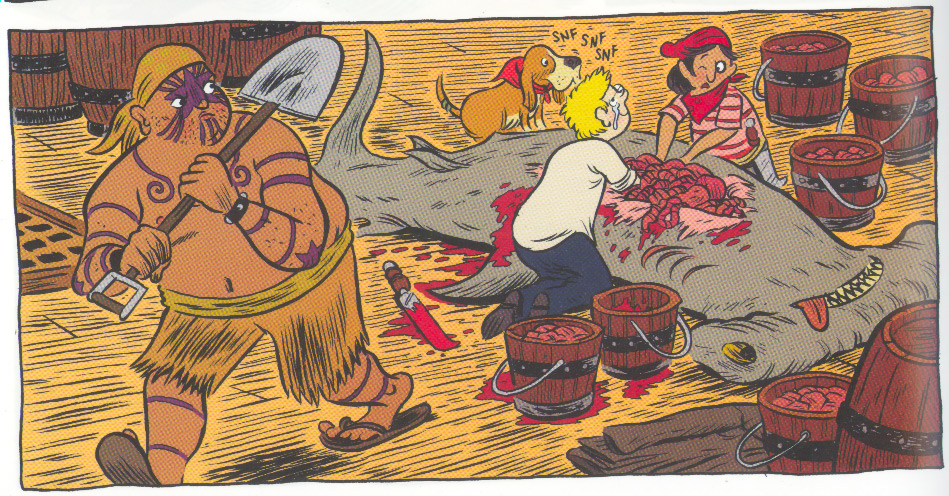
It’s a different Moby Dick character, though, that I’ve been thinking about comics-wise of late: Queequeg, the heavily-tattooed South Pacific Islander who’s the chief harpooner aboard the Pequod. Much to my delight, there’s been an explosion of nautical-themed graphic novels of late, and it seems like it’s now almost required that if you’re going to do an 1800s nautical book, that you’ve got to have a character who’s a Queequeg homage. Here, for example, is a Pacific Islander character from the great all-ages nautical adventure The Unsinkable Walker Bean:
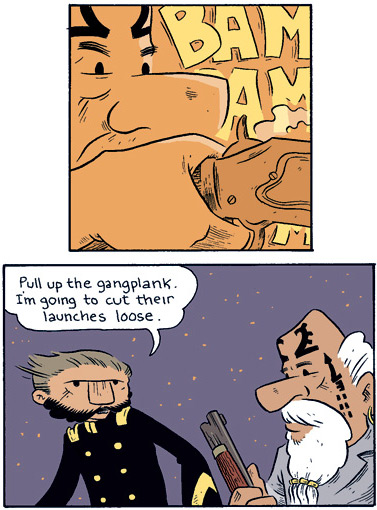
And of course, there’s my own personal homage to Queequeg, Tevia from my Oyster War webcomic:
I only recently learned, though, that the character Queequeg himself was a bit of an homage–to a real person.

I just finished reading Nathaniel Philbrick’s Sea of Glory, a really great history of the U.S. Exploring Expedition. The Ex. Ex. (as it was called) was a truly spectacular globe-spanning surveying and exploring expedition that took place from 1838 to 1842. The Ex. Ex., though, was mired in controversy almost from the moment planning stages began and it has since been largely lost to history despite its many remarkable accomplishments, among them the exploration and mapping of nearly three hundred Pacific islands, mapping over eight hundred miles of the Oregon coast, the recovery of over 60,000 bird and plant specimens, and the eventual founding of the Smithsonian Institution.

Interestingly, though, Herman Melville was apparently very influenced by Charles Wilkes’s (the Expedition’s leader) written account of the expedition, Narrative, written in 1845. While Sea of Glory points out a number of things from the expedition that appear directly or indirectly in Moby Dick (and apparently this is common knowledge among Melville folks–hence the “not so” in this post’s title) as a cartoonist I was particularly interested to hear how influential one of Narrative‘s illustrations was–that of an islander encountered by the expedition  that was apparently the origin of Melville’s character Queequeg. Thanks to the magic of Google Books, here it is:

I found this really fascinating partially because it makes a sort of “full circle” with a drawing influencing a prose novel which then influences (cartoonists’) drawings. Also, though, it’s an interesting example of  image as inspiration. Conveniently forgetting that the near-total separation of words and pictures in literature is a relatively recent phenomenon, many people tend to make a hierarchical division between them with words being the inspiration and pictures being illustrations of those words.  But here’s a great example where one of my favorite characters in one of my favorite prose books has his origin squarely in my “home turf”: drawings.

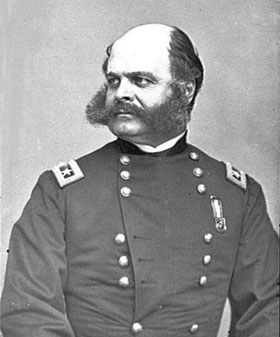
Portrait Night 6/28 (Ambrose Burnside)

Tonight’s #PortraitNight subject is Union Army general Ambrose Burnside. If I get flack for being from the South and drawing a Union officer, I’ll edit with Photoshop and add “stink lines.”

If you’d like to suggest a #PortraitNight subject, you can do so either via the comments section here, or via my Twitter.

M is for Mandarin Duck

“M” is a pretty rich letter animal-wise. I went with the mandarin duck mainly because of my love of the children’s book The Tale of the Mandarin Ducks. It’s for sure a lot of fun to re-read books from my own childhood (George and Martha, Tomi Ungerer’s stuff, Sendak, etc.) with my daughter, but I also really enjoy discovering great modern kid’s books and the Mandarin Ducks is one of them. In typical online review fashion, there are a million reviews of this book out there–none of which include a single image other than the cover. The artwork though is quite beautiful and the story is touching yet not cloying or patronizing in the way modern kid’s books often can be. Anyway…

You can follow the other “M” entries as people post them to Twitter this morning by following the #AnimalAlphabet hashtag. To see all the entries so far, check out the Animal Alphabet Tumblr: http://animalalphabet.tumblr.com.

M is for Mandarin Duck


The original art for this is for sale here.

Playing With Watercolors

(Sorry about the bland title; I’d considered titling this post “Catch the Water in your Magic Paintbox,” which is a line from the totally hilarious psychedelic rock song “Rainy Day Sun” by Spın̈al Tap, but that song’s off their second record and I don’t think anyone other than me actually bought it.)

Anyway… Here’s the deal: I don’t know how to paint. I took an introductory painting class in college, but it was taught by one of those artists who just gives you a brush and basically says, “now, go ‘express yourself.'” So, I never really learned the basic mechanics of color theory, color mixing, etc. I really did, though, want to know that kind of stuff. I’ve learned a lot about color theory by reading about/studying it independently and, of course, by doing lots and lots of digital coloring of my own work and of freelance work.

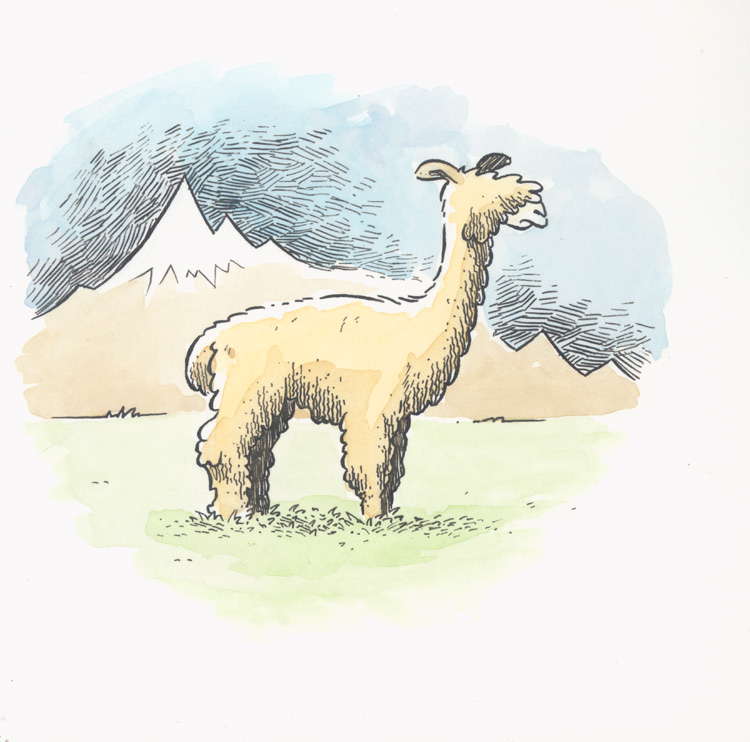
To learn about actual paint, though, you’ve gotta paint. I initially bought a “how to” book about watercolors, but I’m really not a person who learns very well that way; I need a project, a problem to solve. So, when Rob Ullman and I brewed up this Animal Alphabet project, I decided that I’d do them all with watercolors, hopefully learning a bit about watercolor painting in th process. Here’s the first one, an alpaca:

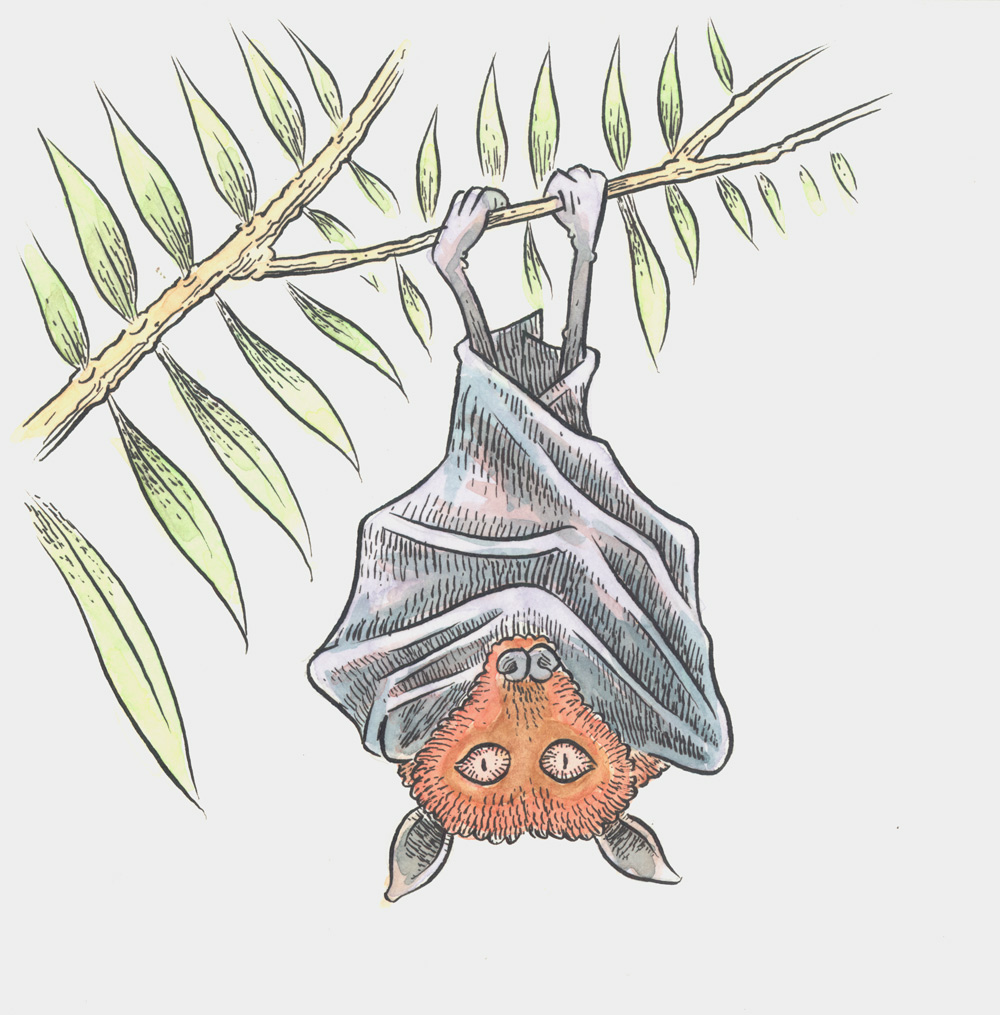
At this point I was painting with one of those cheap plastic pans of watercolors you can get for five or six dollars at a Michaels or A. C. Moore. A few letters into the project, though, I found myself in Toronto for TCAF (a fantastic yearly comics festival) without my watercolors. I needed to complete the “F” entry while there because it was due Monday, the day after the show, so I hoofed it up to Curry Art Supply in Toronto and bought one of these nice little travel watercolor kits:These are obviously much nicer paints and you can really see the difference in the level of pigment here in the first animal I did with them, the flying fox:
I’m not sure that I’m getting a whole lot better technique-wise, but I’m really enjoying messing around with watercolors–enjoying it so much that it’s seeping over into my non-Animal Alphabet work. Here, for example, is a recent painting of Bob Dylan I did for my Portrait Night. I’ve ditched the India Ink outlines all together in this one:

For casual drawing in my sketchbook, I’m tending to use just a basic wash. Since I work in my sketchbook downstairs in the living room (not in my studio), I don’t want to have a whole ton of messy materials out. For a basic wash, though, I can just mix of a small jar of gray or sepia wash and leave it downstairs. Here’re some sketches of hands and safety glasses (sorry about the stuff bleeding through; I work on both sides of each page):

I do occasionally bring the watercolor travel set downstairs and work with it. Here are some hand drawings with two color washes:

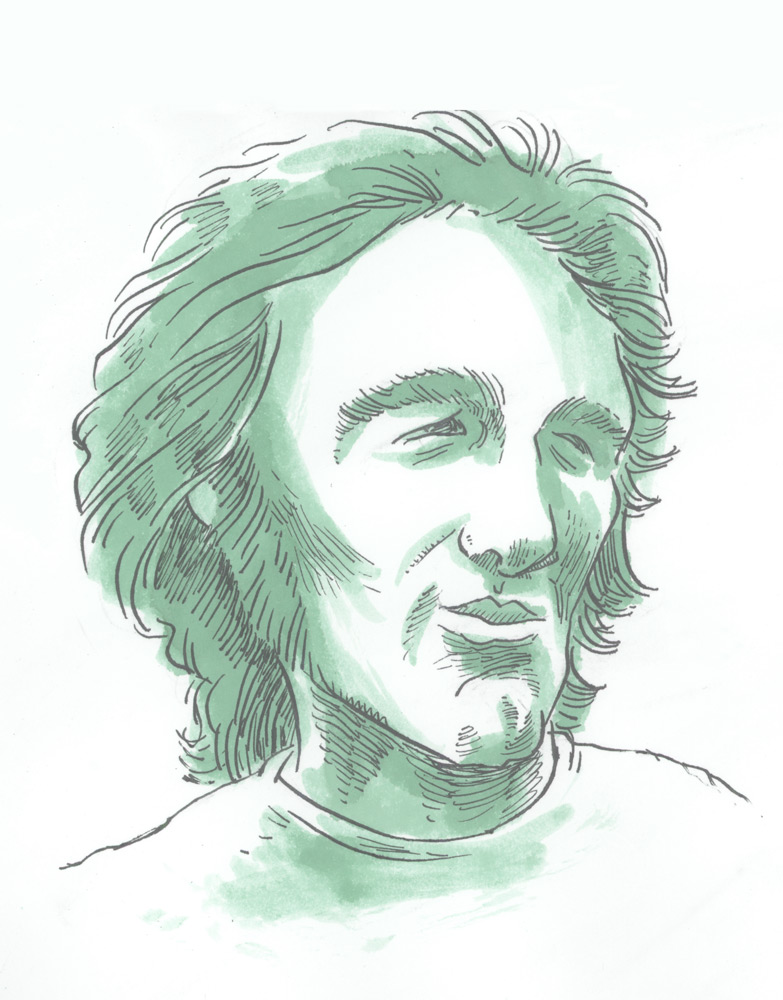
I recently incorporated some watercolor wash into a sketchbook exercise I do occasionally: ten-minute portraits. Facial likenesses is a real weak spot of mine, and this is one way I’m trying to address it. I give myself a nine-panel grid on a sketchbook page, and then using a timer try to do a likeness from a photograph in ten minutes. The basic breakdown is: pencil sketch – five minutes, inking – three minutes, watercolor wash – two minutes. Here’s a grid of them taken from a book about the U.S. Civil War (or, “The War of Northern Aggression” as we say in these parts.):

(None are very good likenesses, but for what it’s worth, left-to-right/top-to-bottom, that’s: Sen. John C. Calhoun, Andrew Jackson, Sen. Henry Clay, Gen. George Picket, Jefferson Davis, Ambrose Burnside, Frederick Davis, Sen. John B. Gordon, and Dorthea Dix.)

Incidentally, using watercolor for sketchbook work has necessitated a pen switch. If I’m working in pen in my sketchbook, I usually use a Rotring Art Pen, which is just about my favorite drawing tool. Here’s one:

The one thing I don’t like about this pen, though, is that you can’t use your own ink in it and the ink that comes in the cartridges it takes isn’t waterproof–so you can’t do any sort of wash or water-based anything on top of it.
I happened upon this Tachikawa  “School G” pen over at JetPens.com (amazing site for all kinds of pens, by the way) and it looked like it might be my “holy grail” pen: a flexible nib drawing fountain pen that uses water-fast ink. Is it? Well, not exactly. I’ve gotten used to it, but it has a few drawbacks. For one, it’s a very tight nib–much tighter than the Rotring and much tighter than an actual dip G-pen nib. Also, the ink it takes is apparently some “fast drying” formulation and as a result the pen tends to (a) dry up if you don’t use it every day, and (b) have inconsistent ink flow when you first start using it.

I’ve gotten used to the tightness of the nib (although the Rotring is a far better-feeling pen and I’ll continue to use it for anything that doesn’t need to be water-fast) and neither of the other two problems I mention are deal-breakers. With (a), you can just dip the pen in some clean water and it will restart; for (b) you just have to scribble with it for a while to get the ink flowing.

Moving forward, I think I need to get less “washy” with my watercolor painting. I recently saw an exhibit of original art from the Curious George children’s books and one thing that really struck me was how rich and saturated those illustrations are. I wondered if they might also have been combinations of watercolor and gouache. Speaking of which, that’s yet another painting thing I need to learn how to do…


http://static1.jetpens.com/images/a/000/013/13122.jpg

Portrait Night 6/21 (Dennis Wilson)

Tonight’s #PortraitNight subject is The Beach Boys’ Dennis Wilson. This is the second–and only slightly less terrible–of two finished sketches I did of him. I could probably get a decent likeness with another iteration or two, but there’s a point at which I’ve got to just draw the line time-wise for these sketchbook exercises.  My apologies, folks!

Anyway… Dennis didn’t write or sing many Beach Boys songs and none of his songs were big hits for the group. Two of my absolute favorite Beach Boys songs, though, were sung and co-written by Dennis: “Little Bird” from the 1968 album Friends, and “Forever” from the 1970 LP Sunflower. Dennis doesn’t have a “good” voice in the classical sense, but his vocals have an amazing emotional frailty that reminds me a little bit of Chet Baker’s voice.

Dennis is also clearly the coolest Beach Boy: (1) He’s the only one that actually surfed, (2) He’s the only one that’s not kinda goofy-looking, and (3) He was in one of the greatest road movies of all time, Two-Lane Blacktop (along with James Taylor and Harry Dean Stanton!).

If you’d like to suggest a #PortraitNight subject, you can do so either via the comments section here, or via my Twitter.