OK, before you call me on suddenly deciding that last names are now legit for my Alphabooks entries, note that “Mi” in the novel Planet of the Apes is a fictional honorific, like “Dr.” or “Mrs.” In the book, the character is referred to as “Zaius” or “Mi Zaius” throughout. Anyway…
Z is for Mi (Dr.) Zaius – from Planet of the Apes by Pierre Boulle
 Planet of the Apes–or La Planète des singes, in the original French–is one of those rare examples of a mediocre book that gets turned into a really great film. I read The Planet of the Apes because I’m a big fan of the film and I was curious about the source material, and because the other Pierre Boulle book I’d read–Bridge on the River Kwai–was great. Sadly, Planet of the Apes is not a very good book. It has a “twist” ending so terrible it’d make William Gaines blush. (As I’m sure you recall, the 1968 film has a pretty great twist ending; the lame Tim Burton remake preserves the original book’s ending, as I recall.)
One part of the novel’s twist ending, though, I find interesting as a comics-maker. The book is set up with a framing story in which two characters, out on a space cruise, find a “message in a bottle” that contains the story of a human astronaut who lands on the ape planet. One of the framing story characters reads the story and that narration is the bulk of the novel. One of the reveals (and don’t read further if you’re considering actually reading the book) is that at the very end of the story we realize that the framing story characters are themselves apes.
What interests me about this is that this is exactly the kind of thing that’s virtually impossible to do with comics. Because comics is a visual medium, you have to show something on the page. Boulle here simply avoids concrete visual description of the characters until the very end of the book. You can’t really do that with comics very effectively. In this case you could try all caption boxes and never show the speakers–but that unconventionality in and of itself would tip your hand to any astute reader.
The “untrustworthy narrator” is a literary technique that’s fairly common in literature (Nabokov’s Lolita is maybe the most well-known), but it’s one that’s difficult to explore in comics. Really the only person I can think of off the top of my head who explores this territory is Dan Clowes. David Boring has some aspects of untrustworthy narrator to it as I recall.
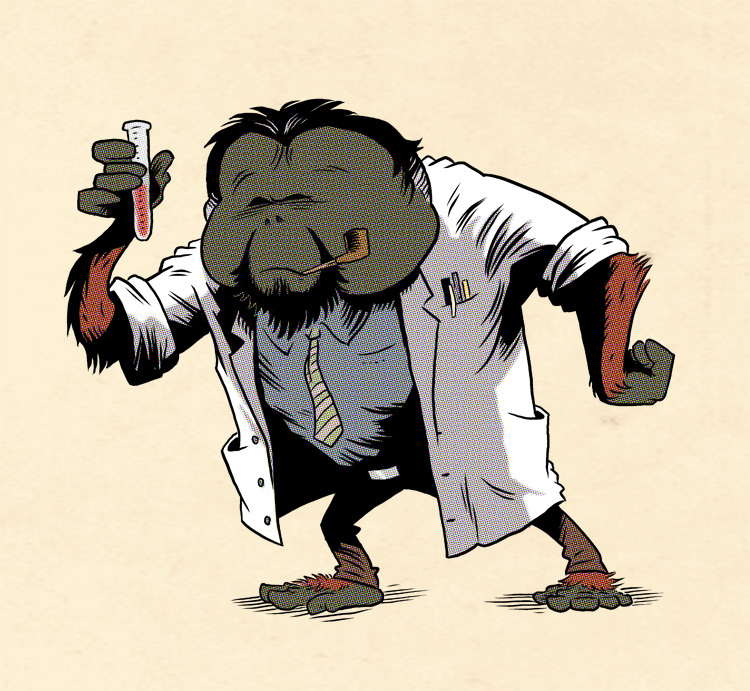
As for the design here: in the films–for obvious practical reasons–the apes had human bodies with different ape heads/faces. In the book, though, the apes are simply apes, as I recall. So, here I did Zaius with basically a standard orangutan body. Also, unlike the somewhat primitive looking villages from the Apes films, the ape culture in the books was identical to modern cities. “Modern” when the book was published was 1963, hence the Reed Richards-esque lab coat and pipe. The book specifically mentions that the apes dressed identically to humans other than wearing gloves on their feet, but I forgot about the gloves thing until I was pretty much done with the drawing.
I initially did him with human-like black hair, but then I modified him a bit to get the image above. Here’s the original:
 Next week: Nothing! Congratulations AlphaBooks people!
You can find all the AlphaBooks entries to-date at the AlphaBooks tumblr: http://alphabooks.tumblr.com. You can also follow many of the entries as they’re posted in real-time by following the #AlphaBooks hashtag on Twitter on Mondays.

 A week or so ago I made my second appearance on the call-in segment of NPR’s music show/podcast Sound Opinions. You can find the show here. I’m at the very, very end of the show–around 59:30 minutes–talking about the influence of Winston-Salem’s own “5” Royales on James Brown’s band The Famous Flames, who were discussed the week previous in the show’s “album dissection” of James Brown: Live at the Apollo.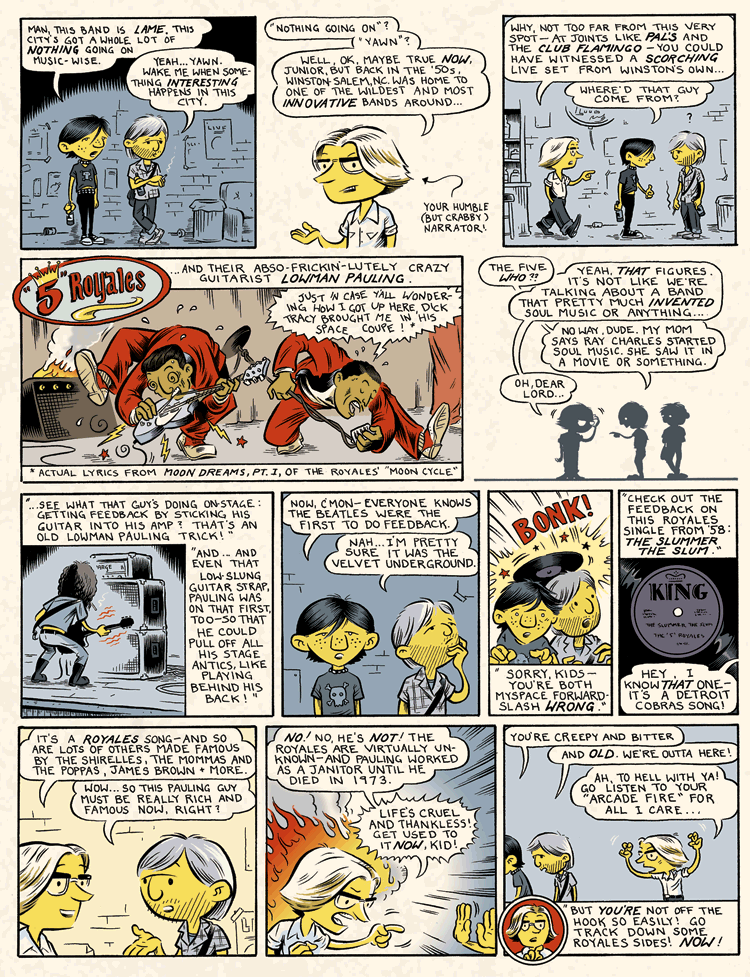






Recent Comments