I haven’t run any reviews here for a long time, mainly because I feel like I don’t have enough time to really dig in and do anything substantive. Here, though, are just a few quick thoughts on some recent reads:
Three Recent Comics Biographies
Crockett Johnson and Ruth Krauss: How an Unlikely Couple Found Love, Dodged the FBI, and Transformed Children’s Literature by Philip Nel

Nel’s biography of Branaby cartoonist Crockett Johnson and his wife, children’s book author Ruth Krauss, is a straightforward and thorough birth-to-death biography of the couple. In that respect it’s sort of a polar opposite of the last big cartoonist biography I’d read, the David Michaelis Charles Schulz biography, which is a prime example of a biography that starts out with a “thesis” and then sets out to back that thesis up with selective biographical facts.
If anything, Crockett Johnson is enough of a non-controversial, likable figure that there’s not much in the way of drama to latch onto here. Despite the book’s title, neither Johnson nor Krauss were ever in any real trouble with the FBI, but were merely persons of interest because of the folks they associated with during the McCarthy era. As Dan Clowes remarked at last year’s SPX panel discussion about Johonson, “It’s the only cartoonist biography I’ve ever read where I didn’t wind up hating the guy afterwords.”
Nel’s unearthed some really interesting stuff here, though. For example, there’s a sample comic strip written by Johnson and drawn by Jules Feifer included. This was apparently from a rejected submission they had put together for a syndicate. There’s also a tantalizing mention of a now-lost Barnaby T.V. pilot featuring Ron Howard, Mel Blanc and Bert Lahr. The most fascinating thing in the book to me was the relationship of Johnson and Krauss to then-young Maurice Sendak. Nel digs into this and manages to give us a really insightful and nuanced look at what was obviously a very complex–and occasionally charged, at least in the case of Krauss–relationship.
This thoroughly researched biography is a much needed addition to the growing body of cartoonist biographies. Johnson’s Barnaby, while never hugely popular, was quite influential–as evidenced by the Chris Ware-drawn cover–and I believe this is the first and only biography of Johnson.
The only real complaint I had with the book was that I really wanted to see more images of the work being discussed. The book has black and white images scattered throughout, but I would really have loved to see a ton more of the stuff that’s mentioned in the book, perhaps just via an accompanying online source, a la Sean Howe’s Marvel Comics: The Untold Story tumblr.
Hergé, son of Tintin by Benoît Peeters

This is, again, a fairly straightforward survey of a cartoonists life from childhood to his death. In this case, though, there are a few additional things factoring into the work: first, the subject, Tintin creator Hergé, is a figure both well known and controversial. Also, the author of the biography, Benoît Peeters, is himself involved with comics–he’s the writer of the acclaimed Les Cités obscures graphic novel series.
With regard to the first, Peeters doesn’t shy away from Hergé’s most controversial aspect: his work at Le Soir, the newspaper in which Tintin was originally serialized, while it was controlled by the Nazis during their occupation of Belgium. In this regard, Peeters paints a picture of a man who, rather than being a willing collaborator, was more likely some combination of self-obsessed, overly-worked, and just plain uninterested in the political goings on around him. It’s a theme that repeats itself throughout the biography–despite Hergé’s undeniable contribution to the comics art form and to European culture in general, on a personal level he’s a deeply flawed character. I found myself almost wishing he was more the man he was accused of being–a collaborator, a racist. At least then he’d be a figure who was passionate about something. Instead, we see a man who’s mopey, self-obsessed, unhappy in the midst of success, insensitive, and a philanderer.
Peeters’ intimate familiarity with the comics-making is one of the more vexing aspects of this book. On the one hand, he’s able to discuss the technical details of Hergé’s process with the kind of authority that’s essentially non-existent in biographies written by non-cartoonists. On the other hand, each such discussion made me long to actually see the page or panel being discussed–there’s not one single illustration in the entire book. To be fair, Peeters is also the author of Tintin and the World of Hergé: An Illustrated History, which is rich with images and illustrations. Again, though, with the internet offering a cheap and easy to post color images, I really think some ancillary website/blog would have fleshed out the reading experience here.
Al Capp: A Life to the Contrary by Michael Schumacher and Denis Kitchen
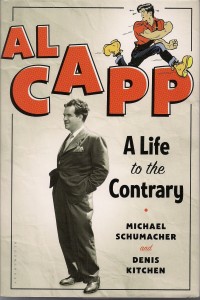
The ambivalence you’ll likely feel about Hergé a personal level after reading his biography is nothing compared to the impression of Li’l Abner cartoonist Al Capp you’ll walk away from after reading A Life to the Contrary. Capp appears to have been an abject schmuck from day one and the eventual fame an fortune he’d acquire only exacerbated his already-dubious (lack of) morals. I have to admit, I’ve read very little L’il Abner–and I honestly don’t think I’d really be able to do so now without Capp’s personality and personal history clouding my reading of the strip.
On the other hand, though, the fact that he was such a colorful (that’s putting it kindly) character makes his biography a compelling read. His feuds, both real and staged, with other cartoonists are now legend and are a blast to read about. (Although, it must be said that his most notorious feud, with cartoonist Ham Fisher, came to a tragic end.) He was also a brilliant and 100% shameless self-promoter that makes current internet self-promotional types look like small time players. Even his training in art is hilariously rich: he attended a series of art schools–one semester each–by scamming each of them with the promise of a (fictional) relative who would (supposedly) be picking up the tab.
For whatever reason, this book seems to paint a broader picture of the general cartooning climate of the time than either of the other two do. It’s really fascinating to become immersed in an era when newspaper comics were so culturally relevant in the U.S.–and when the people who drew them were superstars. (In fairness, the Johnson/Krauss biography is only partially about comics–Crockett did just a few years of Barnaby and he and Krauss did children’s books thereafter–and the comics “scene” in Belgium during Hergé’s time wasn’t anything like the heyday of American newspaper strips during which Capp was active.)
It’s probably safe to credit cartoonist/publisher Dennis Kitchen for the relative wealth of images in the book. For example, we are provided with the L’il Abner panels in question from an episode where Capp’s rival Fisher anonymously submitted doctored L’il Abner panels to his syndicate and to the courts, claiming the strip contained obscene imagery. The book benefits as well from a section of color images and photographs.




Recent Comments