Winter Wuf-Fest ’05

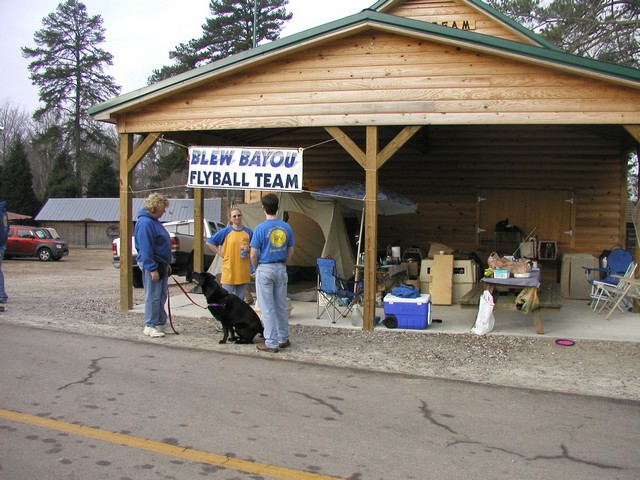
Katherine and I have just returned from Raleigh NC, the site of the Winter Wuf-Fest flyball tournament. I’ve posted some pictures from the event at the top of my photo gallery page:

Winter Wuf-Fest ’05

BBY campsite
(Click for larger image)

The pail’s progress, pt 6

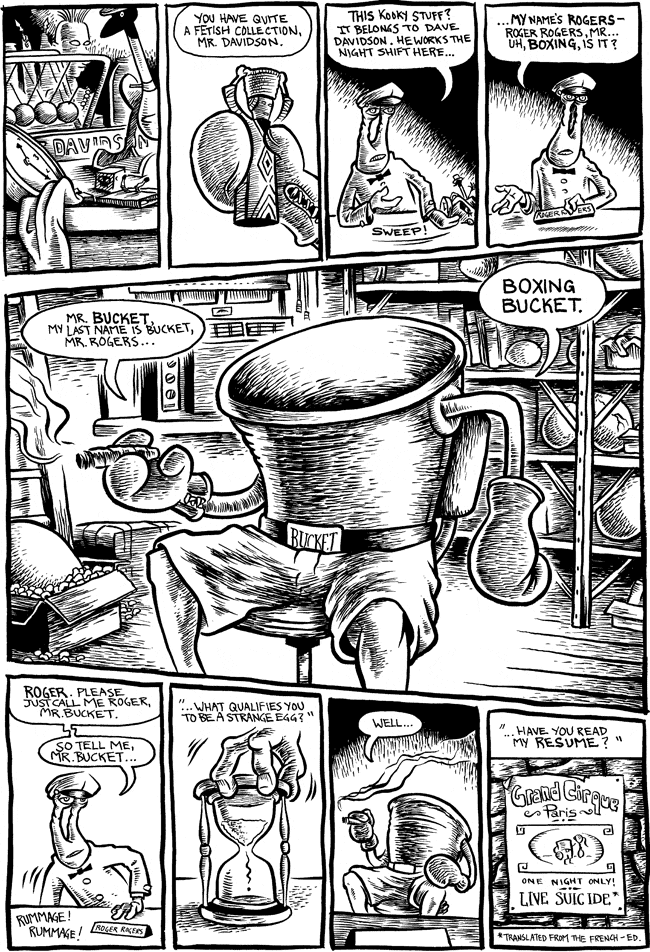
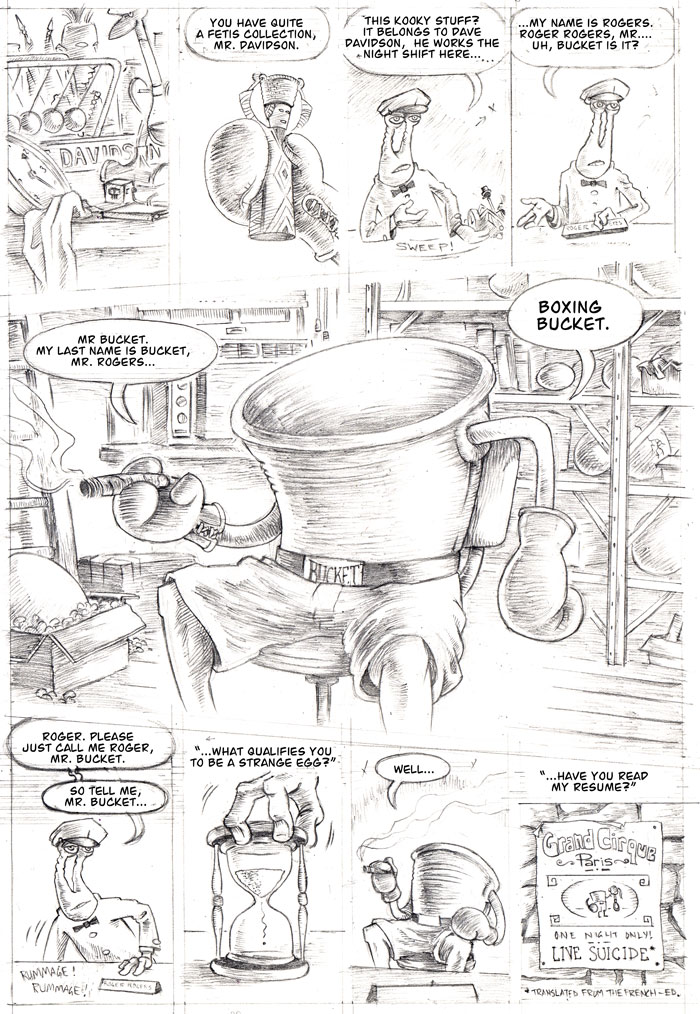
Well, here’s the final inked page. I still don’t like the way the first panel turned out, but at this point I’ll chalk it up to a learning curve since I’m attempting an inking style that’s somewhat new to me. Depending on how I feel about it once all four pages are complete, I may go back and redo it yet again.

I’m pretty happy with the way the rest of the page turned out. I wound up doing most of the outline drawing with a #3 brush and I did all the hatching/stippling with a Hunts 108 nib. This is the first time I’ve done any work that required using the quill so much, and I wound up enjoying it after I got used to it. You have to reload the nib with annoying frequency, and have to be very careful not to smudge the ink, since a quill lays down a lot of ink (relative to a brush) and it stays wet a lot longer.

I drew this page at 190% of final printed size, which is the size at which I usually work, but I think that if I do another story inked this way I’ll reduce that and work a lot closer to actual size–like maybe 135%–in order to be sure that the hatching detail doesn’t get lost in the reduction or reproduction steps. For consistency’s sake, though, I’ll do the rest of this story at 190% and hope for the best.

bucket pg 1 inked
(Click for larger image)

The pail’s progress pt. 5

Normally I wouldn’t start inking until I had all of the penciled pages of the story done, but just for the sake of this experiment I decided to go ahead and ink this one page and see it through to completion.

I pretty much always start inking with a brush, then fill in smaller details with pen or crow-quill–then do shading either with crosshatching or with a duotone overlay of gray. I had it set in my min, though, that for this story I was going to attempt a Robert Crumb-style inking job using only pens, and a lot looser hatching than in normally would.

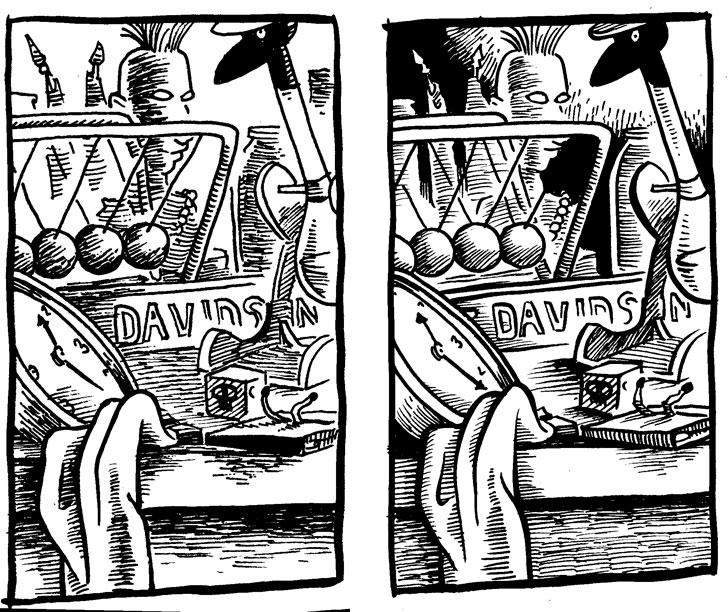
The results of this on the first panel were, unfortunately, very poor (shown on the left of the image below). So poor, in fact, that I wound up scanning the panel into Photoshop, converting the black ink to a non-photo blue, then printing that out and re-inking it with a brush in my more natural style (shown on the right). This is a pretty cluttered panel to start, which is difficult to deal with, so I’m not entirely happy with the results this second time around, but I’m gonna keep going and see how it goes.

panel 1
(Click for larger image)

The pail’s progress pt. 4

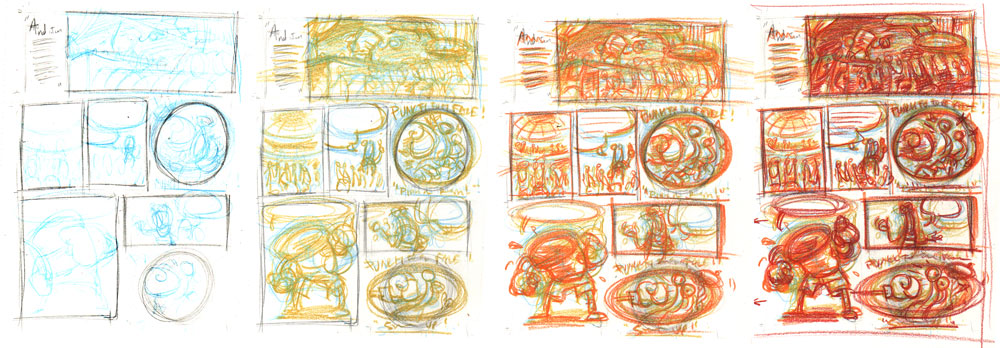
Well, here’s the completed pencils of the first page. This page threw me a few loops, and I’ve wouund up breaking a few generally acccepted “rules” of comics storytelling in order to set this page up the way I wanted to.

First, I’ve made some changes from the script. This isn’t really a “rule” per se…but you generally don’t want to piss off the person whose story you’re drawing. In this case, though, the story and dialog is all pretty much there, but I’ve just chosen to show things a bit differently, as well as having broken the actions of certain single panels down into multiple panels.

The second rule I’ve broken is one to which I’ve always adhered in the past: when showing a conversation between two people, you should always include an image early-on somewhere of the two interlocutors in the same panel, so that the reader really gets the sense that the two people are in the same room, talking to one another. (A great play on this rule, which is generally shared by the film medium, is in Airplane II: The Sequelwhere there’s a conversation bewteen two people that appears to be going on over a monitor, since we never see the two of the together, but which turns out to be between two people right next to each other who are separated by a small window.)

In this case, though, I really felt that the best place for that image (and the place it was called for in the script) would have been the big center image. However, I really felt that the standard way of doing that–a three-quarters/behind-the-head shot of one person, looking toward the other person–decreased the imact of seeing the bucket for the first time. I wanted his whole body shown and nothing else. Also, I plan to use the called-for shot, a profile of them face-to-face, as the “payoff” panel, after the bucket tells his story.

The other rule is the so-called 180-degree rule, which I flagrantly violate all the time. Its origin is in film, and I generally ignore it because, frankly, comics and movies are two different things.

So, here’s the page, with computer lettering added on top so you can follow the action (although I’ll actually hand letter the final page):
Bucket pencils
(Click for larger image)

Comic Book Pioneer Will Eisner Dies at 87

Comic Book Pioneer Will Eisner Dies at 87

Anyone interested in comics and its history should be saddened by the passing of this great artist and advocate for the medium.

The NPR story above is significant as well in that it’s the first time I can recall that something notable has happened in the comics world and they’ve called someone other than Art Spiegleman to comment on it–in this case Michael Chabon. While Chabon’s connection to cartooning is somewhat tangential, I suppose we should be glad that the “comics” section of NPR’s rolodex now has not one, but two names in it. My personal nerd-alert© suggestion for commentator would have been either Neil Adams, who borrowed heavily from Eisner, or Frank Miller who swiped a lot of style both from Eisner and Adams.