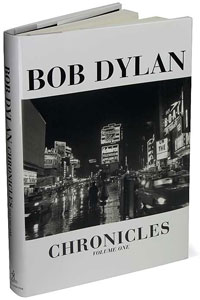
I recently finished reading Chronicles Vol I by Bob Dylan, which my Mom gave me as a present. I’m probably not typical of the audience for this book: I’m too young to have been around in the 60s for Dylan’s heyday, and I’ve never had a real “Dylan phase” like many folks. I do like some of Bob Dylan’s music, but certainly not the records that most die-hard fans would site as their favorites. I find most of his folk/protest music from the 60s sort of silly, particularly since this was the period in which his faux-Woodie Guthrie schtick was at it’s height, but I do really like some of his later records, in particular Nashville Skyline and his recent record Love and Theft.
All of the above would seem to make this book a difficult sell for someone like me; however, in his autobiography Dylan has deliberately avoided discussing precisely the time period his most avid fans likely want to hear about: the sixties. The book opens as he’s hitting the folk scene in NYC in the early 60s, then just as he’s about to hit the big time with “Blowin’ in the Wind” and all that stuff, the book jumps forward in time to the making of his “comeback” record Oh, Mercy in the eighties. For me, this wasn’t a big deal, but I can certainly imagine this was a supreme irritation to hardcore Dylan fans world-wide. The making of Oh Mercy comprises almost a half of the book and it gets somewhat tedious at points. Part of this is likely personal, a result of my strong dislike for the record’s producer Daniel Lenois (sp?), whose main talent seems to be burrying otherwise compelling singers beneath a thick lacey coat of new-agey VH1 schlock (most egregious recent example: the now de-countrified Emmylou Harris).
At any rate, as musician’s autobios go, this was better than most that I’ve read. Dylan’s writing is a bit overly-lyrical and over the top beat poet style for a prose work like this, but he occasionally gets of some really memorable passages–which is more than can be said for most celebrity autobiographies. If you want a really good folk musician autobiography, though, skip this and pick up Bound for Glory by Woodie Guthrie. With Dylan’s writing, like a lot of Dylan’s music, you’d be best served going straight to the source, which in both cases is Woodie Guthrie.


Recent Comments