Interview: Comics and Teaching

I was recently cleaning out a bunch of old documents that had accumulated in my Google Drive and I stumbled on this interview that I did a while back about teaching with comics. I honestly don’t remember what it was for–it may have just been an email interview with a graduate student, or something similar–but it dates from 2012. Reading this over now, it seems like the questions have a “comics vs. prose” undercurrent to them that I wasn’t responding to. I’ve never been really invested in any conversation that “pits” comics vs. other media–particularly the old “comics can do X, which movies can’t” saw. Anyway…

  • How where you first introduced to comics?

I guess the first comics I was around regularly were some books of Rupert, a British comics character that my great aunt and uncle had in their house.  I think my great uncle must have brought the books back from Europe when he returned from World War II.  I remember reading those over and over again as a very, very young child.  Around that same time, I would spend time, while my mom was at work during the day, with an older retired couple who lived next door to me; they had some classic strip collections in their house that I used to really like–Betty Boop, Little Orphan Annie, that sort of stuff.

As far as comic books go, the first of those I remember having were the Marvel adaptations of Star Wars from the 70s.  It used to be that comic books were for sale at pretty much any drug store, grocery store or convenience store, so one didn’t really necessarily need to be “introduced” to comics as a youngster; they were fairly ubiquitous.

  • Do you have any experience teaching with comics?

Yes, I’ve taught comics classes at colleges, high school summer programs, community art centers, libraries, and workshops around the country.  What I’ve taught, though, is not so much teaching with comics, but rather teaching studio classes giving instruction on how one creates comics.

  • What do you think is the biggest difference between a comic book and other teaching materials? (i.e. books, novels, pictures)

Well, since I’ve not taught classes in areas other than comics (and a few other art-related areas), I can’t really compare and contrast teaching comics vs. teaching other subjects.  There is, though, certainly some anecdotal evidence from the teaching community that using comics is quite effective with “reluctant readers” as well as with situations like English as a Second Language programs.  Other than the peculiarities of comics’ visual language, I don’t know that there’s any real fundamental difference between using, say, MAUS, as a primary text vs. using a pure prose book.

  • Have you experienced first hand how comics help students?If so, can you explain the process?

The most obvious benefit of teaching comics is really the same benefit you get teaching any narrative.  Again, I don’t think there’s a huge substantive difference between using comic vs. pure prose literature.  It all comes down the quality of the book you chose.  As far as a story of any particular student goes, I don’t know that I have one, but in general I do find that students who are already interested in comics and graphic novels are often quite excited and passionate about studying them since they often perceive them to be worthy of close examination, but rarely find teachers who are willing to engage them in a classroom environment.

  • How effective do you think teaching with comics/graphic novels is?

Again, as mentioned above, I don’t really have a point of reference to compare teaching with comics vs. teaching with other source material.

  • Why do you think this medium is being used more than before in teaching?

I think there are probably two main factors: 1) There is now a critical mass of teachers who grew up reading comics in the post-MAUS comics environment and who understand and appreciate the art form.  These folks have been instrumental in pushing the art form into areas of academic and cultural prominence that they previously would not have been able to make much headway into.  2) There is, combined with this, a generation of students who have grown up in a world that’s largely centered on visual literacy… and many of whom are steeped in the influence of Japanese comics and animation. Also: it would be difficult to underestimate the incredibly important role librarians have played in moving comics into the mainstream as far as reading/teaching materials go in schools.

  • In your opinion, is the comic industry falling, or in the contrary, growing?

My impression is that the portion of the industry that deals with monthly, serialized genre stories (superhero companies like Marvel and DC) are pretty much holding their own, but not really expanding.  On the other hand, I think publishers that publish graphic novels are generally doing really well.  Certainly there are now a larger number of big previously prose-only publishers as well who now have graphic novels divisions.  The publishing industry as a whole is feeling the effects of the current recession, but proportionally GNs are still doing quite well.

  • Do you think that using comics or graphic novels in teaching have a limitation?

Certainly, like teaching with anything else, it’s limited by the quality of the source material.  You’re unlikely to be able to do high quality teaching with a low-quality book, whether a GN or pure prose.

  • What do you think about how people used to see comics in the past and how they see them now?

Comics in the U.S. have been the subject of varying public opinion over the last century or so.  I think that currently they’re accorded higher status than they have been for quite some time among those “in the know”–people up on what’s current in the literary world–and also among people under, say, 20 years of age or so.  I don’t know that your average person on the street, though, (particularly older folks) have much of an association with comics beyond comics-related cultural signposts: Hollywood movies and whatnot.

Oyster War Is Now Complete. A Few Thoughts:

davidson_01

(An early sketch of Davidson Bulloch)

I can’t exactly remember when I started working on Oyster War–I found some initial character drawings in my sketchbook from as long ago as 2008–but I posted the last page, page 128, earlier this month. I say in this post’s title that Oyster War is “complete,” but that’s not entirely accurate; I’m currently hard at work on doing corrections and edits in preparation for a print edition that will hopefully appear in the latter half of 2015. I say “hopefully” because I have not yet signed on the proverbial dotted line. I’m pretty excited about the prospect of a nice print edition of the story and I couldn’t be happier with the publisher I’ve been speaking with. I hope to be able to make an official announcement soon. In the meantime, though, here’re a few thoughts on the whole process of putting together the story, partially just for my own edification, and partially as advice to folks considering beginning a long-form narrative webcomic:

  • Buy a domain name and use it. – For reasons that I can’t now recall, when I first started Oyster War, I decided to host it on Tumblr. Oyster War‘s tumblr URL was OysterWar.tumblr.com, which was well and good until I decided to switch to a different platform. Since that’s Tumblr’s URL not mine, I couldn’t take it with me. If I’d purchased OysterWar.com from the get-go I could simply have re-pointed it to the strip’s new location. In addition to the inconvenience to readers, I wound up stuck with a bunch of promotional materials (mainly bookmarks, I think) with the old tumbrl URL on them that I had to just pitch.
  • Tumblr is a terrible platform for long-form narrative comics. – Tumblr is a fantastic platform for any kind of comic that can be digested in its entirety within Tumblr’s page posting limit–which I think is ten images total per post. It is, though, not a great platform for posting page-by-page stories. The default page width is far too small (something I solved with a workaround), but far more important: navigation becomes extremely difficult once you’ve got a substantial number of pages posted.
  • Use your personal Twitter account for page updates. – I set up a separate @OysterWar twitter account that just posted page updates. My thinking was that some people might want to receive reminders about page updates without being subjected to all of my personal blather about arcane comics-related stuff that they’d get from my personal @ben_towle account. I never really, though, got a lot of followers to the Oyster War account–and a lot of the ones I got were people who also followed my personal account. The appeal of social media for a lot of comics folks is interaction with creators, so give it to them. If they want just page updates they’ll use an RSS reader. I also had a separate G+ Oyster War account–also a bad idea, for the same reasons.
  • RSS is still important – You don’t hear folks talking about RSS much these days, but just anecdotally it sure seems like tons of people who I talk to about webcomics use RSS readers to keep track of their reading progress.
  • Whatever social media you use, you’ll get out what you put in. – I got the most traction on my comic from twitter and Google +. Not surprisingly, twitter and  G+ are the social networks I’m most active on.
  • Post your comic at one website. – By the end of the strip, Oyster War was being posted at three different sites: my own OysterWar.com, on G+, and at GoComics.com. Not only was this a lot of work, but I was likely diluting my audience. Since I was getting paid based on page visits at GoComics, I probably should have redirected OysterWar.com there and just posted links at G+.
  • There’s no easy way to post stuff across multiple social media platforms. – I looked into this several times while I was doing Oyster War and unless I missed some important piece of software, there’s really no easy way to do this. You have to just bite the bullet and do each manually. I posted on Wednesdays and I allotted myself around 40 minutes or so just for posting. I scheduled three tweets each Wednesday on Twitter (from two accounts), G+ (from two accounts), and Tumblr. I also made sure to respond to anyone who replied with comments about the strip and I kept a text file of everyone who RT’d my updates on twitter so I could thank them the next day.
  • Include a picture when you post to social media. – For Twitter and Tumblr, I excerpted one panel from the page I was posting and included it with my page updates. This seemed to get more traction than tweets/updates with just text and a link.
  • Spend some real time doing character designs. – I have a terrible habit of not spending the amount of time that I really should designing my characters and getting comfortable drawing them. Oyster War is no exception. I started doing finished pages before I really had my characters nailed down and I wound up with a lot of “character design drift” (where the character changes appearance over the course of the story) and some characters that I just don’t like that much visually–Tevia and Lourdes are two in particular that I wish I would have done a better job with design-wise.

14

(Top: original panels from early in the strip. Bottom: corrected panels with the character now on-model)
  • Assume that your comic will be printed, Part I. – You may just be planning on throwing some stuff up online and seeing what sticks, but you can make some serious trouble for yourself down the line if you wind up deciding that you want to print your comic if you haven’t been doing some basic “just in case” things. Thankfully, I did the most basic of these with Oyster War–more just out of habit than good planning. Work in CMYK. Exporting CMYK to RBG is a lot less prone to problems than vice versa. Also: work at print resolution. I keep my line art at 1200 dpi and my coloring at 300 dpi. Again, it’s easy to export all that down to 72 dpi for screens… but there’s no way to do it in reverse.
  • Assume that your comic will be printed, Part II. – Some print-prep things that I really should have done, I didn’t start doing until about half way through. I wish I’d done them from the get-go. First: coloring with a K-free palette. Despite Oyster War being my first long comic I’ve done in color, I knew good and well that it’s a best practice to do CMYK coloring with little if any black (K or “key”) values in your colors… but, I foolishly took a “I’ll figure it out later” attitude, and now I’m having to go back and color correct a lot of early pages. I felt especially dumb when I finally decided to remix the color palette I’d been using to get it K-free and it took all of about 45 minutes to do. Other things I should have done from the get-go that are now costing me time: digitally blacking in areas of spot blacks that didn’t scan as completely black, superblacking the color under the line art.
  • Approach the right publishers at the right time. – Publishers tend to be interested in comics at two points: at the very beginning or the very end. Either you’ve got such a great, commercially viable idea that some big trade publisher will give you an advance to get it done (usually this is an all ages/YA book or “graphic novel memoir”), or a publisher will look at your comic once it’s done (or almost done) and decide they’re interested in it. Also, as Chris Schweizer points out so well here, for any given comic, there are really only a small handful of publishers who it even makes sense to approach. I initially took Oyster War at far too early a stage to a (great) publisher that wouldn’t have been a good fit.
  • If you get asked to syndicate your strip at GoComics, do it. – About halfway through the strip’s run, I got invited to start posting at GoComics. If you’re already doing a strip, it’s pretty easy to get set up at GoComics. The pay structure is based around the number of hits your strip is getting, so you’re not going to buy an island in the Caribbean with your revenue if you’re doing a weekly updating narrative comic, but you will make some money.
  • GoComics, Part II. – Really more of a benefit than money, GoComics comes with a built-in, engaged reader base who actively comment on pretty much every update. It’s like having a free editor–or just think of it as a “test run” for the print version. I kept a printed-out binder of Oyster War in-progress, and I made notations whenever dialog or particular scenes weren’t communicating the way I’d intended them to (or even when readers caught typos)–and I’m now using those notes to revise.
  • Pick a Posting Schedule You Can Handle, Then Stick With It. – I got some grousing from my readers about how slowly I was turning out pages, but I felt like it was better to pick a reasonable schedule and then stick to it. I committed to a page every two weeks and once I’d settled on that, I never missed an update. The pages were big, four rows, and full color; they took a while to produce.

ow_bookmark_nomarks

(Promotional Oyster War bookmark)
  • Next Time: Better-Looking Website. – I was never really happy with the look or navigation of OysterWar.com. I could have spent more time trying to get it to look nicer, but frankly I wanted to spend that time drawing. Next time, I’ll probably pay someone to do a custom WordPress design/theme for me.
  • Next Time: Horizontal Format. – I’d imagined Oyster War first as a print book and only after getting about ten pages in did I decide to set it up as a webcomic. The pages are formatted “portrait” for print and don’t read very well on a monitor. With whatever I do next, I’m going to format the pages such that they can be posted  horizontally and then “stacked” for a print edition. That’ll mean having two concurrent “dummies” at the thumbnail stage, but I feel like it’ll be worth it in the end.
  • Next Time: No Adobe Products. – This is more of an ideal than an attainable goal at this point, but I’d love to ditch Adobe products entirely. Their new subscription-based pricing model is loathsome and support-wise they seem to only really care about Wacom-based drawing setups. Photoshop CC 2014, for example, doesn’t do pen pressure with many non-Wacom products and Adobe doesn’t seem to really care. Unfortunately, there’s not a good alternative to PS right now for doing professional coloring for CMYK printing. GIMP’s CMYK support is still fairly rudimentary and Manga Studio has real problems with the way it deals with ICC profiles and exporting to CMYK.
  • Next Time: Digital. – I’m thinking pretty seriously about doing my next book all digitally. I’ve grown to really love drawing in Manga Studio and the time advantages of working digitally would allow me get pages done faster. Maybe I’m not seeing my work objectively enough, but I feel like my digital drawing looks pretty much indistinguishable from my traditional stuff.
  • Next Time: Bigger but Less Frequent Updates? – I know this goes against the grain of most webcomics advice you’ll hear, but I’ve been thinking that the webcomic reading experience for long-form narrative work might be better if I posted short 6-10 page “scenes” every six weeks or so, rather than posting a page/week.

Oh, and one last thing: A big thanks to everyone who read and supported my efforts on Oyster War! All the support, kind words, and RT’s/shares meant a lot. Stay tuned–I’m hoping to be able to release some good news about a print collection soon…

Marvel’s 25th Anniversary, 20/20, and Jim Shooter in the Letters Page

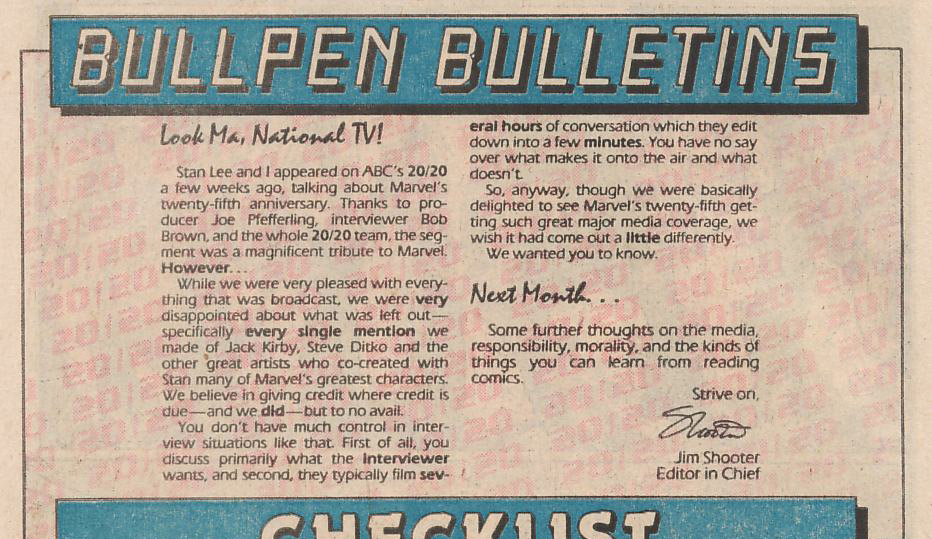
I’ve been reading Michael Golden’s great 80’s Marvel Vietnam War comic, The ‘Nam–something I should really devote a whole blog post to when I’m done–and I’ve been fortunate enough to get a hold of the actual issues, rather than the collected edition. In addition to having the original coloring, the issues also obviously include non-story material like ads and the letters page. The second issue (cover dated January, 1987) contains this fairly interesting notice from Jim Shooter in the letters page–click through for a bigger version:

The-'Nam---02---Dust-Off---24---BB

I was surprised to see the term “co-creator” used so matter-of-factly here… and kind of surprised to see this subject addressed at all, as there’s a long history, even in 1987, of articles and other puff pieces on Marvel that either implicitly or directly claim that Stan Lee “created” the characters that he in fact co-created with folks like Jack Kirby and Steve Ditko.  You can still find the 20/20 segment on Marvel’s 25th anniversary that Shooter is addressing:

SPX 2014

You’d think with me now being pretty much done with Oyster War I’d have time for a big, extensive SPX 2014 wrap-up, but I’ve actually got to jump right into several other comics (and other) projects pretty quickly. But, I did want to do just a quick post–mainly just to show off some of the great stuff I bought at the show.

As with last year, I went to the show this year as a “civilian” and did not get a table. It’s looking like (knock on wood!) I’ll have a book out by next year’s show, so this was probably my last show for a bit where wandering the floor and catching a lot of programming is an option. I caught several interesting panels including the Lynda Barry talk, The John P. panel (which included a screening of a shortened version of the documentary about him, Root Hog or Die), and the Digital Comics panel. My favorite panel of the show by far, though, was the panel on Spanish language comics. You occasionally hear some discussion of Argentinian comics because of the connection with Italian comics, but it was so great to hear folks discuss comics from places you rarely hear mentioned: Columbia, Mexico, Spain (which you’d think would be discussed more with other European comics, what with Spain’s being in Europe and all), etc.

I don’t have any idea how things with sales-wise with the new, bigger floor, but I did observe a few general things just wandering around:

  • The level of quality of work was exceptionally high. There’s always great stuff at SPX, but this year in particular there seemed to be almost no glaringly non-professional looking work on display.
  • People were mostly selling actual comics. There have been years in the past when it seemed like non-comics stuff was in danger of taking over the show: t-shirts, stuffed animals/characters, screenprints, and other crafts. There was a smattering of that kind of stuff throughout, but the bulk of merch at the show was actual comics.
  • There are still a few outlying folks trying sell to straight fantasy and SF genre comics packaged/printed like monthly books from the “big two.” There’s nothing inherently wrong with that, but that sort of material has never seemed to do well at SPX.
  • There were almost no old school black and white foldedover 8 1/2 x 11 minicomics for sale. Other than King Cat and Phase 7 this format seems to have largely vanished. This is a bad thing.
  • There were no carnival barkers. I wasn’t once hit with the “hard sell” as I walked through the floor. This is a good thing.
  • The younger set seemed to really get into the “SPX Prom.” I’m betting/hoping that this will become a regular thing.
  • The level of organization was exceptionally high. This has been the case for the last several years, but it bears mentioning again. The folks who are currently running SPX are doing a spectacular job. The show just gets better and better.

Anyway… I had an absolute blast and enjoyed seeing all the folks that I usually hang with at SPX and I met a bunch of new folks as well. I also managed somehow to completely miss a number of people who I was looking forward to meeting/seeing. I’m gonna do a better job of “making the rounds” next year if I can.

So, on to the swag! I got a ton of great stuff and would have bought more but I was going broke and maxing out my luggage.

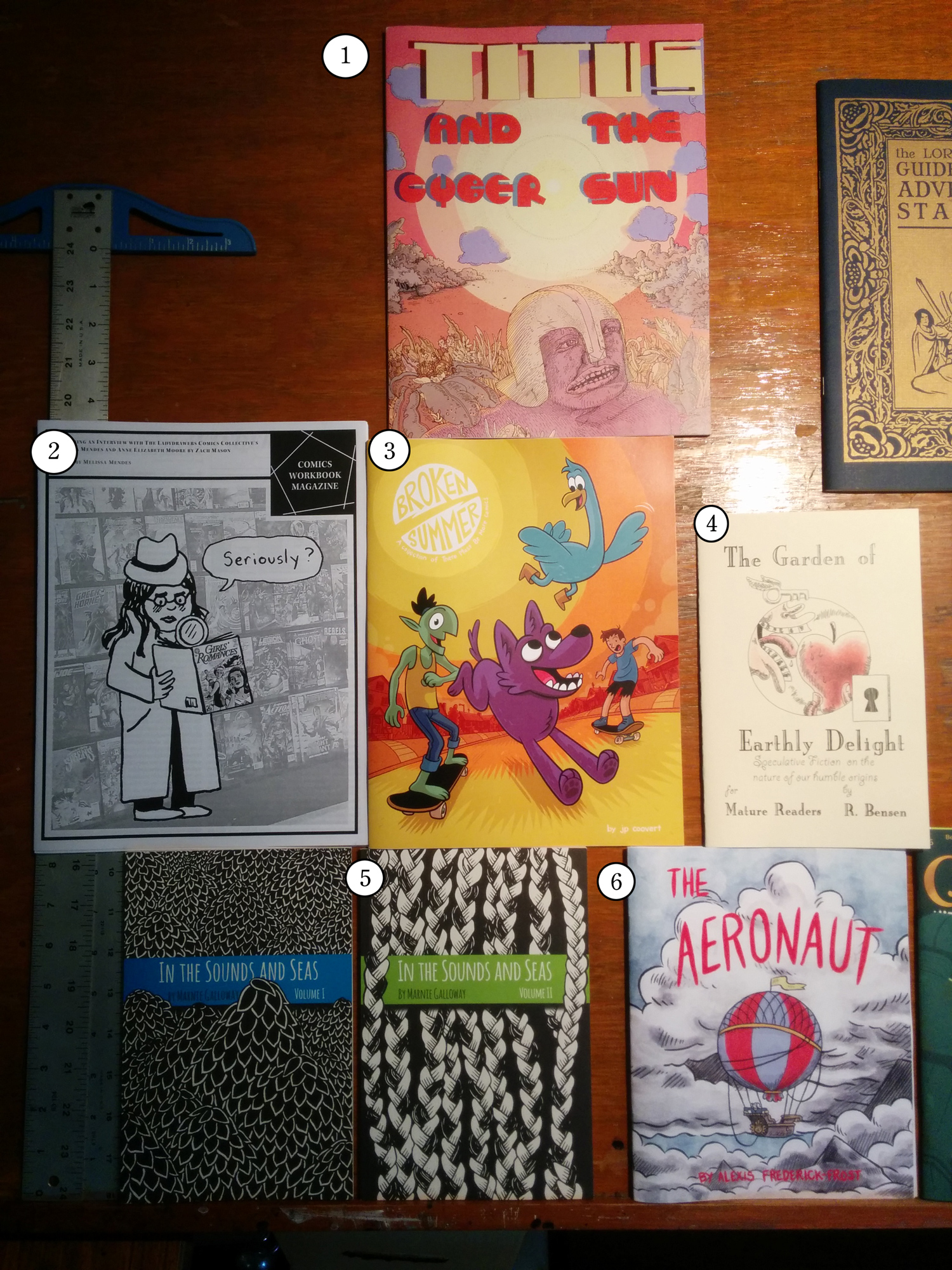
01


1 – Titus and the Cyber Sun/Lale West – Maybe my fave “find” of the show. It’s a big, surreal, wordless comic that’s beautifully drawn with all kinds of great hatching and stippling.

2 – New Comics Workbook magazine.

3 – Broken Summer/JP Coovert – JP’s stuff is always so great. I’m really looking forward to this one.

4 – The Garden of Earthly Delights/R. Bensen – Impulse buy. I flipped through it and really liked the art.

5 – In the Sounds and Seas vols. I & II/Marnite Galloway – Again, I don’t know this artist, but the interior art looked fantastic so I picked both of these up. They’re wordless as well.

6 – The Aeronaut/Alexis Frederick-Frost –  I love Alexis’s art and I’ll buy pretty much anything he puts out. This is the first thing I’ve seen from him in a while.

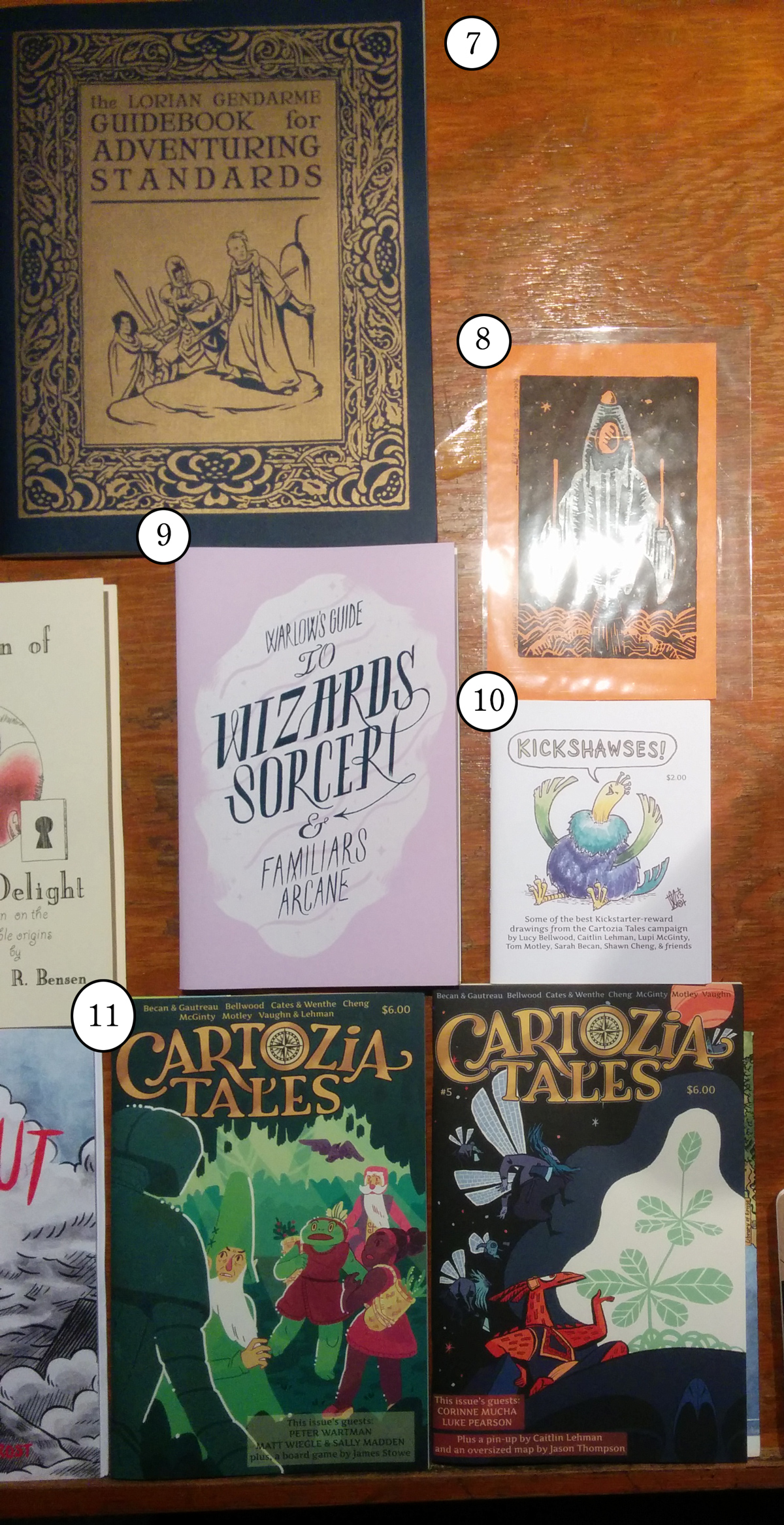
02

7 – The Lorian Gendarme Guidebook for Adventuring Standards/M.K. Reed & Jonathan Hill – This is an adventure manual for an imaginary fantasy world gendarme. I’m a sucker for this kind of stuff.

8 – A little print by J. Chris Campbell.

9 – Warlow’s Guide to Wizards & Familiars Arcane/Andrea Kalfas – A beautifully drawn bestiary/character guide.

10 – A Cartozia Tales minicomic of Kickstarter reward art.

11 – The two most recent issues of Cartozia Tales.

03

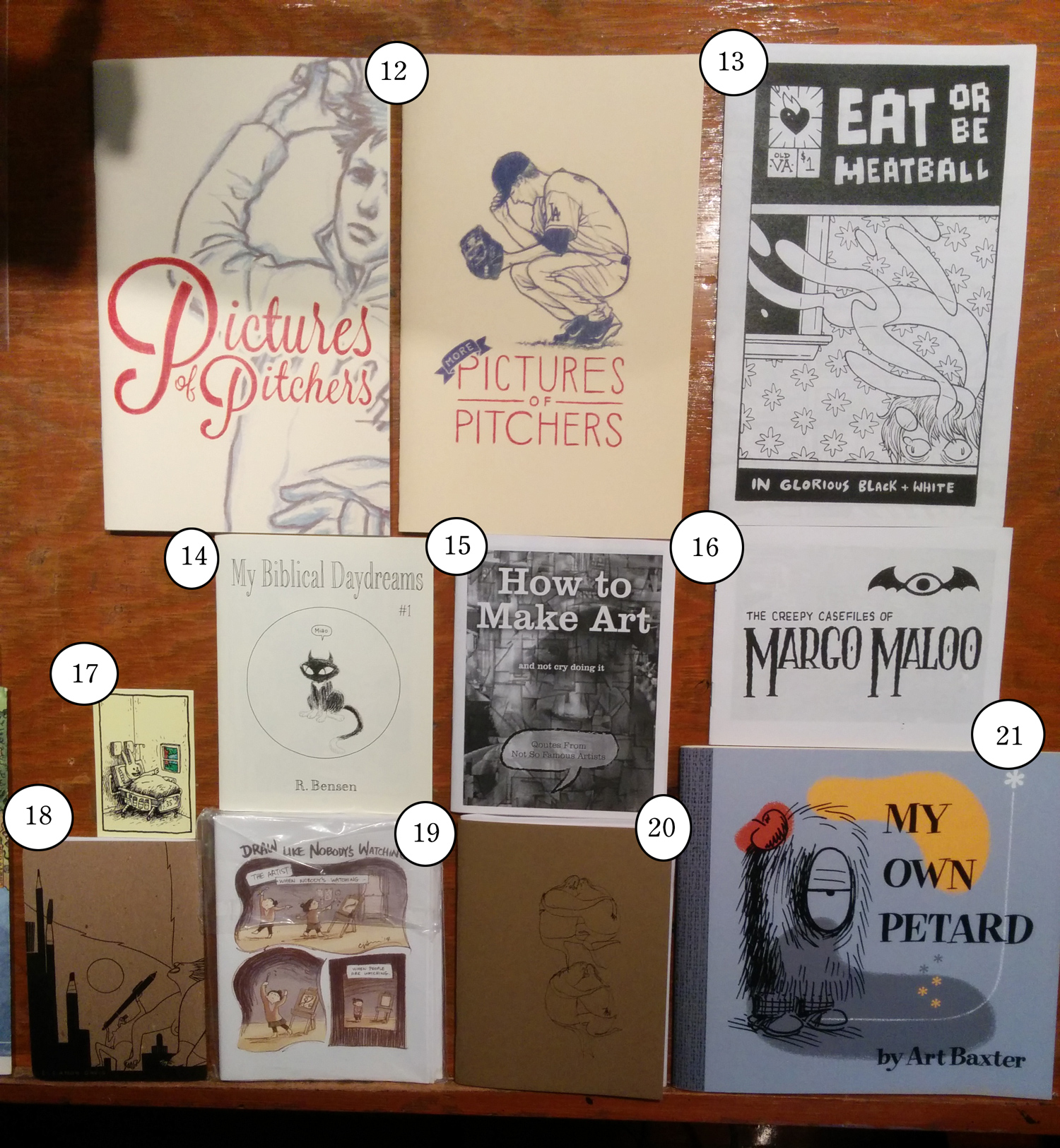
12 – Pictures of Pitchers/Katherine K. Wirick – The title says it all.

13 – Eat or Be Meatball/Liz Suburbia – I love this artist’s webcomic, Sacred Heart, but don’t know her other work at all.

14 – My Biblical Dreams/R. Bensen

15 – How to Make Art/J. Chris Campbell –

16 – Margo Maloo  black and white “teaser”/Drew Weing. This came with a great Margo Maloo business card.

17 – A Josh Cotter sticker.

18 – A little blank sketchbook with Eleanor Davis covers.

19 – Minicomics by Connie Sun – I’ve been reading Connie’s comics on GoComics for a while, but I got to meet her and hang out some at the post-Ignatz party. She’s awesome–and her comics are great!

20 – A sketchbook mini by Eleanor Davis.

21 – My Own Petard/Art Baxter.

04

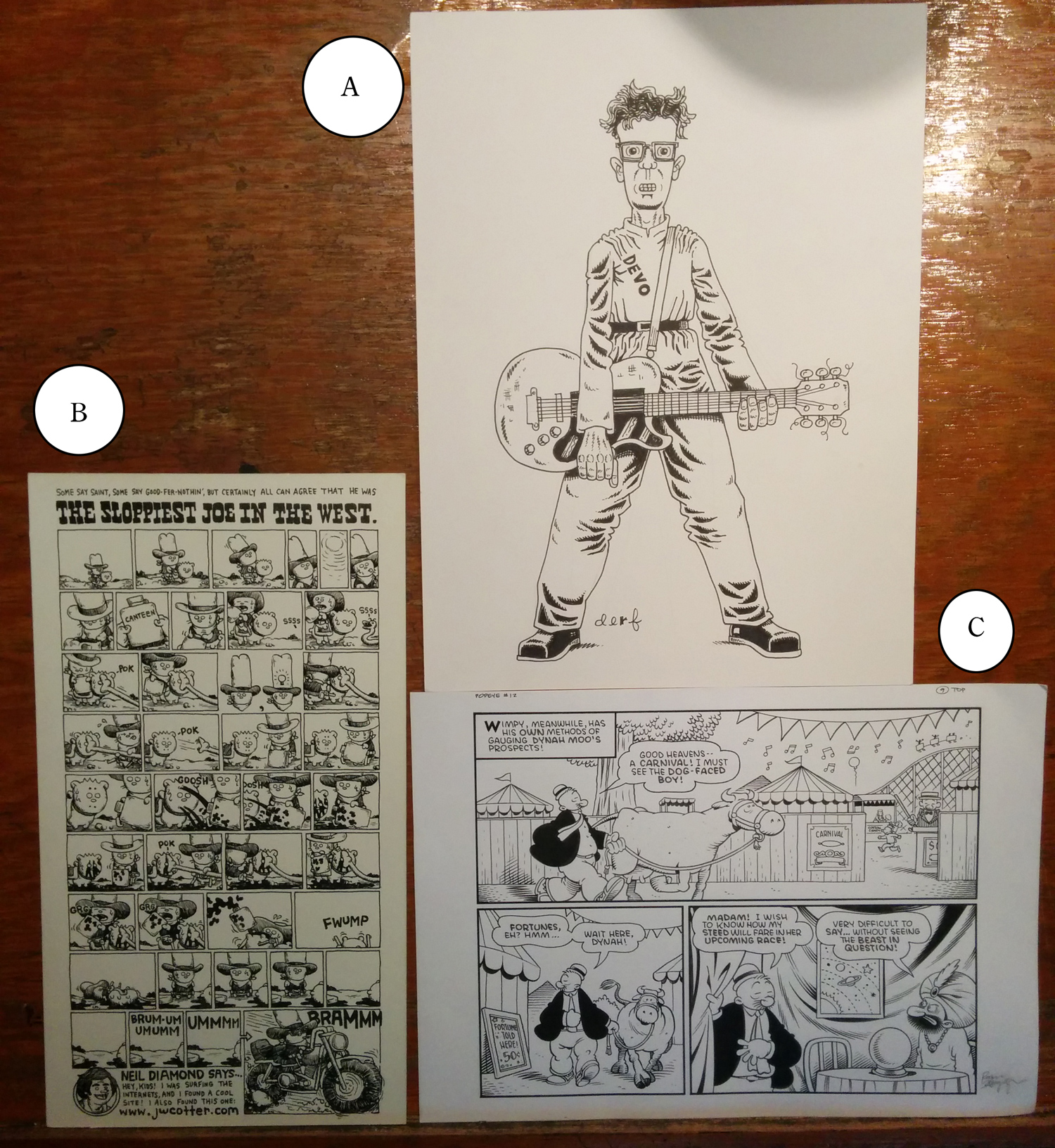
Originals:

A – A Derf DEVO drawing.

B – A Josh Cotter one-pager. (And he had some originals from his in-progress GN with him at the show. That book is gonna be amazing.)

C – A Popeye page by Roger Langridge.


Think of a City

Here’s my contribution to the wonderful Think of a City collaborative project.

tumblr_nbu4u4gne31spy5pdo1_r1_1280

The idea behind the project is that each artist participating draws a cityscape or scene that takes place in a city with his or her contribution containing one drawn element and one color from the previous artist’s submission. There’s some pretty amazing artwork already up on the tumblr. Be sure to click back to the beginning–and keep an eye on it for future submissions every two weeks or so.

If you read my webcomic, Oyster War, you will no doubt recognize this particular city as Blood’s Haven. I thought this project would be a good opportunity to put together a big overall drawing of the city that I could maybe use as endpapers for a print edition of the book. The section you see here is the only portion I colored for Think of a City, but this is only the left half of the actual drawing. I have to admit, I had no overall map of Blood’s Haven in mind when drawing Oyster War, so I had to “reverse engineer” this drawing from the story. I had to flub a few things here and there, but it worked out OK. Maybe at some point when I finish the whole drawing I can post an annotated version that shows what locations correspond to what pages/panels in the story.