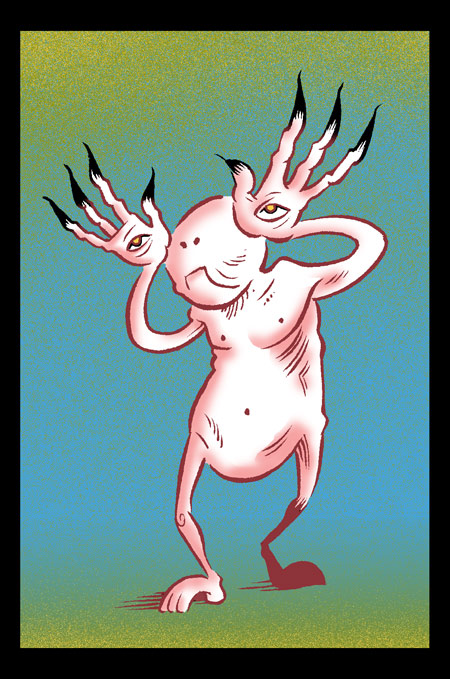
Pan’s Labyrinth

I don’t have the background or expertise to write a film review that would even be considered well-informed (I’m all about the comics, see?…) but I will say that the new Guillermo Del Toro film, Pan’s Labyrinth, is awesome. Go see it.

Given that all of my sketchbook doodles for some reason wind up with goofy Peter Bagge-esque “spaghetti arms” (and the fact that I was drawing from memory), you’ll just have to take my word when I tell you that the creature from the film that I’ve drawn here is actually really, really creepy.

pans.jpg

“Bucky Katt is on Pot”

People these days have a tendency to get irrationally worked up about anything in the comics page of the paper that’s not totally innocuous. Just last week, for example, somebody had written their local paper about a Zits strip that had Jeremy doing the old mentos in the diet coke bit that’s been making the rounds on “the internets” these days. Apparently the writer had never heard of this and thought that Jeremy was shown throwing an actual bomb into the teachers’ lounge, and that the strip was making light of school violence. WON’T SOMEONE PLEASE THINK OF THE CHILDREN?! I can only imagine what this person might have thought of Jiggs and Maggie, or Andy Capp and Flo (although, admittedly, their weaponry was somewhat lower tech).

At any rate, this hypersensitivty is pretty typical of your average suburban newspaper comics reader, which is what makes it so incredibly baffling to me that no one’s even raised an eyebrow (as far as I can tell) about this week’s story arc on Get Fuzzy. On maybe Tuesday or so, Bucky Katt declared that he was running for president, and began debuting campaign slogans to Rob and Satchel. The running gag is that all of the slogans–supposedly unintentionally on the part of Bucky–are obvious pro-marijuana slogans. Here are a few:

fuzzy_3.png

fuzzy_2.png

fuzz_1.png
I say again, WON’T SOMEONE PLEASE THINK OF THE CHILDREN?!

Igor the Cowboy pg. 2

I’ve wrapped up my two page “guest appearance” for the forthcoming sequel to Chris Reilly’s The Trouble With Igor. I’m not sure how successful I’ve been at aping the “bigfoot” cartooning style of the ’20s–in fact, I don’ think I really get a decent bigfoot style drawing of Igor until panel five on page two. One interesting thing, though, about doing this was realizing in a real hands-on way how much the vocabulary of the comics art form came to be influenced by the conventions of Hollywood cinema.

Even at a casual glance, someone with any familiarity with old newspaper comics can tell that this story doesn’t look truly authentic. That’s mainly because the story as written called for–and really required–panel compositions and croppings that would only enter the comics vocabulary later via film. The style I’m immatating–E.C. Segar-ish stuff–was still heavily vaudvillian in most respects and since the artists weren’t thinking in terms of “camera angles” as they so often do today, you almost never saw panel compositions in older comics than didn’t show the entire body.

Interestingly, I also noticed that the “establishing shot” of the General Store which the script called for (in page two, panel one) is something that you don’t see a lot of in older strips, I’m guessing because this visual device doesn’t really have an equivalent in the world of stage, in which characters travel from scene to scene exclusively by means of changes of interior scenery.

On a less analytical note, I also learned that modern Hunts/Speedball inking nibs pretty much blow in comparison to whatever folks must have been using back in the day. I’ve heard some comics folk saying that they’ve switched to using Japanese Nikko G-Pen nibs, claiming that they’re much better made. I’ve added them to my “check it out” list…

Anyway, here’s the completed story. I’m reposting page one since I’ve now reversed panel two in order to do a better job of establishing direction of movement. Now Igor moves right across the page until he reaches his destination (the store) and then returns to the sandbox by moving left across the page, putting him back in the correct panel relationship to the kid when he gets there.

pg_1r.png

igor_2.png

Bill “Jack T. Chick” Gates

Microsoft to use comics in antipiracy campaign | CNET News.com

From the article:

Dubbed “Genuine Fact Files,” the campaign is now launching in the U.S. It went online last month in Italy, France, the U.K., Indonesia, Brazil, Australia and the United Arab Emirates. Microsoft plans to draw attention to it through banner ads on its Web sites and promotional material that it will hand out through partners. By using comics, the company aims to make the message more accessible to a broader audience. They are black and white, in a style similar to newspaper comics.

While this may seem dopey at first glance, It’s nice to see that people understand the potential effectiveness of the comics art form to convey important information–although who knows what the euphemism “broader audience” is supposed to mean; it’s kinda got that “differently abled” vibe to it.  That being said, I’m far more likely to wind up with a shiny new Microsoft comic book this year than Windows XP, since my ancient computer would likely grind to a smoking ruin trying to run it, given the OS’s hardware requirements.

Actually, the comic that Microsoft did to promote Office 2007 is very nicely drawn.  You can view it at EnchantedOffice.com.  “Oh my God, they killed Clippy!”  Classic.  You can even see the mangled, bleeding form of Clippy, the annoying anthromorphized paperclip/pre-Office 23007 MS Office assistant in the background.

James Sturm at App State

[With the deadline for Midnight Sun #3 looming over my head like the proverbial sword of Damocles throughout the tail end of ‘06, I’ve only now had a few moments to write about my excursion up to Appalachian State University to hear a presentation given by cartoonist (and friend) James Sturm.]

It was dark, raining and generally miserable on the evening of November 30th when I set out up the mountain towards Boone, N.C., home of App State, as it’s called colloquially in these parts. Among the things I most dislike in the arena of driving are: driving in the mountains, driving in the dark, and driving in the rain—and yet, I was having a pretty enjoyable trip, thanks to newly added PART bus route by means of which which one can travel from Winston-Salem to Boone for the low price of eight measly dollars. Every once in a while I’d give a maniacal laugh as I glanced out the window of this brand spanking new bus at the poor rubes in passing cars pulling their hair out trying to drive in the maelstrom; I, meanwhile, was drawing in my sketchbook.

After a delicious meal at the local hippy-ass vegetarian restaurant (can’t remember the name of the place, but it’s really good), I wandered with a friend into the University’s Plemmons Student Union hoping someone there could guide me to wherever the talk would be going on. I didn’t need to look far, though; a sandwichboard in the main hallway had the full skinny on Sturm’s talk. Well… not Sturm’s talk exactly, but close enough: “James Saturn,” it said, would be speaking in the Table Rock Room. How does “Sturm” get transmogrified into “Saturn?” Who knows—maybe FEMA’s Michael Brown has got a new gig at the App State student union. Needless to say, James was henceforth referred to as “Jimmy Saturn” throughout his visit.

Sturm was at the school as a part of the Hughlene Bostian Frank Visiting Writers Series and had been invited by professor Craig Fischer, who teaches a comics and graphic novels class there. By the time Craig had stepped to the podium to introduce James, the room was pretty well packed. As I said, it was a while back that this all occurred, but I took a few notes while there… so, what follows is what James Sturm discussed, as best as I recall, along with a few sample pages from his forthcoming graphic novel that he was kind enough to forward to me for purposes of this essay:

Sturm (For consistency’s sake, I’ll refer to him as “Sturm” throughout, despite the fact that this seems somewhat stuffy—and kinda nerdy, in a sort of “I prefer Buscema’s Silver Surfer to Kirby’s” way) began by discussing the work he’s probably best known for, The Golem’s Mighty Swing. He mentioned what he considered to be some of the themes he sought to address throughout, specifically the societal roles of media and identity. In reference to the latter he highlighted the metaphoric parallels between the sport of baseball and Judaism—shared by both the fictional “Stars of David” baseball team from the book and by the author himself—mentioning the analogous goals of “returning home” shared by the two, and the less obvious wandering Jew/barnstorming ball team counterparts. The pages from the book that he showed to accompany this section really struck me in a way that I didn’t recall them doing when I last read the book. I don’t know whether this was just the impact of seeing them projected at such a large scale, or maybe due to the printing of the book itself, these images being presumably the master files from which the book was printed rather than scans of the finished book. I own a first printing of the book and seem to recall Sturm having some misgivings about the way the halftoned grays in the book turned out when it was first published. (I was a student at the Savannah College of Art and Design when Sturm taught there, which was around the time the book was released.)

Sturm then briefly discussed his influences, citing Harvey Krurtzman in particular. Things he mentioned specifically about Kurtzman were his (Kurtzman’s) consideration of the page as a single unit, the idea of each tier on a page as a “sentence,” and the use of darks and lights of his backgrounds. I was a bit surprised to hear Kurtzman cited here since I’ve known Sturm for a while and can’t recall Kurtzman ever coming up in conversation. Kurtzman in one of my “top three” so I’m sure as heck not protesting the choice, though—and I wonder if maybe Sturm’s recent move into the role of graphic novel director/editor for the Center for Cartoon Studies-produced graphic novel biography series—a role so much like that which Kurtzman played throughout the latter part of his career—hadn’t brought him a newfound interest in and appreciation for Kurtzman’s work.

The next topic up was Sturm’s 2004 Fantastic Four mini-series, Unstable Molecules, which he wrote for Marvel Comics—his sole outing into the world of “mainstream” comics. He cited his interest in both the X-Men and the Fantastic Four as a youngster and mentioned the FF’s soap opera-like nature as something that contributed to the book’s appeal. The particular jumping off point for Unstable Molecules, though, was apparently a line in Kerouac’s On The Road in which the Kerouac refers to people—the “mad ones,” as he says—who, “burn, burn, burn, like fabulous yellow roman candles exploding like spiders across the stars.” Fifties beat culture was of course featured prominently throughout Unstable Molecules and the Human Torch imagery evoked by the quote above seems strangely fitting given the era in which the Fantastic Four first appeared. Sturm half-jokingly recalled that throughout the project, the powers-that-be at Marvel kept asking, “When are they going to get their powers?” His response, simply: “They’re not.”

Sturm then discussed the more general formal considerations of the comics art form that have been shaping his newest work, a 250 page (or thereabouts) graphic novel set in an art school. He discussed first the oft-repeated Chris Ware/Scott McCloud school of comics aesthetics in which the language of comics is purported to be a visual language which communicates via a semi-shared language of abstract formal shapes. As such, it’s assumed, the art form best performs its duty of pictorial allusion with a simple visual vocabulary exemplified by work such as Schulz’s Peanuts. Sturm admitted, though, to be at the same time “seduced by the beauty of the illustrative image,” citing an admiration for artists like Thomas Hart Benton (whose influence on Sturm is readily apparent in his work to-date) and New Yorker cartoonist, Whitney Darrow, Jr.

Seeking an aesthetic of rich textured surface similar to Darrow’s, Sturm began working on his new book using the laborious methods Darrow utilized to get his rich, exquisitely composed gag cartoons. Sturm showed a page or two of his book done in this style—black and white with lots of loose marks that appeared to be dry brush, charcoal, litho crayon or the like. Sturm, though, quickly realized that this method—which yielded Darrow a single gag panel per three-week period—was not well-suited for the production of a long-form comics work, and he changed gears, reverting back to the duotone style familiar to readers of his previous work, The Golem’s Mighty Swing. He showed a page from the new book done in this fashion as well. Ultimately, though, Sturm decided that this Roy Crane-ish style wasn’t appropriate for the narrative at hand and that it really demanded what he referred to as a “candy coated” palate. The final results you can see below:

3s.png

11s.png

Sturm finished his presentation with an demonstration of his work process, using a single panel as an example and showing its progression from thumbnail through to completion. Narrating that here wouldn’t make much sense without the visuals, but my general observation was that his process is as exacting and particular as what I saw of his in-progress work on Golem when I was a student of his in Savannah, but that now substantially more of that work is being done digitally.

A final note of interest to potential Sturm fans is that one item he showed during his presentation was endpapers for a forthcoming collection, James Sturm’s America, presumably to be published by Drawn & Quarterly, that will collect Revival, Hundreds of Feet Below Daylight and The Golem’s Mighty Swing in a single hardbound edition. While I chided him later over drinks for “milking” these stories, since the former two of those books had already recently been reissued as Above and Below by D&Q, in all likelihood, I’ll probably wind up buying the damn thing and James—A.K.A. “Jimmy Saturn”—will have the last laugh.