Rock of (Bygone) Ages: The Spice Girls ’98

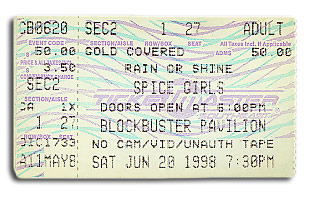
Well, for the second of my “Rock of (Bygone) Ages” posts, I decided to switch gears as much as possible–so, here goes: The Spice Girls at Blockbuster Pavilion ’98.
spice

I don’t know that I really liked The Spice Girls; I think I was, though, fascinated by The Spice Girls.  For one thing, they were in some ways a breath of fresh air.  By 1996, when The Spice Girls fist hit the scene with the annoyingly catchy single “Wannabe,” we were a good five years deep into the post-Nirvana era of  “modern rock” on the airwaves.  Where previously the musical mopings of the myriad Gloomy Gusses of alternative rock were confined to the CD shelves of college students  (like me, for example) and MTV’s 120 Minutes,  now the airwaves of even top 40 stations were saturated with angst and ennui.  When a band (Creed, maybe?) can score a hit that features the totally serious and non-ironic lyrics, “I feel hurt!  I feel angry!” you know something’s really, really wrong.  Tell it to your therapist, dude–I don’t fucking care. As Jonathan Richman once remarked, “Rock and roll isn’t about ennui and philosophy; it’s about cars… and beer… and girls.”

And so, like an Archies 45 played at the intermission of a Wagner opera, into the midst of a musical environment saturated with The Stone Temple Pilots, Rage Against the Machine, etc., came “Watcha watcha want?  Wathca really, really want?”  The Spice Girls didn’t have the afore-mentioned cars or beer–but they sure had the girls part.  Now, you’re probably saying to yourself, “but, hey, there was tons of other lightweight pop going on in the 90s, not just the Spice Girls, right?”  Yeah, sure… but none of that generated the sheer mania of the Spice Girls–the “Spice-Mania,” if you will…

That said, though, my fascination with the band didn’t really extend much beyond picking up a copy of their first record for $4.00 at the used record store I worked at, and lecherously ogling them when their videos came on.  Then, though, the Spice Girls came to town.

As mentioned, I was working at a record store at the time, and that record store was a Ticketmaster outlet, which meant we were selling a lot of Spice Girls tickets to parents so their kids could go to the show.  The venue at which they were playing was what’s known as a “shed”: it has a couple of sections of covered, reserve seating areas up front, but also a huge uncovered grass field behind that–the “lawn seats,” as they were called.  The way things usually worked was that when someone wanted seats, you’d hit “best available” on the ticket machine and it’d give you the best seats available, if any, in the reserve section.  Depending on how good those seats were  and how much they wanted to spend, they’d either take those or just opt for the cheaper lawn seats.

A few days before the show, a mom and her little girl came into the store to buy Spice Girls tickets and I began with the “best available” option.   What turned up was a pleasant surprise: two seats, front row center.  (Note the “row 1” on the ticket above.)  This isn’t a totally unheard of occurrence, since often some really good seats for a concert are “held” for radio promotions and give-aways and whatnot, but then re-entered into the system a few days before the show if they’re not used.  Now, of course my first thought was, “Man, this little girl and her friend are going to have the best time ever at this show!  Awesome!”  My second surprise came, though, when this cheap-ass broad asked what the tickets cost, and then opted instead for lawn seats that were maybe ten dollars cheaper, if that.  That’s right: to save maybe $20, this graduate of the Joan Crawford School of Parenting decided she’d turn down front row seats for her daughter, and instead leave her and her friend out on the lawn–potentially listening to their favorite band in garbage bags with holes cut out for their tiny, adorable heads in the pouring, pouring rain.

But, hey, carpe diem, right?  Once they’d left, I bought the pair of tickets for myself and phoned up the only person I knew who I could imagine being even vaguely interested in going to a Spice Girls concert, my friend Cheryl.  Cheryl accepted and apparently mentioned the impending show to a client of hers at the salon she worked at in Charlotte.  The client, as it turns out, ran a limo service and offered us a free stretch limo for the evening.  And so it was that a few days later we were lounging comfortably in the back of a stretch limo, knocking back tumblers of Glenfiddich en route to see The Spice Girls perform.

So, how was the show?  I honestly can’t remember that much about it.  It was post-Ginger, which of course left a hole in the hearts of all of the Girls’ fans (including me, nach)–but at least they projected a head shot of her on the gigantic “jumbotron” screen above the stage much to the cheers and delight of the audience.  I remember feeling really guilty for being a guy over six feet tall in the front row of a concert full of kids–effectively blocking pretty much everyone’s view.   At one point they invited some random boy from the audience onstage and sang to him personally.  He looked a lot like “Jimmy Jam” from the old “Dance Party U.S.A.” show.  I was hoping they’d invite me on stage instead, but alas, it was not to be.  I would have totally tried to engage them in some dirty dancing–not like the kid they selected, who just stood there like a calf at a new gate.

My favorite memory of the evening actually occurred after the show was done.  Cheryl and I were leaving in our limo and, of course like everyone else, were stuck in the post-concert traffic trying to exit.  All the kids on foot, heading back to the Family Truckster, though, saw a limo leaving the concert and assumed it was carrying the Spice Girls themselves, and so they begin to pile onto the outside of the vehicle like the proverbial flies on a rib roast.  While this in no way satisfies my long-standing desire to be piled on by a throng of teen-aged girls, it was hilarious nonetheless.

Some people reminisce about particular concerts, saying this concert or that concert “changed their lives,” and in this case I think the Spice Girls show did change me: before seeing them in person, I thought Posh Spice was the hottest Spice Girl, but afterwords I knew for sure it was Baby Spice.

Pylon Guitarist Randy Bewley, R.I.P.

pylon

He died yesterday, it was reported, after having a heart attack.  He was, I believe, 53.

I’m not sure how well known the band Pylon was outside of the Southeast in the 80s, but I remember having to order a cassette (!) of their record, Gyrate, from the local “Record Bar” after seeing the documentary Athens, GA Inside-Out at the local midnight movie.  Even then, I think I was drawn to them because they really did sound unlike anything I’d ever heard before. (Of course, at the time, I was a clueless teenager who listened mainly to Chuck Berry and John Lee Hooker records and I’d never been exposed to stuff like Gang of Four or Wire–whose sound is at least in the same general neighborhood as Pylon’s.)  As Michael Stipe, of the infinitely less-interesting Athens band, R.E.M., put it in the liner notes to the recent reissue of Pylon’s Gyrate though, “Pylon defined a sound by simply being the only band to ever sound like that.”

Unlike a lot of music I was into in high school, I’ve often revisited my love of Pylon.  During college, while trying to learn to play bass, I revisited their music for its simple yet driving danceable bass lines.  And later, just a scant few months ago, I was fortunate enough to witness what I imagine was the very last Pylon show, here in Winston-Salem at the Wherehouse.  It was a  stunning show.  The band sounded like they’d been frozen since 1983 and had just defrosted, musical chops in-tact, for this one (and what would turn out to be final) show.  The band was firing on all cylinders that night, not the least of which was the beautiful, mechanical,  jigsaw-ish playing of the too-soon-deceased Randy Bewley.

Rock of (Bygone) Ages: Soundgarden ’91 and ’94

I was rooting around today in the storage cabinets in my studio, looking for a good place to stash (or stuff) the bundled mess of receipts and invoices that pass for my 2008 tax records, and I discovered a long-forgotten envelope of old concert tickets.  I’d forgotten I still had these, and they’re an odd thing for me to still have since I’m by nature neither a pack rat nor overly-sentimental; I thought, though, that they might be worth digging though for a few blog posts before they fade away (literally) or I decide to ditch them.

The bulk of them are largely uninteresting–and frankly, the best live shows I’ve seen have mostly been at venues small enough that one needn’t have purchased an actual advance ticket, rather than just arriving and paying at the door.  I don’t know how many posts I’ll do on these, but perhaps they’ll be of some interest to the few folks from my halcyon days as a young rock-and-rollist who occasionally check out this blog.  First up:

Soundgarden ’91 and ’94

soundgarde

These two stubs struck me as a good place to start since they represent one of the best rock shows I’ve seen, and one of the worst–and both by the same band.

The first stub chronologically is the red one at the bottom.  It’s from a show that Soundgarden headlined at the 13 13 club in Charlotte.  Nirvana is clearly the ’90s band as far as most folks are concerned, but I was never really into them.  I’ve come around to them more now, over a decade later, but at the time they seemed to me like “The Melvins Light.”  A “grunge” band I was really into, though, was Soundgarden.  I’d first been introduced to them when I’d listened to their record Louder than Love that had arrived as a promo at the college radio station I worked at in 1989.  By the time of their sophomore major label release, Badmotorfinger, I was a rabid fan.  When they came through Charlotte, NC in November of 1991 the first single off the record, “Jesus Christ Pose” had hit MTV and stirred some low-key interest, but it’d be a bit longer before the band hit real pop fame with the single “Outshined.”  Lucky for those of us at the show, the band was still at a point in their career where they were being booked in small clubs like the 13 13, which had a capacity, I’d guess, of maybe 800 people (assuming the fire marshal didn’t show up).

The Soundgarden show at the 13 13 was phenomenal.   The band was on.  The crowd was on.  I recall someone from the band (most likely, singer Chris Cornell) commenting on the lively crowd–and commenting in a way that seemed to me (at least at the time) as genuine, rather than in a “hello, Cleveland” way.  The opening band was pretty much unknown at the time: Blind Mellon.  Yeah, the “bee girl” band from the ’90s.  I remember commenting to the friends that I’d come with about how much the opening band pretty much sucked and sounded like a lame, slightly hippie-er version of Guns-N-Roses.  Clearly some record producer talented at crafting hit singles had gotten a hold of the band between then and whenever that “bee girl” song came out (what the Hell was the name of that song, anyway?) since they sounded pretty much nothing like they did on that single at this show.

Cut, though, to a few years later.   Now Soundgarden’s had a huge hit with “Outshined” off of Badmotorfinger, but more importantly they’ve released their breakthrough album, Superunknown, which would spawn a string of big singles for the band: Black Hole Sun, Spoonman, Fell on Black Days, and more.  When they’d returned to Charlotte, they’d outgrown the 13 13 and instead were playing at the Charlotte Colosseum.  Also, they’d apparently become huge douche-bags–particularly their bassist, Ben Shepard who was apparently angry that the crowd in this huge, ugly, fluorescent light-lit, sports colosseum weren’t sufficiently “into” the show.  When the band starts acting like a bunch of dicks, a viscous cycle ensues in which the crowd gets even more irritated and responds even less to what’s going on on-stage.  Thank god the Reverend Horton Heat was opening up, or the whole evening would have been a lost cause!


First Look: Adventures in Cartooning by Sturm, Arnold and Frederick-Frost (First Second)

Mixed in with my usual mail from last week (bills, incessant missives from local political crackpot Virginia Foxx, etc.)  was the new children’s cartooning how-to book, Adventures in Cartooning.  The book’s published by First Second and, as the cover’s “The Center for Cartoon Studies Presents” notes, was put together by three CCS folks: James Sturm, Andrew Arnold and Alexis Frederick-Frost.  The book doesn’t mention who did what specifically, but I’d wager, based on the art in his great debut book of a few years back, La Primavera, that Alexis Frederick-Frost handled a lot of the art, and certainly the inking.

Adventures owes a great debt–one that it explicitly acknowledges itself–to children’s art instructor/writer Ed Emberly.   In books like Emberly’s Make a World, he shows kids how to construct an entire world of easy-to-draw people, places and things using simple basic shapes.  The premise behind Adventures is similar: the book uses a set of simply-drawn objects, builds a comics story using only those objects, and while doing so tries to show kids the basic “toolkit” of comics-making.  Here’s the page from the book where the base objects are presented:

aic_1

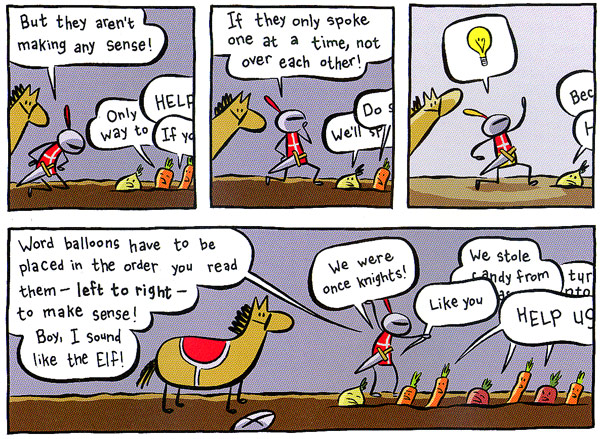
The premise of the story is fairly straightforward: a knight sets off to slay a dragon, but with the knight on his quest is a “magic cartooning elf,” who along the way explains about things like panels, how to show motion and movement, and how words and pictures interact.  Rather that present this sort of information in a straight-ahead “how-to” fashion, though, the book cleverly creates story elements that allow these discussions to crop up as part of the narrative.   Here, for example, the Knight (now sans elf) encounters a bunch of other knights that have been turned into vegetables, but in order to understand them, their word balloons have to be untangled and placed in the order in which they need to be read:

aic_2

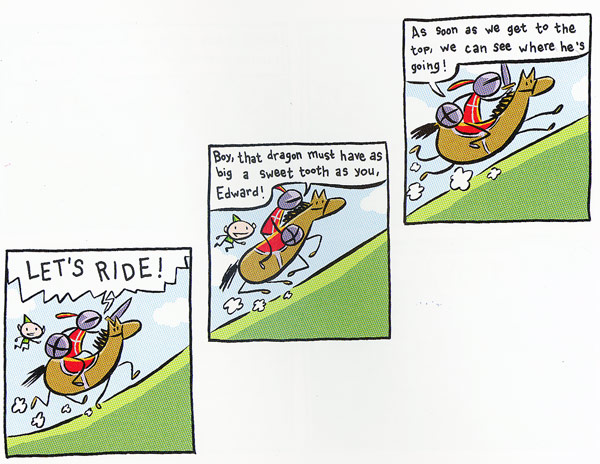
It’s easy to imagine this overdone and the story just becoming a bunch of cobbled-together excuses for some narration about how comics work.  Fortunately, though, this isn’t the case, and the story is mainly just a fun adventure–with the teaching elements occurring sporadically and integrated pretty seamlessly.  The flip side of this, however, is that there’re a lot of good cartooning “tricks” in use in the story that aren’t explicitly pointed out to the reader–like here, where the panels are set up on the page in a rising tier to mimic the upward motion of the horse and rider:

aic_3

I actually really like that the writers have chosen not to point out each and every formal comics device throughout the book.  If there’s a common flaw to a lot of the children’s literature I’ve read, (and my reading of this stuff has increased by about a million percent of late, since my daughter has now become really interested in books–and just just to chew on) it’s underestimating how much kids are capable of picking up on without being beaten over the head with it.

My own daughter is still far too young to serve as a real “test subject” for this book, but overall Adventures in Cartooning looks fantastic and I look forward to giving it a real trial run in a few years.

Published by First Second | 112 pages | Available in April (I think)

Craft: A Review of the New Koh-i-nor Rapidosketch Pen

The reason I buy all of my art supplies online isn’t just because it’s cheaper: I’m a sucker for picking up pretty much any new drawing tool I happen upon in a “bricks and mortar” store.  I usually manage to avoid the temptation, but last week I found myself in the local Michael’s dropping off some things to be framed (50% off framing sale going on now, y’all!) and as a wandered through the drafting isle, I saw this–the new Koh-i-nor Rapidosketch pen:

21013-1025-1-2ww-m

You’re probably familiar with the Rapidograph pen from the same company.  They’re pretty much the industry standard technical pen.  I have a set, which aside from a few replaced points, is about ten years old and I use them mainly for panel borders and balloon outlines.  They are, though, not particularly great for working in a sketchbook.  The problems here are mainly two things: First, there’s inconsistent ink flow at high speeds.  When working a little more slowly, as on an original comics page, they’re perfectly fine, but for quick casual sketches they tend to “skip” pretty frequently.  Second, they can tend to really dig into the paper you’re drawing on and this can be a real problem, especially of you’re working on flimsy paper such as those Moleskine tablets that folks really seem to love.  (Yeah, sure, Robert Crumb seems to be able to sketch with them fine, but, Hell, that’s ’cause he’s Robert Crumb.  Normal people can’t sketch well with Rapidographs… trust me.)

If you’ve seen any of my random sketchbook pages I occasionally post, you know I tend to sketch directly in pen.  My normal tool of choice is the Rotring Art pen, which, in addition to having neither of the above faults, also features a “split” point which causes it to preform like a really tight crowquil, giving you just a bit of line variation.  This Rapidosketch thing, though, seemed like it was worth a try.  Based on the name, I assumed it was designed specifically for sketching–and the box even boasted the Viagra-like claim of “consistent performance,” an allusion, I assumed, to the Rapidograph’s well-known inconsistent ink flow I mentioned above.  All signs pointed to a cool new pen.

Things began to sour a bit, though, when I got home and started to investigate the pen further.

First off, it comes with no instructions.  If you’ve used Rapidographs before, this is not a big deal, but if you’re new to this stuff I can imagine it would be a bit mystifying to try to figure out–particularly since if you store them incorrectly they tend to clog up.  On a similar note, although it came in the same packaging as a Rapidograph, the little circle indentation where the circular “wrench” (for removing the pen point) would normally be  is empty.  This is a recipe for disaster, as you really need to remove the point before re-attaching a freshly-filled ink reservoir or else you’re essentially pressuring your ink through the point mechanism and you’ll be dealing with a leaky pen right off the bat.

pen_in_case

As I took the pen apart in preparation to fill it, I noticed that it’s innards looked suspiciously like the innards of a regular old Rapidograph, as you can see below:

mechanism

While there’s some new sheathing around the mechanism, it’s pretty similar–and my technical pens are pretty old so I may be comparing old apples with new oranges here.  Out of curiosity, I removed the points, and as you can see, they’re pretty darned similar:

points

But, hey, for all I know, the interiors of those points could be radically different and the Rapidosketch could really be some new design intended for sketching!  I loaded the thing up with ink and gave it a roll.

First off, there’s no discernible difference in the line quality between this pen and a regular Rapidograph pen of the same size:

hatch

To get a true feel for the pen, I cranked out a page of sketches–my usual subjects: hands and drapery.

sketchbook_021509

If there’s a difference between this pen and a regular Rapidograph technical pen, it’s far too subtle for me to discern.  I experienced fewer problems with intermittent ink flow than with the standard technical pen, but I’d chalk this up to my technical pen’s being nearly a decade old, not to some substantive design difference between the two pens.  Similarly, the Rapidosketch seemed just as likely to tear into the page, and–just like a Rapidograph–encountered problems working on paper with any tooth to it.

The verdict: As far as I can tell, the supposedly-new Rapidosketch pen is just a regular old Rapidograph that’s been “rebranded” with a different-colored barrel and cap–and is being marketed somewhat deceptively with the new name “Rapidosketch.”  If you’ve already got a technical pen and enjoy sketching with it, you’ll gain nothing from buying a Rapidosketch.  And if you’re looking for a technical pen that’s more suited to sketching than a regular Rapidograph, this ain’t it.