‘My Dinner with Crumb’ II Posted

CrumbIIprev

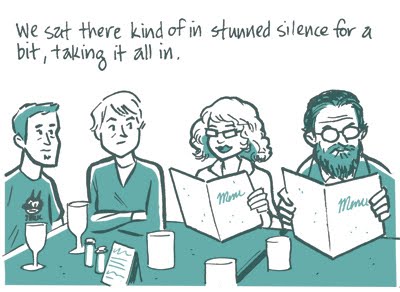
Rob Ullman’s posted the second installment (the first is here) of his “Traffic and Weather” comic strip documenting a recent bizarre happenstance in which we both wound up going out to dinner and drinks with a number of folks, including R.  Crumb.  We’d just finished hearing Crumb and Françoise Mouly speak about Genesis in Richmond and were standing around in the lobby with Ed Sizemore trying to get a few folks together for some drinks.  Pretty much everyone Rob and/or I knew, though, seemed to have somewhere else to be, so we parted ways and started heading for Rob’s house.  Rob mentioned on the way home that Richmond writer/comics scholar Tom De Haven said that he and a few folks (including his wife, pictured there in the middle)  were going to a nearby hotel restaurant, so on a lark we decided to stop by there.

According to that first strip, Rob was apparently aware that there was some possibility that Crumb and Françoise Mouly might be joining the group we were heading out to meet; I, on the other hand, just thought we’d be meeting Tom and maybe a few other Richmond comics folk.  I was about as surprised seeing R. Crumb and Françoise Mouly show up at our table as I would have been if we’d been joined by Osama Bin Laden and J.D. Salinger.  Like Rob, I didn’t talk to Crumb much at all–which is actually OK with me, since I can’t imagine what in the world I’d have to talk about with Robert Crumb (and as depicted, there was some guy chewing his ear off the whole time anyway).  I did, though, get a chance to talk with Kim Deitch and his wife Pamela.  While Crumb is obviously the underground comics guy historically-speaking, I’m actually a much bigger fan of–and am a lot more familiar with– Kim Deitch’s work, so hanging out with them was a real treat for me.  I tried not to pester Kim about comics stuff overmuch, though, so we mainly talked about cats.

I spoke a bit to Françoise Mouly as well toward the end of the evening.  In a testament to my complete and utter lack of self-promotional business acumen, I talked to her mainly about my daughter’s love of Jeff Smith’s Little Mouse children’s book, which is published by her TOON Books imprint, never mentioning that I’m a cartoonist myself.   It occurred to me, though, that being out of town in Richmond, VA may be just about the only time the art director of The New Yorker can go out for a meal in peace with out a bunch of hard-up freelancers putting the pester on her for work.

All in all it was a really fun trip to Richmond all around–from the talk, to hanging out with Rob and his wife and daughter, to the dinner with so many fun folks.  Can I put “Had dinner with R. Crumb” on my resume?

First Look: Final Amelia Book

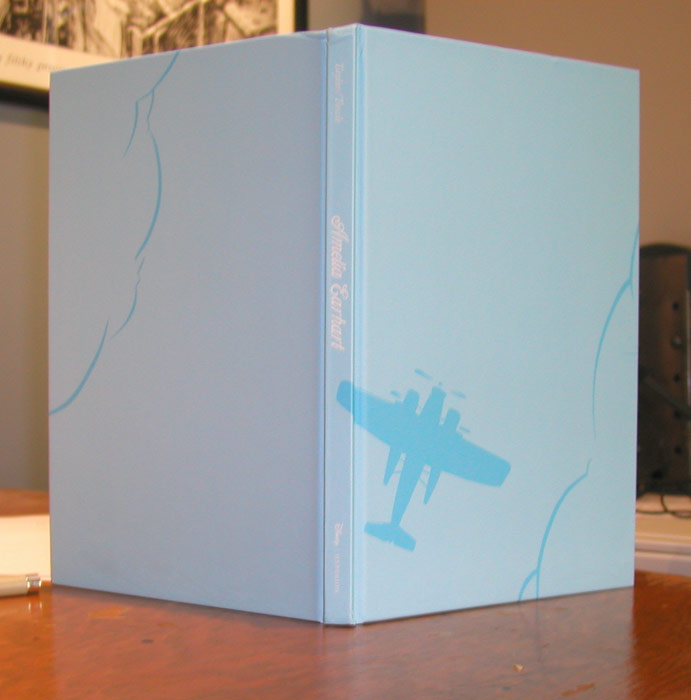
I just received a copy of the finished, hardcover Amelia Earhart: This Broad Ocean and I can tell you, with as much objectivity as I can possibly muster, that it looks really, really fantastic.

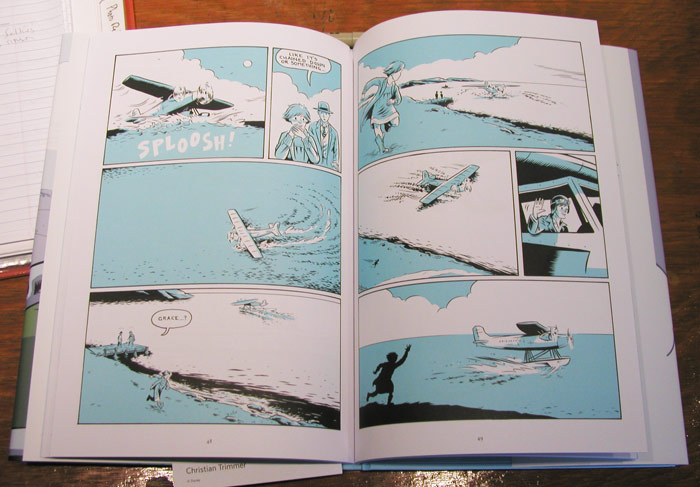
I’d like to think that I did a reasonably good job “faking it” as far as the book designs of my last few GNs go, but when you want a design that’s really top-notch, what you need is–not surprisingly–an actual designer.  In this case, it’s the great work of the folks at Black Eye Design that’s on display here.  Anyway, here are a few pics, including an interior spread that’s no longer line screen gray-toned, but instead a be-yooo0-teefull Pantone two-color print job!

amelia_02

amelia_03

amelia_01

R. Crumb in Richmond – Part II

The second, and final, part of my guest coverage of the recent R. Crumb/Françoise Mouly appearance in Richmond, VA is now posted over at ComicsWorthReading:

Robert Crumb is a well-known aficionado of old-time American blues, jazz, and ragtime music, and this love of music has often found its way into his artwork. Among the many examples of this is the image Françoise showed next: one of Crumb’s portraits of a musician, the blues singer/guitarist Robert Johnson.

I’d seen a pen and ink version of this image before, but not this full-color version, which is apparently from an edition of prints. When the image appeared on-screen, Crumb remarked jokingly to Mouly, “The guy who owns (this photograph) is very litigious. I hope you don’t get sued!” I later found the print for sale on the official R. Crumb website and noted that it was listed with copyright indicia crediting the image to the “Delta Haze Corporation,” which made me wonder if Crumb’s comments stem from first-hand experience. Prompted for why he does so much music-related drawing, he said, “Music has such a profound effect on me, I just want to express my affection.” Crumb did mention, though, that he never listens to music while he works because he finds it too absorbing and that it demands his entire attention. [ more… ]

Robert Crumb is a well-known aficionado of old-time American blues, jazz, and ragtime music, and this love of music has often found its way into his artwork. Among the many examples of this is the image Françoise showed next: one of Crumb’s portraits of a musician, the blues singer/guitarist Robert Johnson.

Robert Johnson

I’d seen a pen and ink version of this image before, but not this full-color version, which is apparently from an edition of prints. When the image appeared on-screen, Crumb remarked jokingly to Mouly, “The guy who owns (this photograph) is very litigious. I hope you don’t get sued!” I later found the print for sale on the official R. Crumb website and noted that it was listed with copyright indicia crediting the image to the “Delta Haze Corporation,” which made me wonder if Crumb’s comments stem from first-hand experience. Prompted for why he does so much music-related drawing, he said, “Music has such a profound effect on me, I just want to express my affection.” Crumb did mention, though, that he never listens to music while he works because he finds it too absorbing and that it demands his entire attention.

Craft: ‘Notecard’ Story Structure Plotting

notecards1

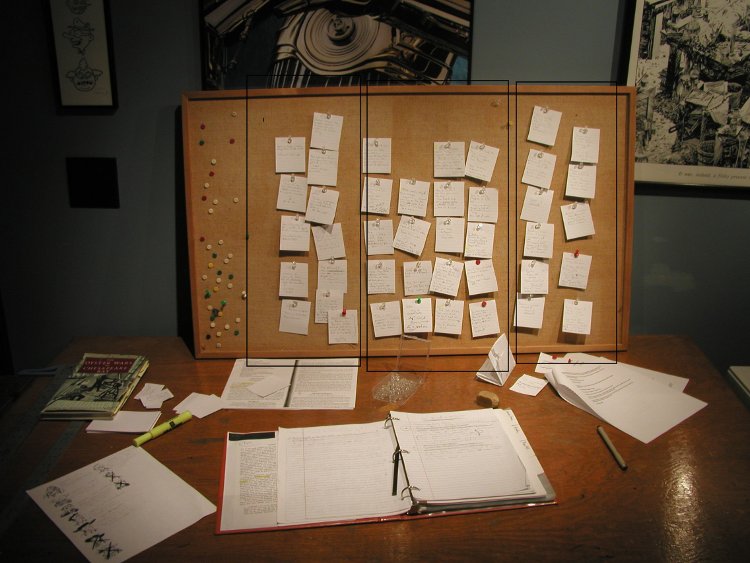
None of this is original to me–you can find instructions on how to do basic three act story structuring with note-cards in any number of writing and screenwriting books, or on writer Alexandra Sokoloff’s extremely helpful website–but I thought it might be useful to post a picture of the thing in operation, since that’s something I’ve never really seen anyone else do.  For a basic rundown of the note-card method, see Sokoloff’s post about it here.

So, here’s the story for Oyster War, just wrapped up this evening (although, likely to be revised as things progress) all pinned up on my bulletin board.  I’ve added outlines around each act’s group of cards, just for clarity’s sake.  But you can see that each group of cards here corresponds to an act in the story, with the second act being about twice as long (and having twice as many cards as) the first and third acts.  If you were doing this for something with a proscribed time limit, like a film, you’d have to be more particular about how many cards you’d have in each act, so that you’d wind up with a two-hour movie (or whatever) but for a graphic novel, I don’t really pay that much attention to that kind of stuff, other than to just make sure that the second act is somewhere in the neighborhood of twice as long as one and three.

The closing events of each act, as well as the mid-point of act two, are important to really nail, so I use different-colored pushpins to indicate these and make sure those points in the story structure are occupied by solid story turning points.  The finales are indicated with red pins and the mid-point of act two is with a green pin.  The last book I wrote, Midnight Sun, had two parallel stories (the reporter, and the men stranded on the ice) that eventually converged–so, for that story I used different-colored note-cards to keep things straight: red cards were scenes with the reporter, blue cards were scenes on the ice, and yellow cards were scenes where they’d converged and therefore involved both the reporter and the stranded men.  In Oyster War, though, the bulk of the story is shown from the viewpoint of the story’s single protagonist, so different-colored cards would have been a bit much.  You can maybe see a couple of cards that have been marked with highlighter; these are the few scenes that take place aboard the “bad guys'” ship.

This is about as far as I usually go with “writing” before I start doing thumbnail breakdowns, but in the case of Oyster War, I may do a written story summary before I move on to thumbnails because act two was such a pain to pull together that I’m afraid there are likely to be some plot problems that I’m unaware of now but will need to sort out before I actually put pen to paper.

Amelia Reviewed in Publishers Weekly

ccs-ameliajacketd1

Publishers Weekly has a very early review of Amelia Earhart: This Broad Ocean in today’s children’s book review section:

Rather than rushing past the highlights of Earhart’s career, this quietly moving book approaches her life through the admiring curiosity of a girl who also aspires to escape traditional boundaries. Young Grace has grown up in Trepassey, Newfoundland, the nearest point in North America from which a plane can take off to fly to Europe; it’s also a seacoast community familiar with shipwrecks and other evidence of how coldly indifferent nature can be. In June of 1928, tweener Grace, the dubious townspeople and a mob of impatient newsmen wait for Earhart to finally get her plane in the air for a transatlantic flight… [ more… ]